
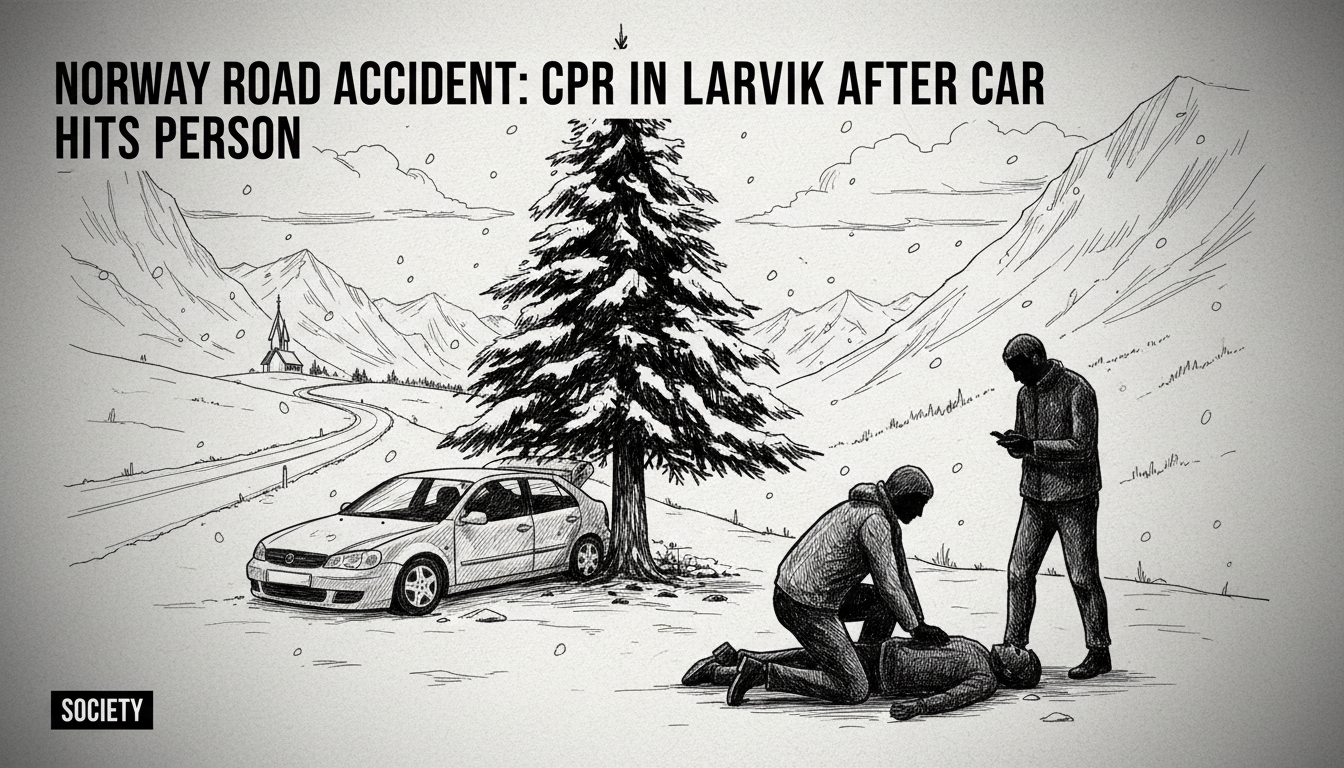
Norway road accident emergency services performed CPR on a person hit by a car in Larvik on Tuesday. A rescue helicopter was dispatched to the scene, and police closed traffic in both directions on the affected road. The incident, which occurred in the coastal municipality in Vestfold county, highlights the persistent challenge of road safety despite national 'Vision Zero' ambitions.
Emergency responders initiated cardiopulmonary resuscitation at the location, indicating the victim suffered cardiac arrest following the collision. The decision to scramble a Luftambulanse air ambulance helicopter underscores the critical nature of the injuries and the need for rapid transport to a specialist trauma center. Such medical helicopters are typically deployed when ground transport time is prohibitive or when advanced life support is required en route to hospital.
A Community Disrupted by Sudden Tragedy
Larvik, a town of approximately 48,000 residents known for its ferry connections to Denmark and its historic wooden architecture, saw its routine shattered by the accident. Local police cordoned off the area to facilitate the emergency response and allow for an initial investigation. These closures are standard procedure to protect rescue personnel and preserve evidence for traffic safety investigators from the Norwegian Public Roads Administration (Statens vegvesen).
While specific details about the victim or the exact location are withheld by authorities during the initial phase, such events send ripples through close-knit communities. "Our immediate focus is on providing all possible assistance," a police operations leader said in a brief statement. The psychological impact on first responders, witnesses, and the driver involved is also a significant, though less visible, consequence of serious traffic collisions.
The Grim Statistics Behind Norway's Safe Roads
Norway boasts some of the world's safest roads, yet fatal and serious accidents remain a stubborn reality. Preliminary figures from the Norwegian Public Roads Administration for 2023 recorded 92 road fatalities. This number, while low compared to many nations, represents 92 profound tragedies and falls short of the official 'Vision Zero' target adopted by the Norwegian Parliament, the Storting.
That policy, formally embraced in Norway, aims for no deaths or serious injuries on the roads. It represents a fundamental shift in thinking: human life and health are paramount, and the road system must be designed to forgive human error. "Every single number in the statistics is a person, with a family, friends, and a future that was cut short," said a senior advisor from the Norwegian Council for Road Safety (Trygg Trafikk). "Vision Zero is an ethical stance, not just an engineering goal."
Achieving it requires a multi-pronged approach. Norway has aggressively implemented measures like lower speed limits in urban areas, extensive use of median barriers on highways, and stringent penalties for driving under the influence. The country's rugged geography and long winter darkness add layers of complexity to road safety work, making events like the Larvik accident a focus for renewed prevention efforts.
The Critical Minutes: Why Immediate CPR Matters
The fact that police reported "hjerte- og lungeredning"—CPR—was in progress is a crucial medical detail. In trauma-induced cardiac arrest, such as from a severe traffic collision, immediate chest compressions and rescue breathing can be the difference between life and death. They manually circulate oxygenated blood to the brain and heart, buying time until advanced medical help arrives.
"For every minute without CPR and defibrillation, the chance of survival decreases by 7-10%," explained a consultant in emergency medicine at Oslo University Hospital. "When emergency services announce CPR is underway at the scene, it tells us bystanders or first responders have initiated the chain of survival. That is often the most important factor we cannot control."
Norway has a strong culture of first-aid training, with many citizens completing courses through organizations like the Norwegian Red Cross. This public knowledge is a key component of the national emergency response system. The helicopter's role then becomes one of rapid stabilization and transport, bringing a hospital-level intensive care unit to the patient for the journey.
Investigating Causes and Implementing Lessons
Following the acute emergency phase, the investigative work begins. Traffic police and road safety experts will examine a range of potential factors. They will assess the road's physical condition, signage, and lighting. They will inspect the vehicles involved and analyze data from any onboard systems. Witness statements will be gathered to reconstruct the sequence of events.
Common contributing factors in Norwegian accidents include speed inappropriate for conditions, distraction—particularly mobile phone use—and impairment from alcohol or fatigue. Icy or wet roads during the Nordic autumn and winter are also a persistent hazard. The investigation's findings may lead to localized safety upgrades, such as improved pedestrian crossings, better lighting, or traffic calming measures on specific stretches of road in Larvik or similar municipalities.
These local actions feed into national policy. Each serious accident is studied not to assign blame, but to understand systemic weaknesses. This data-driven approach has led to Norway's high safety standards, but as the Larvik incident shows, the margin for error on any road is terrifyingly small.
The Long Road Toward Zero
The 'Vision Zero' policy, championed by transport ministers across political parties, frames road deaths not as inevitable 'accidents' but as preventable failures of the system. This philosophy demands continuous improvement in vehicle safety, road design, and enforcement. It also requires public commitment to safe behavior.
For the community in Larvik, the abstract statistics of national road safety campaigns have become a concrete and painful reality. The incident will likely reignite local debates about traffic safety in specific neighborhoods. It serves as a somber reminder to all road users—drivers, cyclists, and pedestrians—of the shared responsibility borne every time we use the transport network.
As the rescue helicopter departed Larvik, carrying the hope for survival toward a distant hospital, the broader question remained. How does a society that has already achieved so much in road safety confront the final, most difficult percentage points of risk? The answer lies in the relentless pursuit of better engineering, smarter policy, and a collective refusal to accept that tragedies like today's are simply a part of life. The ultimate goal, however distant, is a day when such emergency alerts are no longer necessary.