
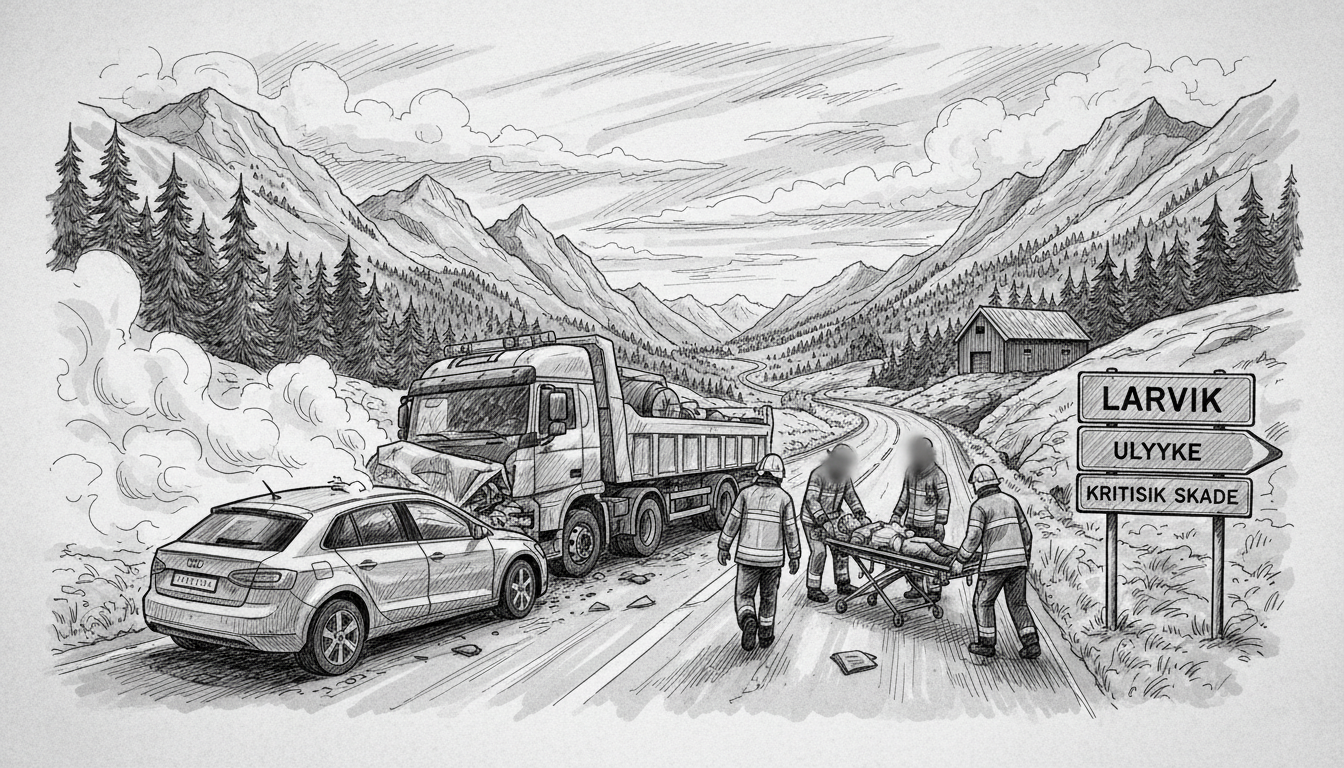
Norway traffic accident response was activated in Larvik Tuesday evening after a pedestrian was critically injured by a passenger car. Emergency services received the alert at 17:39 local time, launching a major rescue operation on a road now closed in both directions. The incident highlights ongoing road safety challenges in a nation with an ambitious goal of reducing annual traffic deaths to below 50.
Two bystanders at the scene immediately began cardiopulmonary resuscitation on the critically injured person before professional help arrived. Police Operations Manager Inge Omli Landsrød confirmed the patient's condition was assessed as very serious. An ambulance was on site by 17:55 and a rescue helicopter was dispatched to the coastal municipality, known for its ferry connections to Denmark.
A Community's Swift Response
The quick actions of the two passersby represent a crucial first link in Norway's emergency response chain. Their immediate initiation of CPR could prove vital for patient survival, according to road safety experts. Police have cordoned off the accident site to allow for a proper investigation, though the identity of the injured person remains unknown. Traffic disruptions are expected to continue as forensic teams work to determine the exact circumstances of the collision.
This serious accident occurs against a backdrop of national road safety efforts. In 2023, 118 people died in road traffic accidents across Norway. The Norwegian Public Roads Administration (Statens Vegvesen) has a stated target of reducing annual fatalities to fewer than 50, a goal that requires continuous improvement in infrastructure, vehicle safety, and driver behavior. Each serious incident prompts fresh scrutiny of specific road designs and traffic regulations.
The Long Road to 'Vision Zero'
Norway's traffic safety strategy is part of a broader Scandinavian approach often called 'Vision Zero', which aims to eliminate all traffic fatalities and severe injuries. The philosophy acknowledges that human error is inevitable and therefore focuses on designing a transport system that mitigates the consequences of mistakes. This involves separated pedestrian and cycle paths, lower speed limits in urban areas, and advanced vehicle safety technology.
Experts point out that while Norway has some of the safest roads in the world, progress has stalled in recent years. The 2023 fatality figure of 118 shows a concerning plateau after years of steady decline. Investigations into accidents like the one in Larvik are critical for understanding whether specific local factors—such as road layout, lighting, or signage—played a role, or if it was an isolated incident.
“Every serious accident must be investigated not just for legal culpability, but for systemic learning,” says a traffic safety researcher at the Institute of Transport Economics in Oslo, who asked not to be named as the investigation is ongoing. “The question is always: could this stretch of road be designed differently to prevent this outcome, even if a driver or pedestrian makes an error?”
The Human Cost Behind the Statistics
Behind the national statistics are individual tragedies that ripple through families and communities. The critical condition of the person hit in Larvik is a stark reminder that road safety is not an abstract policy issue. For the emergency personnel on scene, including the helicopter medics, the focus is on a single life hanging in the balance. Their work, from the first responders to the hospital trauma teams, represents the system's last line of defense after prevention fails.
The psychological impact on the bystanders who performed CPR, the driver of the vehicle, and the first police officers on scene is also significant. Norwegian emergency services have support systems for such events, recognizing the trauma that can affect civilians and professionals alike. The community of Larvik, a town of around 48,000 people, will likely feel the shock of an event that suddenly turns an ordinary Tuesday evening into a local news headline.
Infrastructure and Enforcement in Focus
Accidents inevitably lead to questions about the specific location. Was the road well-lit? Was the speed limit appropriate? Were there safe crossing points for pedestrians? The police investigation will seek answers to these questions. Vestfold county, where Larvik is situated, has a mix of coastal roads, urban centers, and rural highways, each presenting different safety challenges.
National enforcement campaigns often target speeding, impaired driving, and the use of mobile phones behind the wheel. Norway has strict laws and high fines for traffic violations, but compliance remains a constant battle. The government also invests heavily in road improvements, focusing on removing hazardous curves, installing median barriers, and creating safer pedestrian zones.
A National Challenge with Local Impact
The Larvik accident is a single event, but it feeds into a national conversation about responsibility and safety. Norwegian drivers are generally considered law-abiding, and the country's vehicle fleet is among the newest and safest in Europe. Yet the goal of fewer than 50 deaths per year remains elusive. Each winter brings additional hazards of ice, snow, and darkness, particularly in northern regions, though southern coastal areas like Vestfold face their own challenges with weather and traffic volume.
As the investigation in Larvik continues, the immediate concern is for the survival and recovery of the injured individual. The longer-term question is what lessons can be extracted to prevent similar tragedies. Will this lead to a review of speed limits on that road? To new pedestrian infrastructure? Or is it a tragic anomaly in an otherwise safe system?
For now, the facts are scarce. A person was hit by a car. Two strangers stepped in to help. A rescue helicopter flew in. A community waits for news. And Norway's road safety authorities add another case file to their ongoing mission—a mission measured not in kilometers of asphalt, but in human lives preserved.