
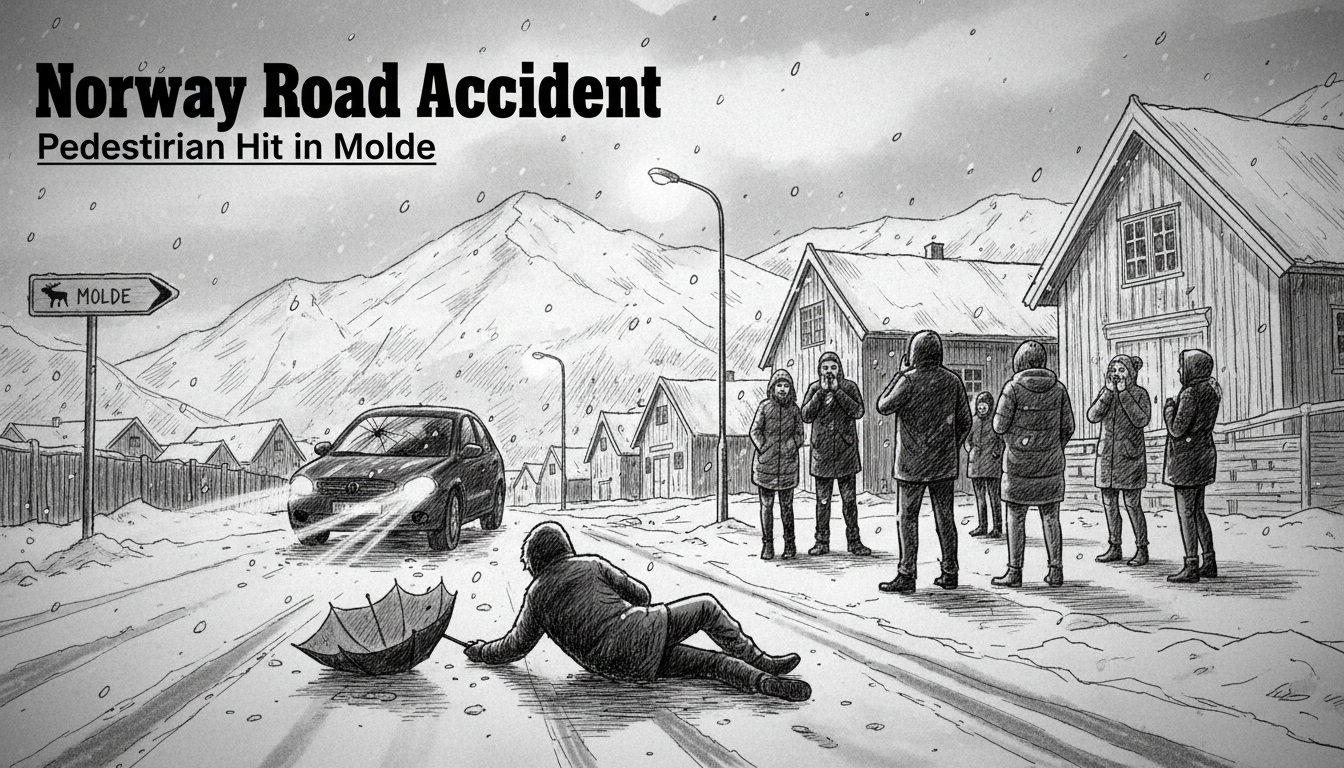
Norway road accident investigators are working at the scene of a serious collision between a car and a pedestrian on Fylkesveg 662 in Molde. The county road remains closed as police gather evidence, with the pedestrian's condition unknown. The incident casts a shadow over the scenic coastal city and renews focus on the nation's ambitious Vision Zero road safety goals.
A Scenic Road Turned Investigation Site
Fylkesveg 662, a regional artery managed by the Norwegian Public Roads Administration (Statens vegvesen), was shut down following the collision. This road serves as a vital connection for communities in Møre og Romsdal county, winding through the dramatic landscapes near the Romsdalsfjord. The closure disrupted local traffic, redirecting vehicles around the investigation zone where forensic teams documented skid marks, vehicle position, and other critical details. Police have described the accident as serious, a term they use cautiously, indicating the potential for life-changing injuries.
Molde, known internationally for its jazz festival and stunning fjord views, now grapples with the grim reality of a traffic tragedy. Such events feel particularly jarring in a nation that consistently ranks among the world's safest for road users. The immediate police work focuses on establishing a clear sequence of events: driver attention, vehicle speed, pedestrian actions, and environmental conditions like visibility and road surface.
The Persistent Challenge of Pedestrian Safety
This accident in Molde represents a critical category within Norwegian road safety statistics. While Norway recorded 117 road fatalities in 2023—a historically low figure—each pedestrian death or serious injury is a stark failure of the Vision Zero policy. Adopted from Swedish models, Vision Zero operates on an ethical principle that no loss of life on the roads is acceptable. It shifts responsibility from individual road users to system designers, including traffic engineers and urban planners.
“Every serious accident demands we ask not just ‘what happened?’ but ‘why did our system allow this to happen?’” explains a senior traffic safety advisor familiar with Norwegian policy, who requested anonymity as the investigation is active. “Was the crossing design intuitive? Were sight lines adequate? Was the speed limit appropriate for a road used by pedestrians?”
Regional roads like Fylkesveg 662 present unique challenges. They often link rural and urban areas, carrying a mix of high-speed through traffic and local access. Pedestrians may need to cross them to reach bus stops, viewpoints, or homes. Balancing mobility and safety on these routes is a constant engineering and regulatory puzzle for Statens vegvesen.
Norway's Systemic Safety Approach
Norwegian authorities do not treat such incidents as isolated tragedies. They are data points in a continuous safety improvement cycle. The response to the Molde collision will be multi-layered. The police investigation will determine any immediate culpability, potentially leading to legal charges if negligence is found.
Concurrently, road safety experts from the Public Roads Administration will conduct a technical analysis. They will examine the accident site's geometry, signage, lighting, and speed limit. Their findings could trigger local measures, such as installing new pedestrian crossings, improved street lighting, or traffic calming measures like reduced speed zones or rumble strips.
On a national level, data from this and similar accidents feed into broader policy reviews. Norway has aggressively lowered speed limits in urban and residential areas, invested in separated pedestrian and cycle paths, and mandated advanced safety technology in new vehicles. The goal is to create a forgiving system where human error does not result in death or serious injury.
The Human Cost Beyond the Statistics
Behind the policy frameworks and technical reports are individuals and communities facing sudden, profound loss. A serious pedestrian accident sends shockwaves through a small city like Molde. The victim's family begins an agonizing wait at the hospital. The driver involved faces severe psychological trauma, regardless of fault. Witnesses to the collision may require support.
Local community leaders often become advocates for change in the aftermath. They channel public concern into petitions for safer crossings, better lighting, or lower speed limits on specific stretches of road. This grassroots pressure, combined with official investigations, can accelerate safety upgrades that might otherwise languish in bureaucratic planning phases.
“The most difficult part of our work is facing the families,” the traffic safety advisor notes. “We can quote the statistics showing things are getting safer overall, but that is no comfort to them. Their loss is absolute. It forces us to work harder.”
A Long Road to Zero
The Molde accident underscores the difficult final stretch of the Vision Zero journey. Norway has successfully reduced fatalities from over 500 annually in the 1970s to just over a hundred today. Further incremental gains require immense effort, investment, and sometimes, difficult trade-offs regarding travel times and infrastructure spending.
Each serious collision tests the resolve of this policy. It asks whether society is willing to accept lower speed limits, more investment in pedestrian bridges and tunnels, and stricter enforcement to eliminate the remaining tragedies. The alternative is accepting a certain number of deaths as an inevitable cost of mobility—a premise Vision Zero explicitly rejects.
As the investigation in Molde continues and Fylkesveg 662 reopens to traffic, the questions linger. Will this event lead to tangible safety improvements on that specific road? Will it influence regional or national policy discussions? And most importantly, will the lessons learned here prevent the next family from receiving that devastating phone call? The pursuit of zero is relentless, and every accident, especially in a place known for its beauty and culture, is a sobering reminder of the distance still to travel.