
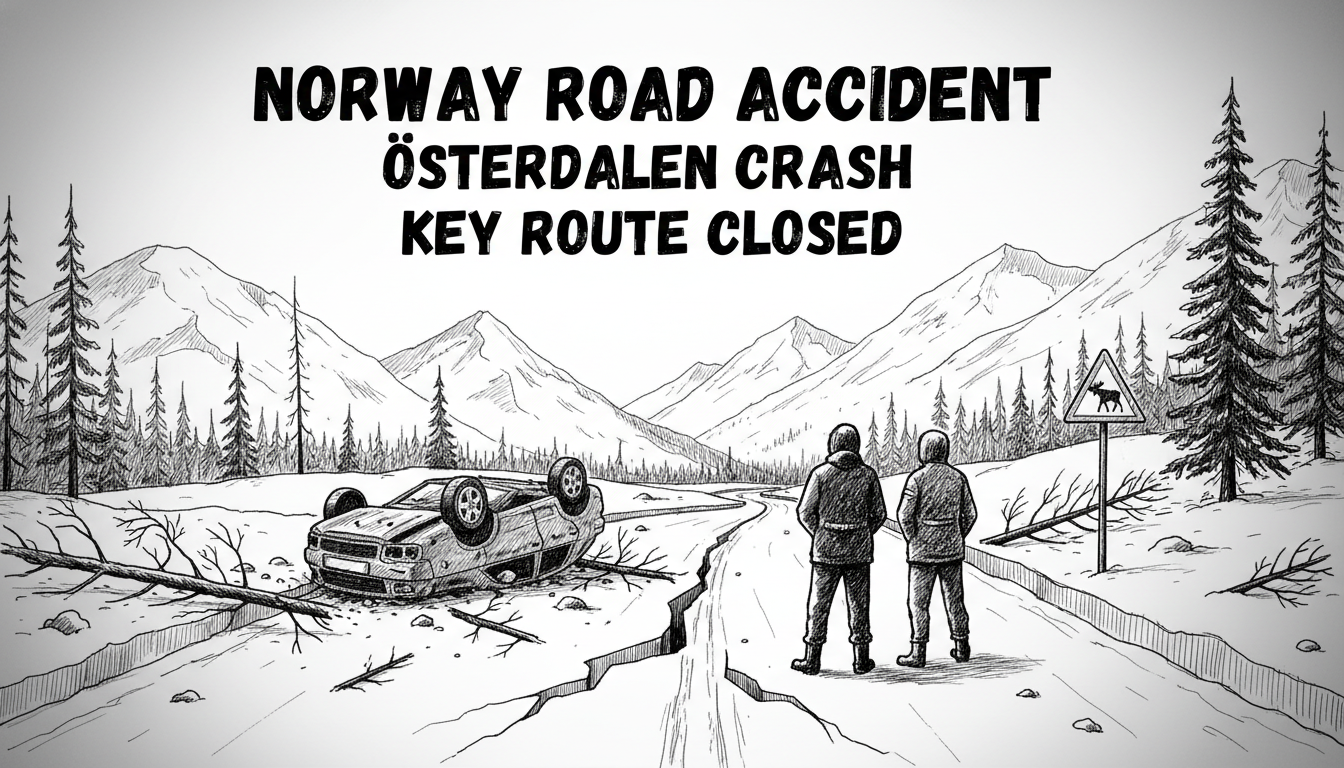
Norway's main road through the Østerdalen valley was closed for an extended period on Wednesday following a serious single-vehicle accident near Åmot in Innlandet county. The crash, which involved one car, prompted a major emergency response and severed a vital transport artery in eastern Norway's sparsely populated interior.
"The road will be closed for a longer period at the site," said operations manager Bård Einar Hoft of the police emergency service. His brief statement underscored the severity of the incident and the logistical challenges it created for a region with few alternative routes. The closure of the Riksvei 3 highway disrupted travel and freight movement through a valley known for its vast forests and remote communities.
A Vital Corridor Severed
The Østerdalen valley forms a north-south corridor through Eastern Norway, connecting the region around Hamar to the far north. The road through Åmot is not just a local route but a key link for regional commerce and travel. Accidents in such areas have disproportionate impacts due to the geography. Detours can add hours to journeys, and emergency services face longer response times across great distances.
This incident highlights a persistent challenge in Norway's road safety efforts. While the country has some of the safest roads in Europe, accidents in rural areas often have more severe consequences. The combination of higher speeds on open roads, wildlife crossings, and driver fatigue on long stretches can be dangerous. Single-vehicle accidents, where a car leaves the roadway, are a particular focus of safety campaigns.
The Human and Systemic Toll
At the time of reporting, details on the condition of those involved were not released by authorities. The police, ambulance service, and fire brigade all responded to the scene. Their investigation will now work to piece together the sequence of events that led the vehicle off the road. This process is methodical and can take considerable time, especially if the crash was severe.
Road safety experts point to a common set of factors in rural single-vehicle crashes. "In areas like Østerdalen, we often see a confluence of conditions," said a traffic safety analyst consulted for this article. "Long, monotonous stretches of road can lead to reduced driver attention or fatigue. Variable weather and surface conditions, especially with seasonal changes, play a role. Speed is always a critical factor, as the energy that must be dissipated in a crash increases dramatically with velocity."
The analyst, who requested anonymity as the official investigation is ongoing, emphasized that modern vehicles are safer than ever. However, the laws of physics still apply. When a vehicle leaves the road at high speed and strikes a fixed object like a tree or rock cut, the forces involved are extreme. Norway's rugged terrain, while beautiful, offers little forgiveness for driver error.
Norway's Road Safety Landscape
The accident occurs against the backdrop of Norway's ambitious road safety targets. The Norwegian government's official goal is to halve the number of killed and seriously injured in road traffic by 2030, compared to the 2018-2022 average. The latest official statistics show 117 road fatalities in 2023, with 628 people seriously injured.
These figures represent a long-term improvement but also a recent plateau. After decades of steady decline, the reduction in fatalities has slowed. This has led to renewed focus on the high-risk scenarios. Rural roads, where this crash occurred, account for a significant share of the most serious outcomes. The Norwegian Public Roads Administration (Statens vegvesen) has identified improving safety on these networks as a key priority.
Measures include installing more roadside barriers to prevent run-off crashes, improving road markings and signage for better visibility, and targeted speed enforcement. There is also a continuous effort to upgrade older road sections to modern safety standards. However, the vastness of Norway's road network makes this a slow and costly process.
The Ripple Effects of a Closure
For residents and businesses in Østerdalen, a prolonged road closure is a major disruption. The valley's economy is tied to forestry, agriculture, and tourism. Deliveries are delayed, workers cannot reach job sites, and tourists may alter plans. Local emergency services also contend with a reduced ability to respond to other incidents if their primary route is blocked.
This dependency on a single trunk road is a structural feature of life in much of rural Norway. It creates resilience in close-knit communities but also vulnerability when the link is broken. Alternative routes often involve long detours on smaller, winding roads not designed for heavy traffic or large vehicles. The economic cost of such closures, though rarely calculated for individual incidents, accumulates across the national transport system.
A Search for Answers and Prevention
The police investigation will follow a standard protocol. Officers will document the scene meticulously, examining skid marks, vehicle debris, and final resting position. The vehicle itself will be inspected for mechanical faults. Investigators will seek to determine speed at the time of the incident and will look into the driver's history and activities prior to the crash.
This forensic work serves two purposes. First, it establishes the facts for any legal proceedings. Second, and more broadly, it contributes to the national database of accident causation. This data informs future policy and engineering decisions. Every serious crash is a tragic data point that helps safety authorities understand where the system failed and how to prevent a recurrence.
For the families and friends of those involved, the wait for information is agonizing. The community of Åmot, with a population of just over 4,300, is the kind of place where news travels quickly and everyone is connected. A serious accident reverberates through the entire social fabric.
Looking Beyond the Crash Barrier
As Norway continues its journey toward zero road fatalities, accidents in places like Østerdalen present the toughest challenges. Technology such as autonomous emergency braking and lane departure warnings is becoming more common in new cars. Yet, the human element remains paramount. Driver education, awareness campaigns against fatigue and impairment, and cultural attitudes toward speed are all part of the equation.
Infrastructure investment is equally critical. The government's National Transport Plan allocates billions of kroner for road maintenance and safety upgrades. Prioritizing which stretches of road receive these funds is a constant debate, balancing traffic volume, accident history, and cost. A serious crash often brings local calls for immediate safety improvements to a specific curve or straight.
The closure on the road through Åmot will eventually lift. Traffic will resume its flow through the deep valley. But the marks on the landscape and the impact on those involved will last far longer. This single incident is a stark reminder that behind Norway's impressive safety statistics are individual tragedies and near-misses that shape policy and personal behavior. The question for transport authorities is whether the lessons from this remote stretch of asphalt can be applied to make the next journey through Østerdalen safer.