
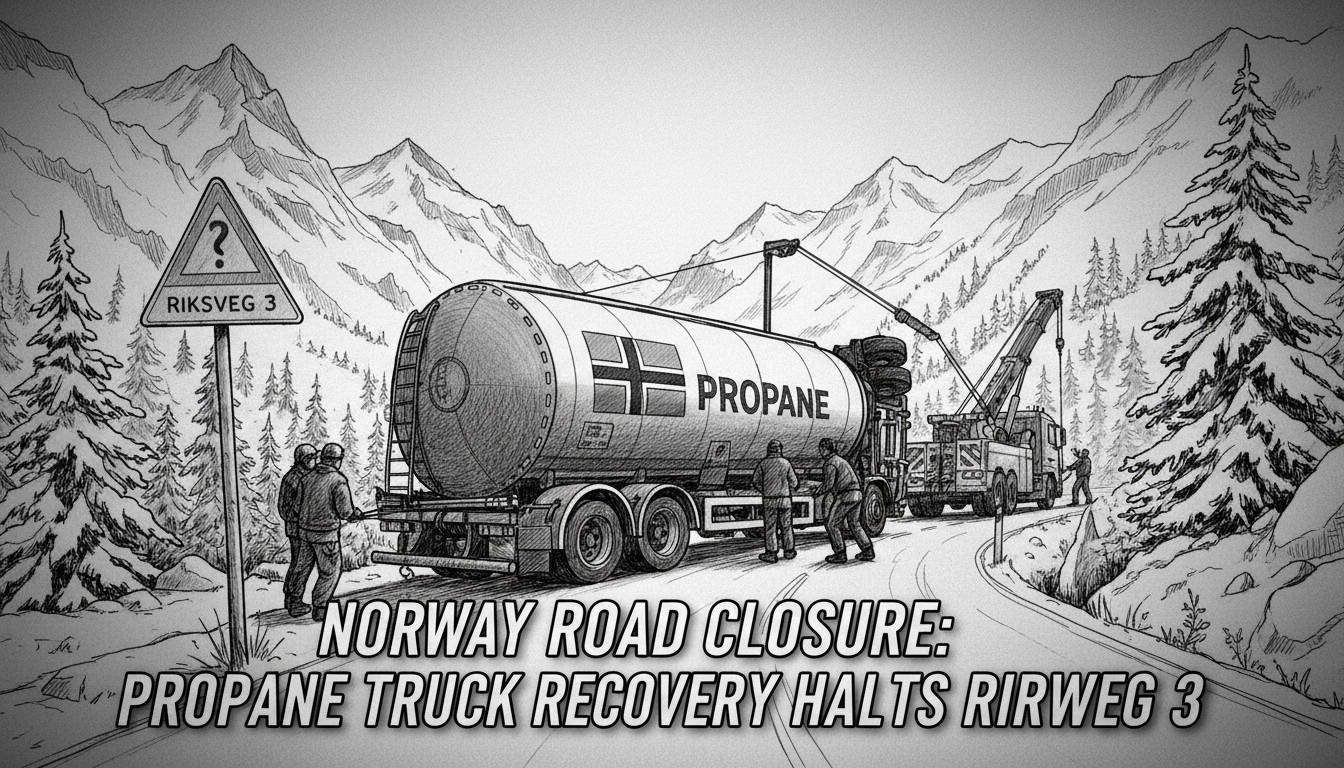
Norway's Riksveg 3 highway faces a complete shutdown and local evacuations as emergency crews prepare to recover an overturned propane tanker. The truck, loaded with liquefied petroleum gas, crashed near Kvikne in the Østerdalen valley on New Year's Day. Authorities have established a critical 300-meter safety perimeter around the accident site, anticipating a four-hour salvage operation that will sever a vital transport artery connecting eastern and central Norway.
A Critical Artery Severed
Riksveg 3 is not just another road. It functions as the primary inland corridor through the Østerdalen valley, linking the counties of Innlandet and Trøndelag. This route is essential for freight transport, regional commerce, and daily commutes. Its closure, especially for an extended period, creates immediate logistical headaches. Alternative routes are limited and often involve longer, more circuitous mountain passes, which are less suitable for heavy goods vehicles and can be treacherous in winter conditions. The timing, just after the New Year holiday, compounds the disruption as commercial traffic resumes.
“When Riksveg 3 closes, the entire region feels it,” said a spokesperson for the Norwegian Public Roads Administration. “Our priority is managing the safe diversion of traffic, but drivers should expect significant delays and plan for much longer journey times.” The agency is directing light vehicles onto county roads, while advising heavy transport to wait or seek major alternative highways far from the incident zone.
The Delicate Science of Disaster Response
The planned salvage operation underscores the extreme caution required when dealing with volatile fuels. Propane, stored under pressure as a liquid, poses a dual threat: explosion and a rapidly expanding flammable gas cloud if the tank is breached. The mandated 300-meter evacuation zone is a standard, non-negotiable protocol derived from risk modeling for such incidents.
“A 300-meter radius is the absolute minimum safe distance for a potential BLEVE,” explained Lars Holmen, a former chief of the Oslo Fire Department with expertise in hazardous materials. “A Boiling Liquid Expanding Vapor Explosion is the worst-case scenario. It turns the tank into a massive projectile. The safety zone protects both the public and the responders working to stabilize the situation.”
Recovery teams will first conduct atmospheric monitoring to check for leaks. Specialized heavy-lift equipment must then carefully right the vehicle onto its wheels. Every movement is calculated to prevent sparking or sudden pressure changes within the damaged tank. This meticulous process justifies the estimated four-hour closure window.
Economic and Community Ripple Effects
Beyond the traffic snarls, the incident highlights the vulnerability of regional supply chains. Østerdalen's communities rely on consistent road access for goods, services, and tourism. Local businesses, from grocery stores to construction firms, may face delivery delays and increased costs. For residents within the evacuation perimeter, the incident brings a sudden and alarming disruption, forcing them from their homes during a salvage operation fraught with unseen danger.
This accident also reignites ongoing debates about road safety and infrastructure investment in Norway's interior regions. Riksveg 3, while vital, features sections with challenging geography. Proponents of accelerated road improvement projects will likely point to this closure as evidence of the economic risk posed by over-reliance on a single, vulnerable transport link. The conversation often centers on balancing the immense cost of building more resilient highways through mountainous terrain against the periodic but severe cost of closures.
A Pattern of Hazardous Cargo Challenges
This is not an isolated event. Norway's extensive road network regularly transports hazardous materials, including propane for heating, fuel, and industrial use. Each incident forces a temporary re-engineering of regional traffic flow and activates complex emergency protocols. The response to the Kvikne accident follows a well-rehearsed playbook developed from past experience, aiming to minimize risk while managing inevitable public inconvenience.
The successful resolution of this incident will depend on precise execution by the salvage crew and strict public adherence to police directives. Authorities have emphasized that the safety zone is legally enforced; trespassing into the area out of curiosity or to retrieve personal items is strictly prohibited and dangerously foolish.
Looking Beyond the Immediate Cleanup
Once the tanker is secured and removed, attention will turn to the cause of the initial accident. The Norwegian Safety Investigation Authority may launch an inquiry, particularly if any systemic issues are suspected. Factors like driver fatigue after the holiday, winter road conditions, vehicle maintenance, or road design will all come under scrutiny. The findings can influence future regulations for transporting dangerous goods on Norwegian roads.
For now, the focus remains on the delicate task at hand. The silent, cordoned-off stretch of Riksveg 3 near Kvikne represents a controlled but potent risk. It serves as a stark reminder of the complex infrastructure that underpins daily life and the thin margin for error when that infrastructure is compromised. The reopening of the road will bring relief, but the questions it raises about safety, resilience, and preparedness will linger long after the last recovery vehicle departs.