
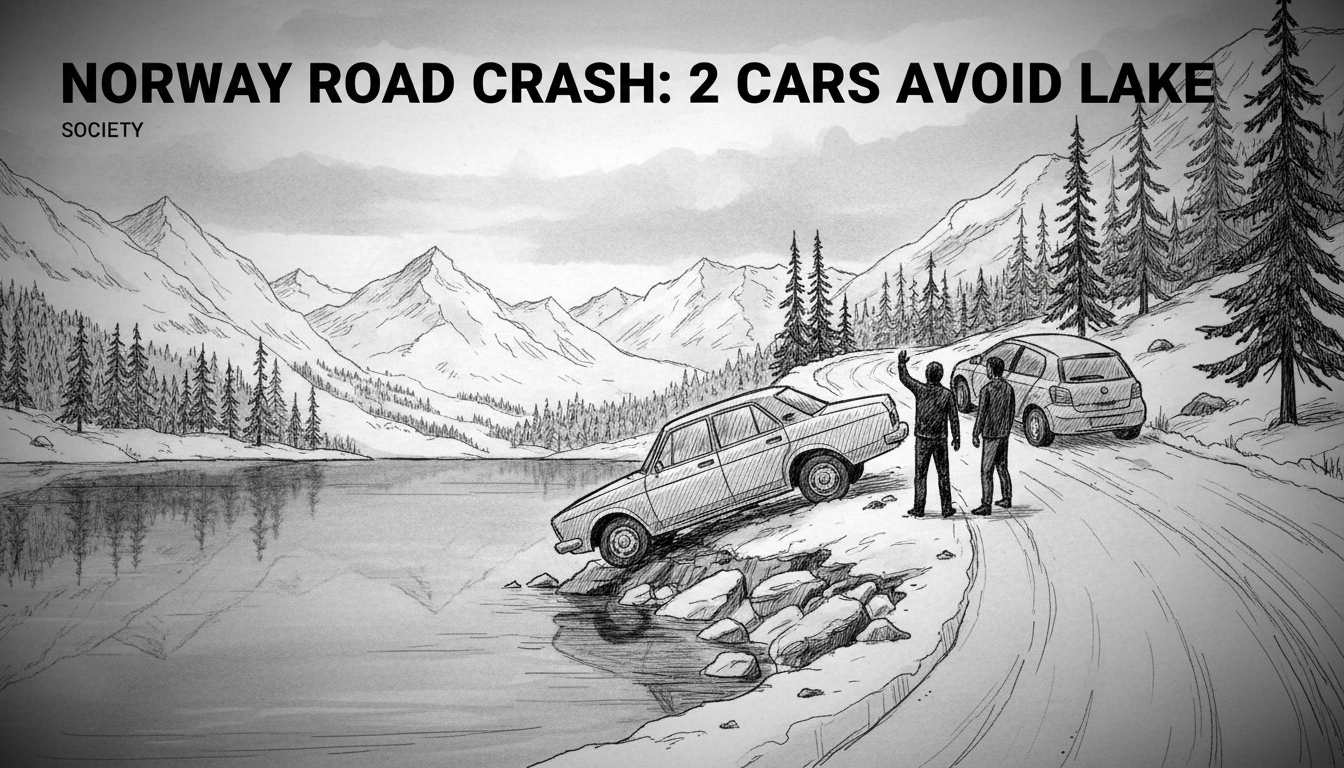
Norway's rugged Trøndelag coast witnessed a narrow escape when two vehicles collided near Beingårdsvatnet lake in Flatanger. Initial emergency calls reported one car teetering on the lake's edge, at serious risk of plunging into the water. Local fire services confirmed both vehicles remained on the roadway upon arrival. The two drivers involved self-extricated and were reported to be in fair condition given the circumstances, according to official statements.
This incident on a rural coastal road highlights persistent traffic safety challenges outside Norway's urban centers. While national figures show improvement, accidents in municipalities like Flatanger underscore the risks posed by geography and infrastructure.
Emergency Response and Scene Details
Police received the initial alert detailing a critical situation. The report specifically mentioned one car positioned precariously close to Beingårdsvatnet, a lake in the sparsely populated area. The visual of a vehicle nearly entering the water created immediate concern for occupant safety and a complex recovery operation.
Flatanger's municipal fire and rescue service responded promptly. Crews arriving at the scene provided the crucial update that both cars were, in fact, on the road surface. This significantly reduced the operational danger and complexity. "The individuals in the cars had already gotten out by the time our crews were on site," a rescue service representative said. They assessed the drivers' condition as relatively good following the collision.
The Broader Context of Norwegian Road Safety
This event fits into a national pattern where rural roads present heightened risks. Flatanger's landscape is characterized by fjords, lakes, and winding roads that connect small communities. Such terrain demands heightened driver attention, especially during variable weather conditions common along the coast.
Norwegian road safety statistics reveal a focused area for public policy. Preliminary data from the Norwegian Public Roads Administration (Statens vegvesen) recorded 116 traffic fatalities in 2022. While this number reflects a long-term downward trend, each incident prompts analysis. The number of serious injuries has also decreased in recent years, yet remains a key concern for transport authorities.
"Every accident is one too many," says Lars Kristian Løvlie, a senior advisor with the Norwegian Council for Road Safety (Trygg Trafikk). "While our national numbers are improving, we see that risk is not evenly distributed. Rural roads, with their unique challenges, require continuous focus on driver awareness, vehicle condition, and targeted infrastructure measures."
Analysis: Factors in Rural Accidents
Experts point to a confluence of factors that can contribute to accidents in regions like Trøndelag. Driver fatigue on long stretches between towns is a known risk factor. So is inappropriate speed for the road's curvature and condition. Weather shifts, including sudden rain, fog, or icy patches, can dramatically alter driving conditions on these roads.
Vehicle maintenance also plays a critical role. The distance to service centers can be greater in rural counties, potentially leading to delays in addressing minor issues before they become major safety concerns. Furthermore, wildlife crossings, such as moose or deer, present a sudden hazard, particularly at dawn and dusk.
Infrastructure investment is a constant topic in municipal politics. Improving road width, adding better barriers near water or steep drops, and enhancing signage are all measures discussed. However, these projects must be balanced against the costs of maintaining vast road networks in low-population areas.
The Human Element and Community Impact
Beyond statistics, accidents like the one at Beingårdsvatnet have a deep impact on small communities. In close-knit municipalities, those involved are often neighbors, not anonymous drivers. The swift response from local emergency services—often staffed by volunteers—highlights the community's role in its own safety.
The successful outcome of this collision, with no serious injuries, is a relief. It contrasts with many other incidents that have less fortunate conclusions. It serves as a real-world reminder of the importance of seatbelt use, which is near-universal in Norway, and modern vehicle safety features like airbags and crumple zones.
Looking Forward: Safety on Norway's Roads
The Flatanger incident concluded without tragedy. Yet it acts as a microcosm of the ongoing effort to achieve Vision Zero—Norway's goal of having no fatalities or serious injuries on its roads. This philosophy guides national policy, pushing for systemic improvements rather than blaming individual driver error.
Authorities continue to emphasize the basics: obeying speed limits, never driving impaired, and ensuring full attention is on the road. For tourists and new residents unfamiliar with Nordic driving conditions, this advice is doubly important. The stunning scenery of regions like Flatanger can itself be a distraction.
As emergency crews cleared the wreckage from the road near Beingårdsvatnet, normal traffic resumed. The question left hanging is how Norway will further leverage its world-class safety standards to protect every driver, on every road, from the bustling E6 highway to the quiet lakeside lanes of Flatanger. Will continued technological advances in vehicles and infrastructure bridge the safety gap between urban and rural Norway?