
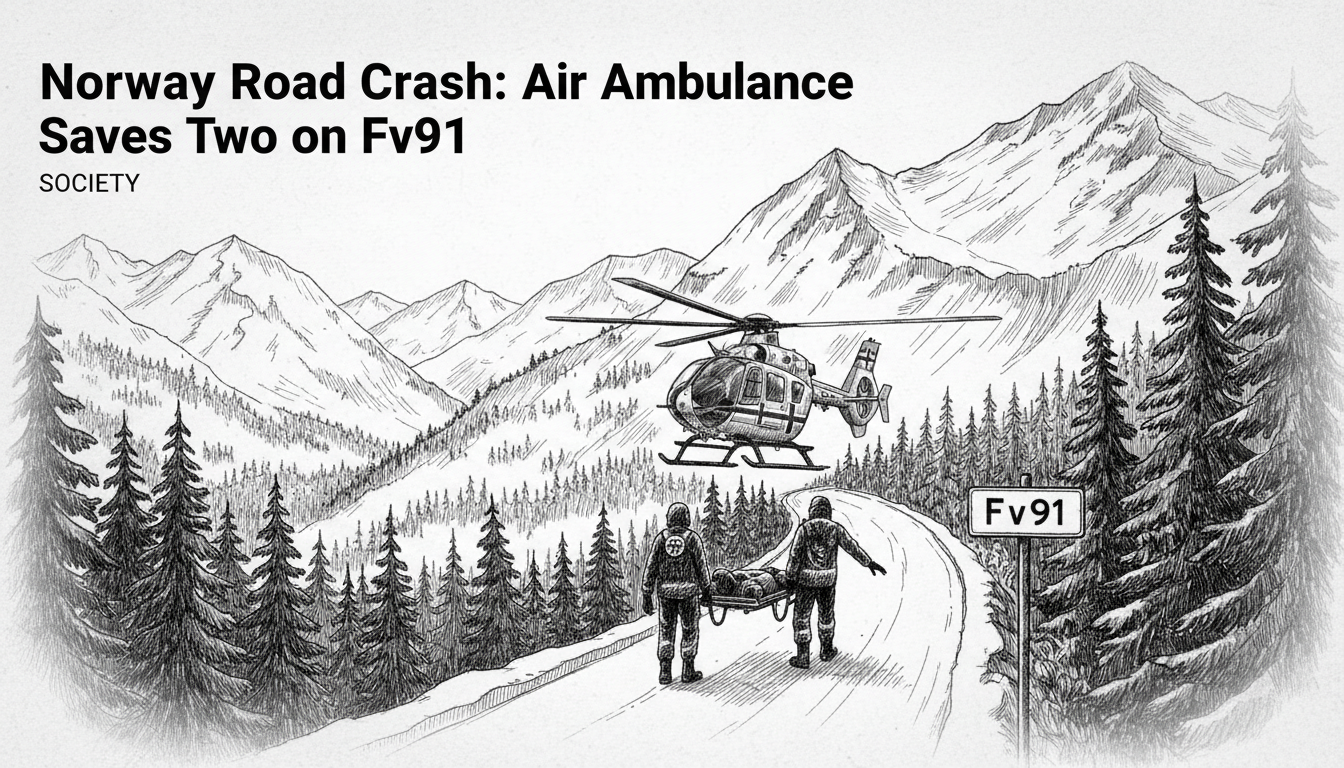
Norway road accident response was tested again on Fylkesvei 91 in Troms on Tuesday when a serious head-on collision required air ambulance evacuation. Two individuals were flown to the University Hospital of North Norway (UNN) in Tromsø following the crash, which caused what police described as 'extensive material damage' to both vehicles involved. The incident closed a vital northern artery, highlighting the persistent risks on Norway's regional roads despite the nation's world-leading safety record.
“It was another motorist who reported the incident,” said operations manager Rune Nilsen in a statement to media. His brief comment underscores how crucial witness reports are in remote areas where automatic detection is sparse. Fylkesvei 91, a county road threading through the terrain of Troms og Finnmark, was closed for investigation and cleanup, with drivers directed to use available detours. The use of the Luftambulanse, or air ambulance service, indicates the severity of the injuries and the challenging location.
The Immediate Aftermath and Response
Emergency services converged on the scene following the alert. The decision to dispatch air ambulances is standard protocol in Norway for serious incidents in regions where ground transport to a specialized trauma center would take too long. The University Hospital of North Norway in Tromsø serves as the main trauma hub for northern Norway, equipped to handle severe injuries. The condition of the two patients has not been disclosed, in line with strict Norwegian patient confidentiality laws.
The closure of Fylkesvei 91, even temporarily, disrupts local logistics. Such roads are lifelines for communities, connecting remote homes to schools, workplaces, and services. Each closure forces lengthy detours, underscoring the infrastructure's vulnerability. Police investigators will now work to determine the cause, examining factors like road conditions, vehicle speed, potential driver error, and weather.
Norway's Road Safety Paradox
This crash presents a stark contrast within Norwegian society. Norway consistently ranks among the safest countries in the world for road travel. Preliminary figures for 2022 recorded 117 road fatalities, a low number per capita achieved through decades of stringent policy. The country mandates rigorous vehicle inspections, promotes widespread use of winter tires, and employs aggressive speed enforcement. Yet, accidents like the one on Fylkesvei 91 remind us that geography and climate are relentless opponents.
The very factors that define Norway's beauty—its fjords, mountains, and vast Arctic landscapes—create inherent driving hazards. Roads wind through unpredictable terrain, weather can shift from clear to treacherous in minutes, and winter brings prolonged darkness and ice. “The Norwegian model for road safety is comprehensive, but it is a constant battle against nature,” explains Lars Tennøy, a transport researcher at the Institute of Transport Economics (TØI). “On regional county roads, the margin for error is much smaller than on the national motorways.”
The Crucial Role of the Air Ambulance Network
The rapid deployment of the air ambulance in this incident showcases a critical component of Norway's emergency response framework. The Norwegian Air Ambulance Foundation operates a fleet of helicopters and fixed-wing aircraft across the country. They are often the difference between life and death for patients in remote areas, providing not just transport but advanced, doctor-led medical care from the moment they arrive on scene.
This network is a direct response to the nation's challenging topography. A ground ambulance might take hours to reach a patient in parts of Troms og Finnmark and then more hours to reach UNN in Tromsø. A helicopter can dramatically reduce that time, particularly for time-sensitive injuries like severe trauma or heart attacks. The service is funded through a combination of state support and public donations, reflecting its valued place in the national consciousness.
Analyzing Risk on County Roads
While Norway's main highway network (Riksveier) has seen massive safety investments, county roads (Fylkesveier) like Fv91 present a different challenge. They are managed by regional authorities with varying budgets and often have lower engineering standards—narrower lanes, sharper curves, and less forgiving roadside clear zones. Traffic volumes can be low, which may lead to complacency, yet the mix of vehicles—from local commuters to heavy timber trucks—creates complex interactions.
“Our analysis shows that the risk per kilometer driven is significantly higher on these regional roads,” says Tennøy. “Improvements here are more costly per user, but essential for local communities. It involves a combination of physical upgrades, like better signage and barrier systems, and behavioral campaigns tailored to local conditions.”
The Human and Policy Impact
Every accident sends ripples through small communities. The individuals involved, their families, and the witnesses are directly affected. The broader impact is a renewed debate on resource allocation for road maintenance and safety in northern Norway. Municipalities consistently argue for greater state investment in northern infrastructure, citing higher costs due to climate and distances.
The Norwegian Public Roads Administration (Statens vegvesen) runs continuous programs targeting high-risk road segments. Data from accident investigations feed into these plans, leading to targeted interventions. Whether this stretch of Fv91 has been previously flagged is not public information, but the investigation's findings will likely inform future safety work in the region.
A Look Ahead: Technology and Persistent Challenges
Norway is at the forefront of implementing new vehicle safety technology. EU-mandated systems like Automatic Emergency Braking (AEB) and Lane Departure Warning are becoming standard. However, the penetration of such technology into the entire vehicle fleet takes time. Furthermore, experts note that technology can only do so much against black ice, sudden white-outs, or the misjudgment of a corner on a familiar road.
The ultimate goal, as stated in Norway's National Transport Plan, is ‘Vision Zero’—the aim that no one shall be killed or seriously injured in road traffic. Achieving this on every winding county road in the north is perhaps the final and most difficult leg of that journey. It will require not just engineering and enforcement, but a sustained cultural commitment to cautious driving, regardless of how empty the road appears.
As the investigation into Tuesday's crash continues, the incident serves as a somber reminder. Even in the world's safest road environments, the interplay of human judgment, machine, and nature can have grave consequences. The question for policymakers is whether current safety measures and investment levels match the unique risks presented by Norway’s majestic but unforgiving landscape.