
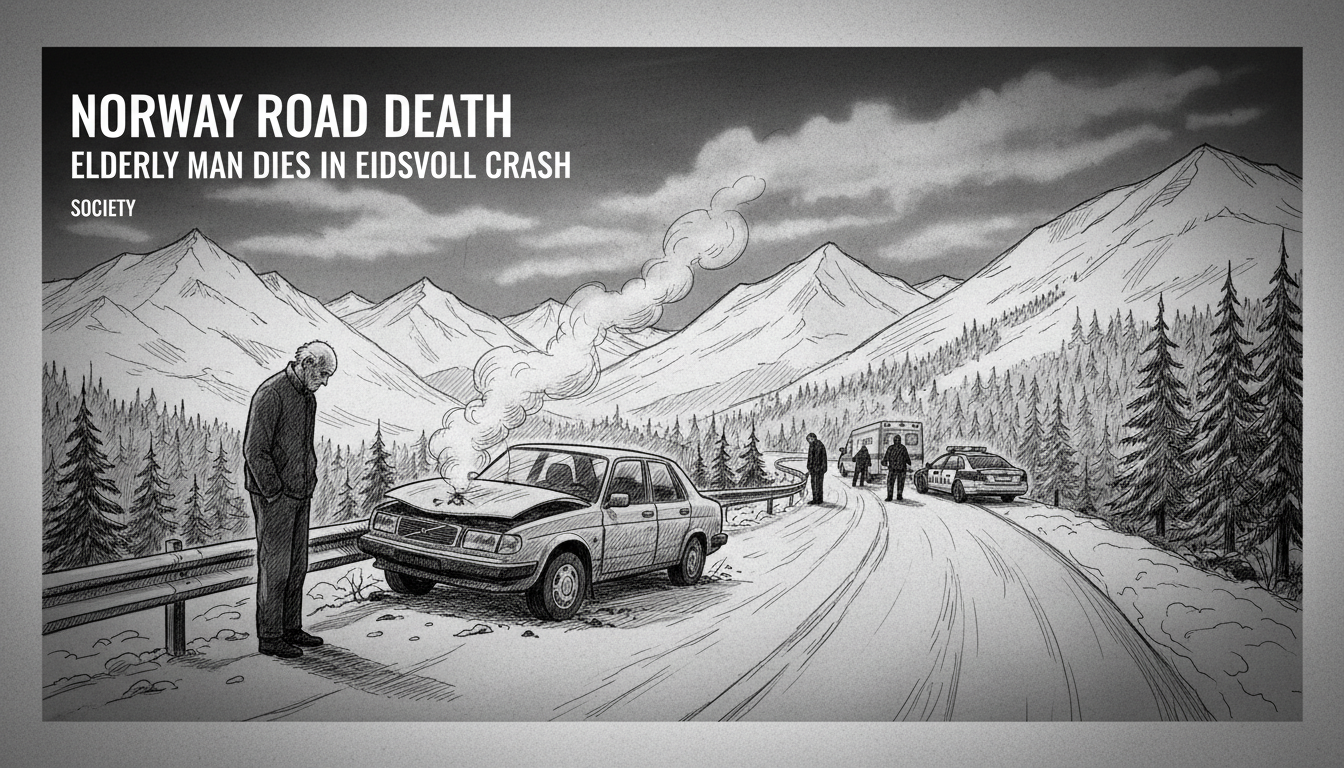
Norway road safety faces a tragic reminder after an elderly man died in a head-on collision near Eidsvoll on Monday morning. The fatal crash occurred around 10:00 AM, involving two cars with a total of two people. Police confirm the man was transported to a hospital where he later died. The driver of the second vehicle is reportedly in satisfactory condition given the circumstances. Initial police reports state the cause is unknown but suggest one vehicle may have crossed into the oncoming lane, with icy conditions present at the scene.
A Monday Morning Tragedy on a Rural Road
Operations Manager Ørjan Hustad with the Eastern Police District provided the basic facts to the press. The investigation is in its earliest stages, focusing on the stretch of road where the collision happened. This accident immediately shifts from a statistic to a profound personal loss for a family and community. It underscores a persistent challenge in a nation otherwise celebrated for its traffic safety achievements. While Norway's annual road death toll is among Europe's lowest, each fatality represents a devastating endpoint where complex factors—human, vehicular, and environmental—intersect.
The Persistent Danger of Head-On Collisions
This type of crash, a frontal impact, is one of the most lethal events on Norwegian roads. It frequently occurs on two-lane highways common in rural areas, where a single error or moment of inattention can have catastrophic consequences. In 2022, Norway recorded approximately 115 road traffic deaths. While this number has fallen dramatically from decades past, head-on collisions remain a significant contributor to this figure. They often involve high relative speeds and offer little opportunity for crash energy absorption, making survival less likely.
“Every fatal accident is one too many, and head-on collisions are particularly severe,” a senior traffic safety engineer with the Norwegian Public Roads Administration noted in a recent report. “Our continued work on physical median barriers, wider center lines, and improved road markings on these routes is critical.” The road where Monday's crash occurred will now be scrutinized for these very features. Investigators will map the exact point of impact, skid marks, and the road's alignment to understand the vehicle trajectories.
Winter's Grip on Norwegian Road Safety
The police mention of likely icy conditions points to a perennial antagonist in Nordic traffic safety: winter weather. Norway's investment in winter road maintenance is substantial, but variable conditions can change rapidly, especially on lesser-traveled roads. Black ice, formed when moisture freezes on a cold road surface, can be virtually invisible to drivers. It negates traction, making steering and braking inputs ineffective. This reality places a heavy burden on both driver preparedness and municipal response.
Expert context consistently highlights a three-part defense against winter accidents: proper equipment, adapted behavior, and robust infrastructure. The legal requirement for winter tires (M+S or studded) from November to Easter is a cornerstone. However, tires are only as effective as the speed they are subjected to. Safety campaigns relentlessly advise motorists to reduce speed significantly during frost, snow, and limited daylight. The driver's condition, including fatigue or distraction, also forms a key part of the investigative picture, regardless of the weather.
The Investigation Process and National Context
Following the protocol for fatal accidents, Norwegian police and specialized traffic investigators will now conduct a meticulous examination. This process typically involves technical inspections of both vehicles for mechanical faults, detailed forensic analysis of the crash site, and witness interviews. Toxicology reports are standard to check for driver impairment. The goal is to build a conclusive sequence of events to determine the primary and contributing causes. This information feeds into national statistics and informs future safety measures, though it offers little immediate solace to the bereaved.
Norway's Vision Zero policy, adopted in 1999, aims ultimately for no fatalities or serious injuries on the roads. This ambitious goal has driven innovations like lower speed limits in residential areas, extensive use of roundabouts instead of intersections, and the gradual removal of dangerous roadside obstacles. The country has seen great success, but as Monday's death proves, the goal remains elusive. Accidents on rural roads, often involving older drivers or isolated weather events, represent a stubborn final frontier.
A Community Mourns and a Nation Reflects
Beyond the police reports and safety statistics lies a human story of sudden, irrevocable loss. An elderly man's routine Monday morning journey ended in tragedy. His family now navigates the shock and grief that follows such news. The community in and around Eidsvoll, a historic town north of Oslo, is reminded of the fragility that exists on familiar roads. For the other driver involved, surviving such a traumatic event carries its own long-term psychological burden.
This single accident serves as a somber national checkpoint. It asks whether current measures are sufficient on every kilometer of road, not just the major arteries. It tests the completeness of public awareness about winter hazards. As the investigation in Eidsvoll continues, its findings will add another data point to Norway's relentless pursuit of safer roads. The broader question remains: in a country that has done so much to protect its people from traffic harm, how can it protect them from the last, unpredictable moments of risk that still emerge from a cold morning's drive?