
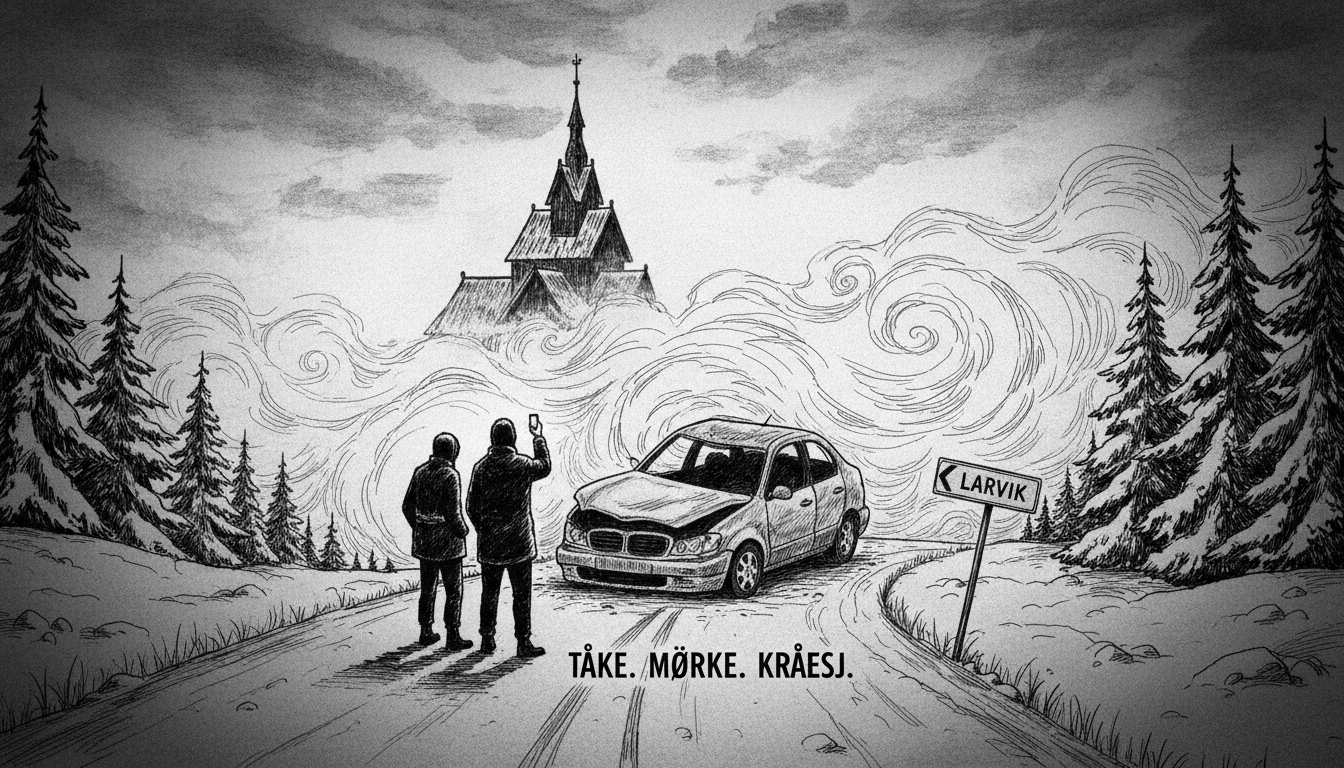
Norway road safety faces scrutiny after a fatal accident in Larvik claimed the life of a man in his 70s. The collision occurred on a foggy Tuesday evening in the village of Tjølling. Emergency services performed extensive CPR at the scene, but the man, a resident of nearby Tjodalyng, could not be saved. Police confirmed his next of kin have been notified. Preliminary reports indicate heavy fog and non-functioning streetlights were present when a car traveling from Sandefjord towards Larvik struck the pedestrian. This incident adds to Norway's ongoing challenge of eliminating traffic fatalities, even as it maintains one of the world's safest road networks.
A Deadly Evening in Tjølling
The accident unfolded on a stretch of road connecting the coastal towns of Sandefjord and Larvik in Vestfold county. This region, typically known for its summer maritime traffic and quiet communities, became the site of a sudden tragedy. According to police statements, the driver of the vehicle involved remained at the scene and is cooperating with the investigation. The exact speed of the vehicle and the precise actions of the pedestrian are now central to the official inquiry. Forensic teams and traffic investigators have likely begun examining skid marks, vehicle condition, and the local topography. The absence of functioning streetlights, a detail confirmed by authorities, will be a critical factor. Municipal maintenance logs for the area's lighting infrastructure will be reviewed.
The Persistent Challenge of Zero Vision
This death occurs against the backdrop of Norway's ambitious 'Vision Zero' road safety policy. Adopted in 1999, the policy aims to eliminate all traffic fatalities and serious injuries. The country has made significant progress, with traffic deaths falling dramatically over decades. Preliminary figures for 2022 show 116 road deaths, a historically low number for a nation of 5.4 million people. Norway consistently ranks among the top three safest countries globally for road traffic mortality per capita. Yet, each death represents a policy failure under the Vision Zero framework. "Every fatal accident is one too many, and each requires us to examine what more we can do," said a senior advisor from the Norwegian Public Roads Administration last year. The focus has shifted from reducing numbers to systematically removing the potential for fatal crashes through road design, speed management, and technology.
Environmental Factors and Infrastructure Accountability
The conditions reported in Tjølling—dense fog and darkness—present a classic and dangerous combination. Road safety experts stress that visibility is the single most critical factor in pedestrian safety. "Fog reduces contrast and depth perception. A pedestrian in dark clothing can become virtually invisible at a very short distance, even with headlights," explains a traffic psychologist from the Institute of Transport Economics. The failure of streetlights compounds this risk exponentially. It raises immediate questions about municipal inspection routines, especially in autumn when weather deteriorates and daylight hours shrink. Who is responsible for reporting and repairing faulty lights? How frequently are these checks conducted? The Larvik municipality's maintenance department will face these questions as the investigation progresses beyond the immediate cause to contributing systemic factors.
The Human Cost Behind the Statistics
The victim, a man in his seventies from Tjodalyng, represents a demographic particularly vulnerable on the roads. Older pedestrians often have slower reaction times and may require more time to cross streets. In smaller Norwegian communities like those in Vestfold, walking remains a fundamental part of daily life for all ages. The loss resonates deeply in tight-knit areas where anonymity is rare. Such tragedies force a community to confront the safety of its own streets. Local politicians often face pressure to implement immediate measures, such as enhanced crosswalks, lower speed limits, or improved lighting, following a fatal incident. The national debate typically revolves around speed limits, alcohol controls, and winter tire mandates, but local safety is dictated by the state of a single streetlight or the design of a specific village crossing.
A Comparative Look at Nordic Road Safety
Norway's approach is part of a broader Nordic model that prioritizes safety over speed. Sweden, the originator of Vision Zero, and Finland both employ similar rigorous strategies. These include extensive use of median barriers on highways, strict drunk-driving limits, and a pervasive safety culture ingrained from driver's education onward. The Nordic countries demonstrate that high car ownership does not necessitate high fatality rates. Their success is built on a consensus view that road deaths are preventable, not inevitable. However, the remaining challenges are often the hardest: protecting vulnerable road users like pedestrians and cyclists on local roads, and combating complacency among drivers in a generally safe environment. The accident in Tjølling is a stark reminder that safety gains can be fragile, dependent on both advanced policy and mundane maintenance.
What the Investigation Will Seek to Determine
The official police investigation will follow a standard protocol for fatal traffic accidents. Investigators will calculate the vehicle's speed at the moment of impact using physical evidence. They will assess the driver's vision sightlines and reaction time given the foggy conditions. The mechanical condition of the car, including brake and light functionality, will be thoroughly checked. Crucially, they will seek to establish the pedestrian's location and direction of travel relative to the roadway. Was he on a sidewalk, a shoulder, or within the traffic lane? The investigation report, which may take months to finalize, will conclude with a determination of primary and contributing causes. Its findings could lead to recommendations for the local road authority, or in rare cases, criminal charges if gross negligence is established.
The Path Forward for Local and National Authorities
In the wake of this fatality, responses will operate on two levels. Locally, the Larvik municipality will likely conduct an urgent review of streetlight functionality on that route and similar roads. Residents may demand temporary speed reductions or new pedestrian signage. Nationally, the accident becomes a data point for the Public Roads Administration and the Ministry of Transport. It will be categorized and analyzed to see if it reveals any emerging risk patterns—for instance, an increase in fog-related incidents or pedestrian fatalities in rural villages. This data informs future safety campaigns and potential regulatory tweaks. The ultimate goal remains the same: to ensure that a simple walk on a foggy evening does not end in tragedy. As Norway strives for zero, each life lost underscores the distance still to travel, one well-lit street at a time.