
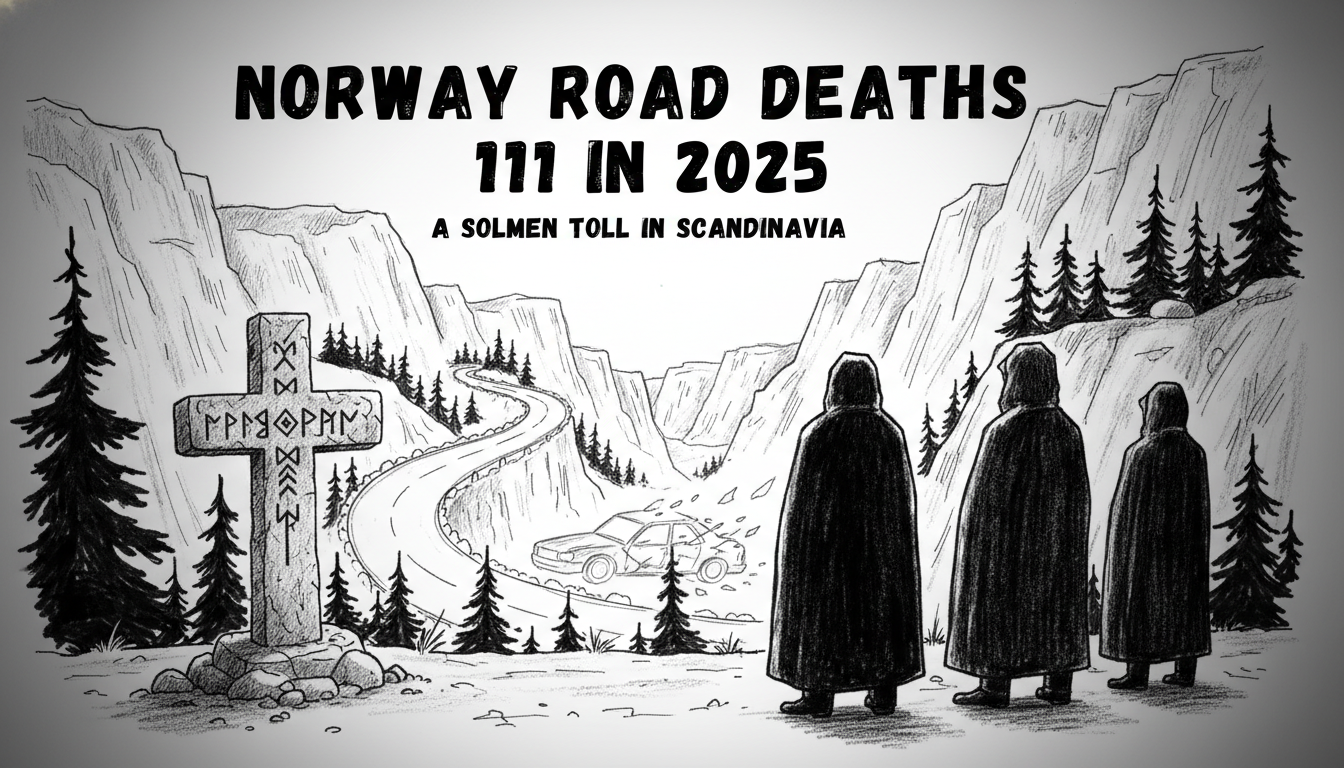
Norway road deaths surged to 111 in 2025, a sharp increase of 24 fatalities from the previous year. Preliminary figures from the Norwegian Public Roads Administration (Statens vegvesen) confirm this troubling rise, reversing recent progress in the nation's renowned safety efforts. Transport Minister Jon-Ivar Nygård has expressed deep concern over the development, labeling the number unacceptably high.
'It is far too many people losing their lives on our roads, and I am very worried about the trend we are seeing,' Nygård said in a statement. The minister's alarm underscores a significant setback for Norway's ambitious Vision Zero policy, which aims to eliminate all traffic fatalities and serious injuries.
A Setback for Safety Ambitions
The 2025 toll of 111 deaths marks a 28 percent increase from the 87 recorded in 2024. This spike interrupts a long-term downward trend in Norwegian traffic fatalities, where numbers had generally declined over decades due to concerted policy efforts. Analysts are now scrutinizing the data to understand what drove this sudden reversal.
The Public Roads Administration's accident analyses point to consistent primary causes. High speed, driver intoxication, inattention, and risky behavior are cited as recurring factors in fatal crashes. These human elements remain stubborn challenges even as vehicle technology and road infrastructure improve.
Dissecting the Deadly Trends
Norwegian authorities have not yet released a detailed breakdown of the 2025 fatalities by location, vehicle type, or demographic. However, historical patterns show that rural roads often see higher fatality rates than urban areas. Single-vehicle accidents, often involving speed or impairment, are a persistent concern on Norway's extensive network of winding highways and mountain passes.
'We cannot attribute this increase to a single cause,' said a senior traffic safety analyst who requested anonymity as final reports are pending. 'It likely reflects a combination of factors, including possible post-pandemic shifts in driving patterns, enforcement levels, and even weather conditions during critical periods.'
The analyst emphasized that year-to-year fluctuations are normal, but a jump of this magnitude demands scrutiny. It puts pressure on the government to review its current strategies under the Vision Zero framework, which has guided Norwegian road safety policy since its adoption.
Vision Zero Under Pressure
Norway's commitment to Vision Zero is a cornerstone of its transport policy. The approach involves systematic changes to road design, strict speed limits, aggressive enforcement of drunk driving laws, and promotion of vehicle safety features. For years, this multi-pronged strategy yielded results, making Norwegian roads among the safest in the world.
Despite this, the 2025 figures highlight the policy's vulnerability to behavioral lapses. 'Technology and infrastructure can only do so much,' the analyst noted. 'The final layer of safety always depends on the person behind the wheel. This data suggests we need a renewed focus on driver accountability and education.'
Minister Nygård's concern signals that the government is likely to consider policy responses. These could include lower speed limits on high-risk routes, increased traffic police patrols, or public awareness campaigns targeting young male drivers, a group statistically overrepresented in serious accidents.
The Infrastructure and Enforcement Equation
Norway has invested heavily in safer road infrastructure over the past twenty years. Projects include building more roundabouts, installing median barriers on highways, and improving lighting and signage. The country has also been a leader in adopting vehicle safety standards, with high rates of electronic stability control and autonomous emergency braking in new cars.
Enforcement remains a critical tool. Norway's legal blood alcohol concentration limit is 0.02 percent, one of the strictest in Europe. Speed cameras are widespread, and penalties for violations are severe. Yet, the 2025 fatalities indicate these measures are not foolproof.
'Enforcement acts as a deterrent, but it's not omnipresent,' said another expert familiar with Nordic transport policy. 'There's always a segment of drivers who gamble with risk. A bad year like this one shows the consequences when that gamble fails, repeatedly.'
Looking Beyond the National Number
While the national figure is alarming, regional variations will be key to understanding the problem. Areas with challenging geography, like the West Coast fjords or Northern Norway's Arctic roads, often present unique hazards. Long, dark winters and rapidly changing weather conditions contribute to driving risks that are less common in southern Europe.
Vehicle type also plays a role. Norway's rapid electrification of its car fleet, while environmentally positive, introduces new dynamics. Electric vehicles' instant torque and quiet operation may influence driving behavior, though no direct link to the 2025 fatalities has been established.
The Political and Public Response
The increase in deaths places road safety back on the top of the political agenda. The Storting, Norway's parliament, will likely debate the issue when final official statistics are published later this year. Opposition parties may criticize the government for complacency or call for increased funding for road maintenance and police traffic units.
Public reaction often follows such tragic statistics, with calls for action from victim advocacy groups. Norway has a strong civil society focus on road safety, which will amplify pressure on policymakers to explain this regression and outline a clear corrective plan.
Minister Nygård's next steps will be closely watched. Will he propose new legislation, or double down on existing Vision Zero initiatives? The coming months will reveal whether 2025 was an anomalous blip or the start of a dangerous new trend.
A Sobering Reality Check
Norway's goal of zero road deaths is a noble and ambitious target. The 2025 data serves as a stark reminder of how difficult that target is to achieve. Each number represents a life lost, a family shattered, and a community diminished. The statistical increase of 24 is not just a data point; it is two dozen personal tragedies that unfolded on asphalt and gravel across the country.
This setback does not invalidate Norway's decades of safety work. It does, however, demand a honest reassessment. Can behavioral change be engineered as effectively as road curves can be straightened? How does a society combat the ingrained sense of invulnerability that some drivers possess? The answers to these questions will shape Norway's road safety strategy for the next decade. The path to zero just got steeper, and the nation must decide how to climb it.