
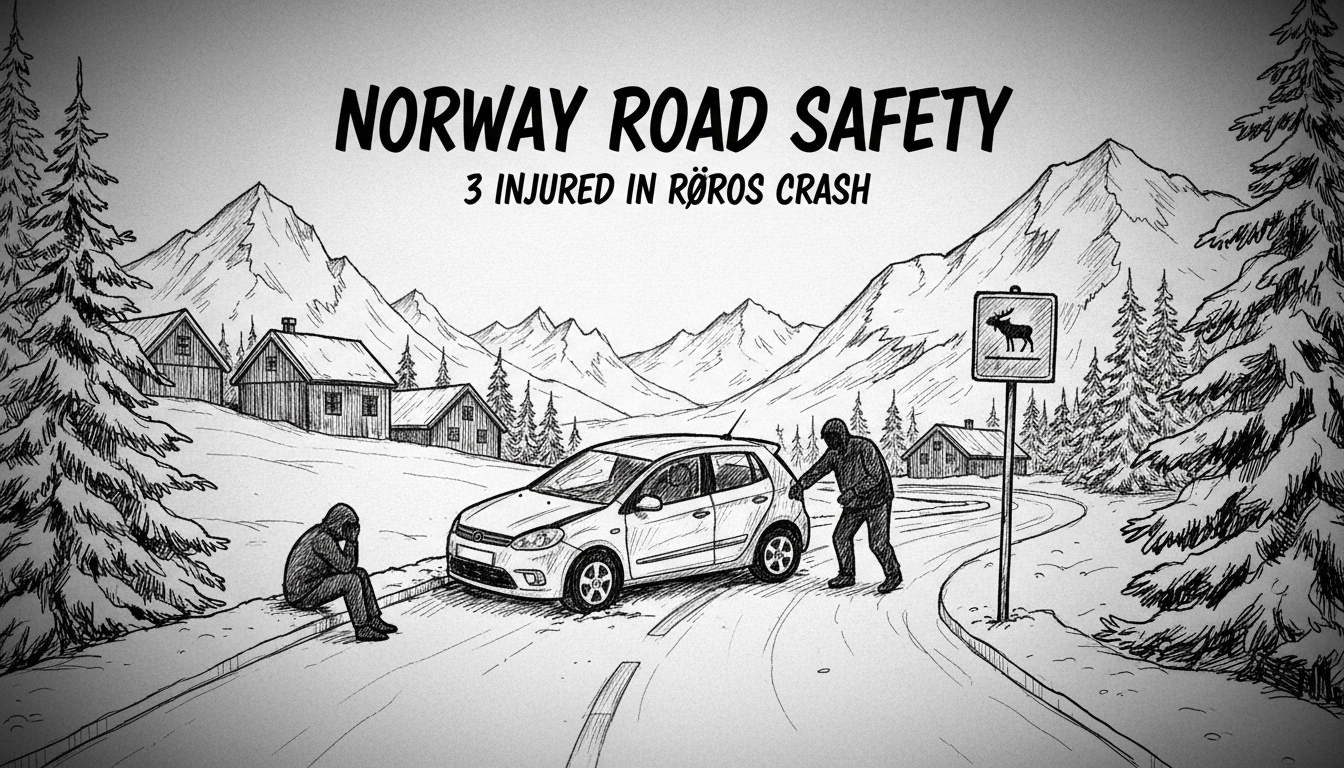
Norway's winter roads claimed more victims as a car with three occupants veered off a highway near Røros. Emergency services rushed to the scene after receiving reports of the single-vehicle accident on a reportedly icy road section. The extent of injuries remains unknown, according to operations manager Svein Erik Wagnild of the Trøndelag Police District.
This incident highlights the persistent danger of Norway's winter driving conditions, even on maintained national highways. Røros, a historic mining town and UNESCO World Heritage site, sits on the mountainous plateau of Eastern Norway, where weather can shift rapidly. Early season snowfall and freezing temperatures have already created hazardous patches across the region.
The Persistent Challenge of Winter Roads
Norway's extensive road network, stretching over 100,000 kilometers, faces extreme winter conditions for up to six months each year. The stretch near Røros, part of the RV30 highway, is a vital transport link connecting central and eastern regions. While the Norwegian Public Roads Administration (Statens vegvesen) maintains rigorous winter service protocols, black ice remains a formidable and often invisible threat.
Black ice forms when moisture freezes on cold road surfaces, creating a transparent, nearly undetectable layer. It frequently occurs on bridges, shaded forest roads, and open plateau areas like those surrounding Røros. Drivers traveling from milder coastal climates into the interior highlands can be caught unprepared by the sudden change in road surface conditions.
Emergency Response and Winter Preparedness
The response to the Røros crash involved coordinated efforts from police, ambulance, and potentially local fire and rescue services. Trøndelag Police District, which covers a vast area, must manage incidents across significant distances, where response times can be critical. The immediate priority is always medical assessment and stabilization, followed by vehicle recovery and road clearance.
Norwegian law mandates the use of winter tires with studs or approved friction tires from November to Easter, depending on the region. Authorities consistently campaign for driver preparedness, urging motorists to equip vehicles with proper tires, carry emergency blankets, and check road reports (vegvesen.no) before travel. Despite these measures, human factors like speed adaptation for conditions remain a primary cause of winter accidents.
Expert Perspective on Road Safety Infrastructure
"Single-vehicle run-off-road accidents are a characteristic and serious winter traffic safety problem in Norway," explains Dr. Karin Monsrud, a senior researcher at the Institute of Transport Economics (TØI). "While vehicle technology like ESC (Electronic Stability Control) has helped, infrastructure improvements are crucial. We need more consistent friction management and physical roadside barriers in high-risk zones."
Dr. Monsrud points to data showing that while total accidents have decreased, the severity of run-off-road crashes remains high. "The mountainous terrain means leaving the roadway often leads to a steep drop or collision with solid rock. Investment in forgiving roadside design—wider clear zones and safety barriers—can prevent a loss of control from becoming a fatal event."
Research from TØI indicates that approximately 25% of all fatal accidents in Norway involve a vehicle leaving the roadway. Winter conditions are a contributing factor in a significant portion of these. The challenge is economic and practical: installing and maintaining safety features across Norway's vast, sparsely populated road network requires immense resources.
The Human Factor in Winter Driving
Technology and infrastructure alone cannot eliminate winter accidents. The Norwegian Council for Road Safety (Trygg Trafikk) emphasizes driver behavior as the most critical element. "The right tires are just the starting point," says a council spokesperson. "Drivers must adjust their speed to the actual conditions, not just the posted limit. On a clear summer day, a road might safely handle 80 km/h. With ice, that safe speed could be 50 km/h or lower."
A common issue is 'local knowledge bias,' where residents familiar with a road may underestimate changing conditions. Conversely, unfamiliar drivers may not recognize high-risk sections, such as areas prone to crosswinds or where road spray quickly freezes. The stretch of road near Røros is used by both local traffic and long-distance travelers crossing the mountain pass, mixing these two groups.
What This Means for Norway's Transport Policy
The Røros accident occurs as the Norwegian Parliament (Storting) reviews long-term funding for the National Transport Plan. Debates often center on the balance between building new mega-projects like the E39 coastal highway and maintaining existing networks. Incidents like this underscore the safety imperative of maintenance and targeted upgrades on current roads.
There is also growing political discussion about mandating more advanced driver assistance systems (ADAS) in new vehicles and potentially requiring professional winter driving courses for all license holders. Norway's vision zero policy, aiming for no road fatalities or serious injuries, faces its toughest test during the dark, icy winter months.
Furthermore, climate change introduces new variables. Warmer winters lead to more frequent freeze-thaw cycles, increasing the occurrence of black ice. This puts pressure on road maintenance crews to be more agile with salting and sanding operations, which themselves face environmental scrutiny.
A Community on the Front Line
For communities like Røros, these accidents are not just statistics. They strain local emergency resources and deeply affect small, close-knit populations. The sight of emergency vehicles racing down the highway is a somber reminder of the environment's power. It reinforces the community's shared responsibility for winter vigilance, from clearing private driveways to checking on neighbors planning long trips.
The outcome of the Røros crash will add to this year's winter accident tally. It will be analyzed by safety agencies seeking patterns and solutions. For now, it serves as a stark warning as Norway moves deeper into the high-risk winter driving season. The message from authorities remains unchanged: slow down, ensure your vehicle is prepared, and respect the formidable power of Norwegian winter.