
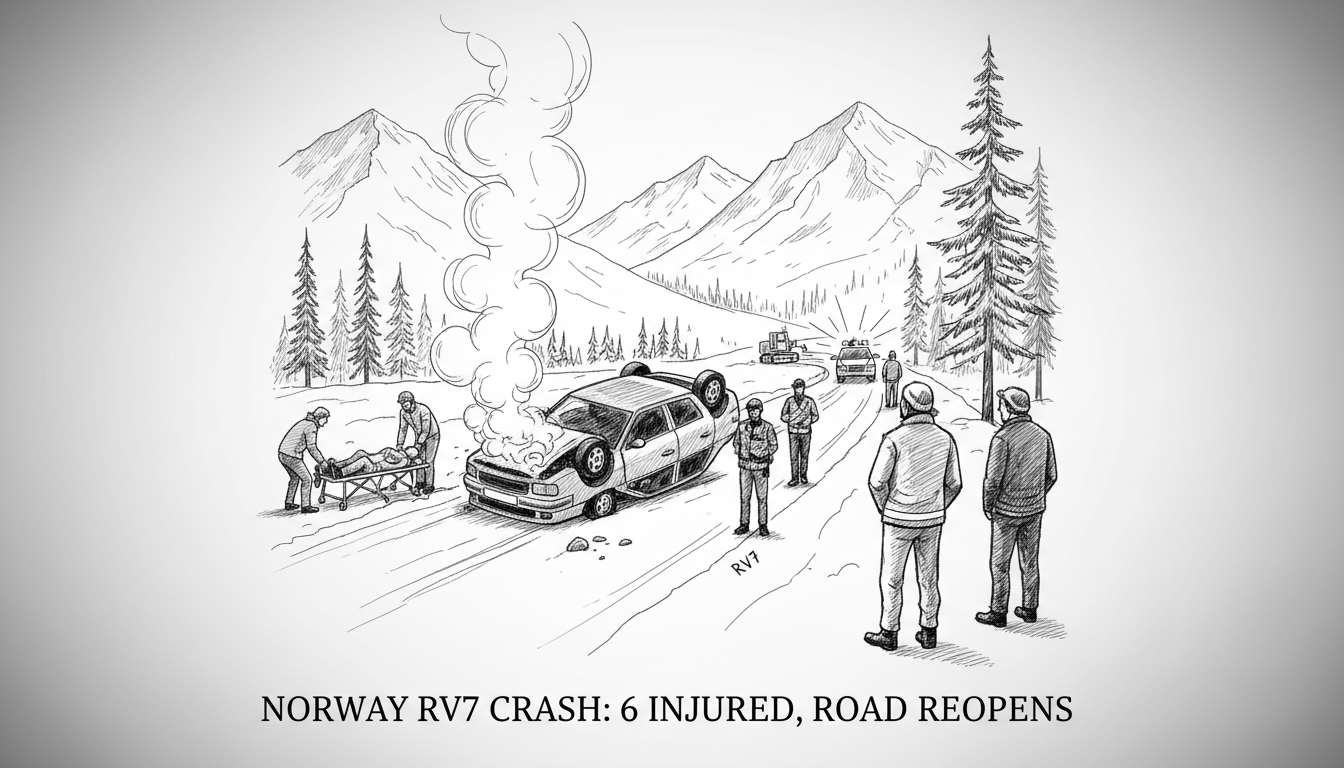
Norway's Riksvei 7 highway reopened late Friday night after a two-car collision caused a complete traffic shutdown near Nesbyen. The accident at Brunsvoll involved six people, with police confirming no serious injuries despite one vehicle ending up in a ditch. Traffic began moving again after recovery vehicles removed the two cars from the scene.
This incident on one of Norway's most vital cross-country routes highlights the persistent safety challenges on national highways. Rv7 serves as a critical artery for freight and passenger travel between Oslo and Bergen, traversing the rugged Hardangervidda plateau. Weekend traffic increases risk, making such collisions a recurring concern for transport authorities.
A Narrow Escape on a Vital Corridor
Police received reports of the collision around 6 p.m. Friday evening. Initial statements described one car in the ditch and the other blocking the road. The involvement of six individuals suggests multiple passengers in at least one vehicle, a common scenario for weekend travel. The fact that no one sustained serious injuries represents a fortunate outcome given the potential severity of highway collisions.
"A car is in the ditch, the other is on the road. Six people are involved, none seriously injured," police reported shortly after the crash. This clear, concise communication is standard procedure, aiming to inform the public while emergency services manage the scene. The swift response from recovery operators, or 'bilbergere', was crucial in reopening the route.
The Economic and Social Lifeline of Rv7
Riksvei 7 is far more than just asphalt. It functions as a primary economic and social connector for Southern Norway. Heavy goods vehicles rely on it for transporting goods between the east and west coasts, while tourists use it to access the dramatic scenery of Hardangervidda National Park. Any closure causes immediate logistical disruption and economic ripple effects.
The stretch near Nesbyen and Brunsvoll is part of the route's passage through Hallingdal valley. This area can experience rapidly changing weather conditions, even in late spring. While the police report did not cite weather as a factor in this specific crash, variable conditions are a constant background risk for drivers on this high-altitude highway.
Expert Analysis on Highway Safety Trends
Road safety experts point to a combination of factors that elevate risk on roads like Rv7. "Major arteries see concentrated traffic peaks, especially on Fridays and Sundays as people travel to and from holiday homes or for weekend trips," explains a transport researcher familiar with Norwegian road patterns. "This mixes local traffic with long-distance drivers, sometimes in challenging conditions."
The human factor remains paramount. Driver fatigue on long journeys, distractions, and speed inappropriate for the road geometry contribute to accidents. Norway has invested heavily in road safety improvements, including barrier upgrades and clearer signage, but the fundamental challenge of driver behavior persists. The design of older sections of highway, with fewer divided lanes, also plays a role.
The Ripple Effect of a Road Closure
A full traffic standstill in both directions, as occurred Friday, creates immediate problems. It strands travelers, delays freight deliveries, and requires police resources to be diverted for traffic management. For local communities like Nesbyen, which depend on through traffic for services, even a short closure has an impact.
The efficient clearance of the scene demonstrates Norway's well-practiced incident response protocols. Coordination between police, road authorities, and recovery services is essential to minimize disruption on these key routes. The priority is always safety, followed by restoring traffic flow as swiftly as possible.
A Look at the Broader Safety Picture
This incident, while ending without tragedy, fits into a national conversation about road safety. Norway has some of the safest roads in the world, but its geography presents unique challenges. Mountain passes, frequent weather changes, and wildlife crossings add layers of complexity not found on continental European motorways.
Continuous investment in road upgrades is a political priority. Projects to widen lanes, install safer barriers, and improve tunnel lighting on Rv7 and similar roads are ongoing. The goal is to create a forgiving road system that minimizes the consequences of driver error. Friday's crash, with its non-serious injuries, could be seen as a testament to improved vehicle safety standards, even as it underscores that collisions remain inevitable.
Moving Forward: Technology and Vigilance
The future of safety on Norway's highways may lie in technology. Advanced driver assistance systems (ADAS) like automatic emergency braking and lane-keeping assist are becoming more common in new vehicles. These systems can help prevent collisions or reduce their severity. However, technology is not a panacea. Driver education and vigilance are irreplaceable.
Authorities consistently message the basics: obey speed limits, take breaks on long journeys, and adjust driving to the conditions. For tourists unfamiliar with Norwegian roads, this advice is doubly important. The reopening of Rv7 allows travel to resume, but the event serves as a stark reminder. Every journey on these majestic yet demanding roads requires full attention. How many more near-misses will occur before the next, less fortunate, crash?