
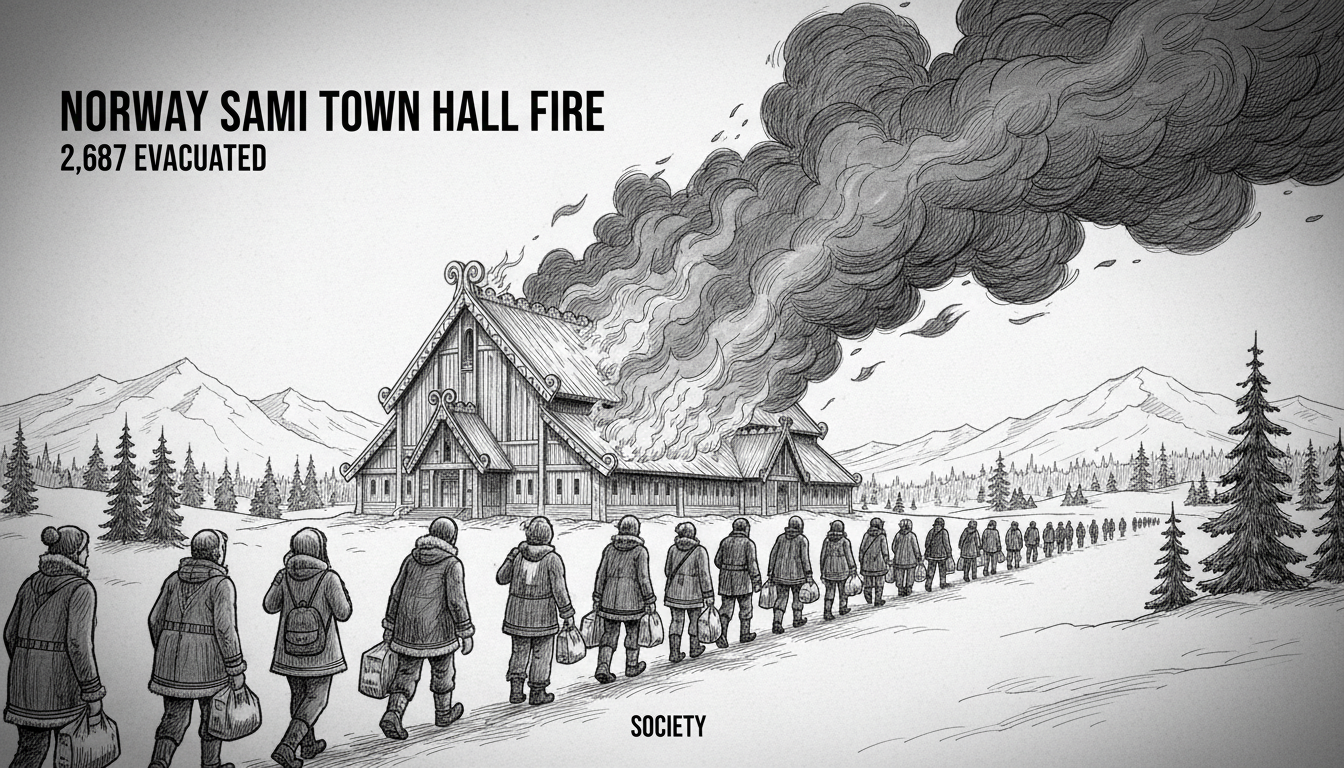
Norway's Kautokeino municipality evacuated its town hall staff Friday after a fire sparked in an electrical outlet. Police and fire services responded quickly to the blaze in the heart of the Sámi cultural region of Finnmark. No injuries were reported, but the incident highlights infrastructure vulnerabilities in remote Arctic communities.
Operational leader Øyvind Johnson Holsbrekken confirmed the fire's origin and subsequent extinguishment. "We do not know the exact cause of the fire yet," Holsbrekken said. "But it started to burn in a power outlet or similar. There are reports of a lot of smoke in the premises, so work is being done to ventilate."
The immediate response prevented structural damage to a key administrative building. All employees were safely evacuated from the rådhus, which serves a municipality spanning 9,707 square kilometers. This area makes Kautokeino Norway's largest municipality by land mass, yet it houses only 2,687 residents.
A Cultural and Administrative Hub
The Kautokeino town hall is more than an office building. It is a vital nerve center for a community where over 80% of the population speaks Sámi as a first language. Municipal services here operate officially in both Northern Sámi and Norwegian. The building's functions touch every aspect of life in this remote region, from education and healthcare to cultural preservation initiatives.
"When something happens to a central building like this, it disrupts the entire fabric of local governance," said Lars Mikkel Nilsen, a researcher specializing in Arctic municipal administration at the University of Tromsø. "In larger southern cities, services can be relocated temporarily. In Kautokeino, alternatives are extremely limited due to distance and geography."
The fire, though minor, forces a temporary halt to civic operations. This includes support for traditional Sámi livelihoods like reindeer herding and duodji handicraft production. These sectors are not just cultural cornerstones but significant parts of the local economy.
Infrastructure Challenges in the Far North
This incident directs attention to the persistent challenges of maintaining modern infrastructure in Norway's Arctic regions. Harsh climates, vast distances, and a small tax base strain municipal budgets. Electrical systems, heating, and communications networks face greater wear from extreme temperature fluctuations than their southern counterparts.
Kautokeino, like many Finnmark municipalities, operates critical infrastructure with limited personnel and financial margins. Emergency services, while professional, are often stretched thin across enormous territories. The nearest major mutual aid resources are hours away by road.
"We often discuss climate risk and geopolitical security in the Arctic," Nilsen noted. "But the day-to-day resilience of basic infrastructure is equally crucial. A faulty outlet in Oslo is a minor issue. In Kautokeino, it can paralyze local government for a community spread across an area larger than some European countries."
Investigators will examine whether the outlet fire was an isolated fault or a symptom of broader systemic aging. Many public buildings in northern Norway were constructed during the post-war reconstruction period or the 1970s-80s oil boom. Upgrading them to contemporary standards requires significant investment from small municipalities.
The Sámi Context and Cultural Resilience
The fire occurred in a region defined by Sámi culture and history. Kautokeino is a central node in Sápmi, the traditional homeland of the Sámi people spanning northern Norway, Sweden, Finland, and Russia. The neighboring municipality of Kárášjohka (Karasjok) hosts the Sámi Parliament of Norway, emphasizing the area's national cultural importance.
This context adds layers to the incident. Administrative documents, cultural records, and historical archives housed in such buildings can be irreplaceable. While there is no indication that cultural artifacts were threatened in this specific fire, it underscores the need for robust disaster planning to protect intangible heritage.
"The continuity of Sámi language administration is vital," said Maret Anne Sara, a duojár (handicraft artist) and community advocate from the region. "Our governance isn't just about bureaucracy; it's about maintaining the tools for self-determination and cultural continuity. Any threat to that physical space is felt deeply."
The community's response likely relied on tight-knit local networks. In remote areas, formal emergency response is effectively supported by informal community action—neighbors checking on neighbors, local knowledge guiding outside responders.
Looking Ahead: Resilience and Investment
The Kautokeino fire will be logged as a minor incident in national statistics. Its greater significance lies in the questions it prompts about equity and resilience. Norway's wealth, heavily derived from offshore oil and gas, is not always evenly reflected in the infrastructure of its northernmost communities.
National policy debates increasingly focus on Arctic development, military presence, and resource extraction. Analysts argue that equal attention must be paid to the foundational infrastructure that allows these communities to thrive. This includes not just roads and broadband, but the civic buildings that enable governance, culture, and daily life.
Climate change adds another dimension. A warming Arctic may alter fire risks, permafrost stability, and storm intensity, potentially increasing the strain on buildings and electrical systems. Proactive maintenance and modernization become issues of long-term sustainability, not just immediate safety.
For now, Kautokeino's municipal staff will return to a ventilated building, resuming the critical work of serving a vast, culturally unique municipality. The event serves as a quiet reminder: in the remote Arctic, the integrity of a single power outlet is connected to the resilience of an entire way of life. How Norway chooses to support that resilience will define the future of its northern regions far more than any single fire.