
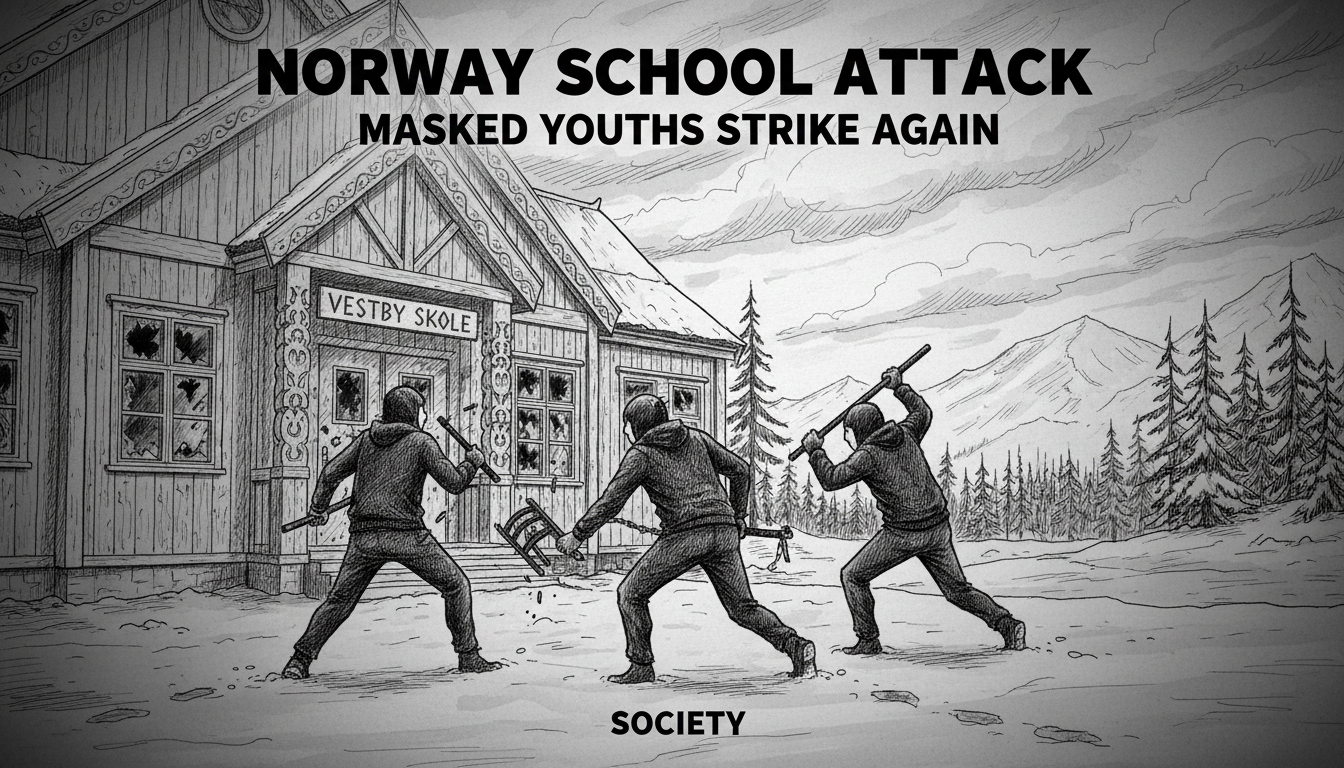
Norwegian police report a masked group of youths, accused of a violent assault at a student at Eidsvoll Upper Secondary School, have returned to the school grounds for the second time in days. The incident has reignited local fears and a national debate on youth violence in a country famed for its low crime rates. Officers were dispatched to the school after receiving reports that the individuals, whose initial aggressive behavior prompted police involvement earlier, were back on site with others. Authorities state the group is alleged to have carried out a violent act against a pupil at the school, located in the historically significant municipality where Norway's constitution was signed. The repeated targeting of a school environment has sent shockwaves through the community of Eidsvoll, a place more commonly associated with national unity than social discord.
A Community on Edge
Eidsvoll VGS is a public upper secondary school serving students aged 16-19 from the municipality and surrounding areas of Akershus county. The school offers general academic and vocational programs, representing a typical cross-section of Norwegian youth. The intrusion of violence into this setting contradicts the tranquil image of the region, known globally for the signing of the Norwegian Constitution at Eidsvoll Manor in 1814. Local parents and residents express deep concern over the safety of students and the apparent brazenness of the perpetrators. 'This is not the Eidsvoll we know,' one parent, who asked not to be named, commented outside the school gates. 'We expect our children to be safe here.' Police presence has been increased around the school as investigations continue.
Patterns and Potential Causes
While details of the assailants and the specific motives remain under investigation by police, experts on youth behavior suggest such incidents rarely have a single cause. Professor Kari Jensen, a sociologist specializing in youth studies at the University of Oslo, notes that recurring public aggression often points to deeper issues. 'When a group returns to a scene, it signals a desire for dominance or recognition within that space,' Jensen explains. 'Potential drivers can include experiences of social exclusion, unmet mental health needs, or affiliations with groups that validate confrontational behavior.' She emphasizes that school violence in Norway, while statistically low compared to many nations, has a profound impact due to its violation of trusted social institutions. Norwegian schools typically have open campuses and focus on inclusive values, making them vulnerable to external threats.
The National Context of Youth Crime
This incident at Eidsvoll VGS occurs against a backdrop of periodic national concern over youth gang activity and violence in Norway's larger urban areas. However, its occurrence in a smaller municipality highlights that these challenges are not confined to Oslo or Bergen. Norwegian police treat school disturbances with high priority when criminal activity or safety risks are involved, reflecting a zero-tolerance policy for violence in educational settings. The response typically involves a combination of law enforcement and cooperation with school social services and the Norwegian Labour and Welfare Administration (NAV). Debate often follows such events, centering on whether the approach should prioritize stricter security measures or enhanced social and psychological support programs in schools and communities.
Searching for Solutions in Eidsvoll
In the wake of the attacks, local officials face pressure to deliver both immediate security and long-term prevention. The school administration, alongside police and child welfare services, has initiated a review of safety protocols. Possible measures include improved entry point monitoring and clearer reporting systems for students who feel threatened. Simultaneously, community leaders are examining ways to strengthen youth engagement through recreational activities and mentorship programs. 'Security alone is a reactive measure,' says a local council representative involved in youth policy. 'We must also work proactively to understand why these young people feel compelled to act this way and address those root causes through available services and community support.'
A National Conversation Reignited
The events at Eidsvoll VGS have captured national media attention, prompting questions about the evolving nature of youth conflict in Norway. Commentators are discussing the balance between preserving the open, trusting nature of Norwegian society and adapting to new social realities. Some argue for increased investment in school nurses and psychologists, while others call for more visible police patrols in areas frequented by youths. The discussion extends to the role of digital media in escalating conflicts and organizing meet-ups outside school hours. This incident serves as a stark reminder that the social challenges facing young people—from isolation to online harassment—can manifest in physical violence anywhere, even in historically symbolic and peaceful towns.
Looking Ahead: Safety vs. Openness
The path forward for Eidsvoll and similar communities involves a difficult calibration. Norway prides itself on egalitarian values and accessible public institutions. Installing metal detectors or fences around schools represents a cultural shift many wish to avoid. The alternative—building stronger, more integrated support networks for vulnerable youth—requires sustained funding and community commitment. As police continue their investigation into the masked group's actions, the broader task falls to educators, social workers, and policymakers. They must collaborate on strategies that protect physical safety without eroding the sense of community that defines Norwegian schools. The ultimate test will be whether Eidsvoll can restore its sense of security while addressing the complex needs that led to this disruption. Can the town that gave birth to modern Norwegian democracy now forge a response to this threat that reflects its foundational values of unity and respect?