
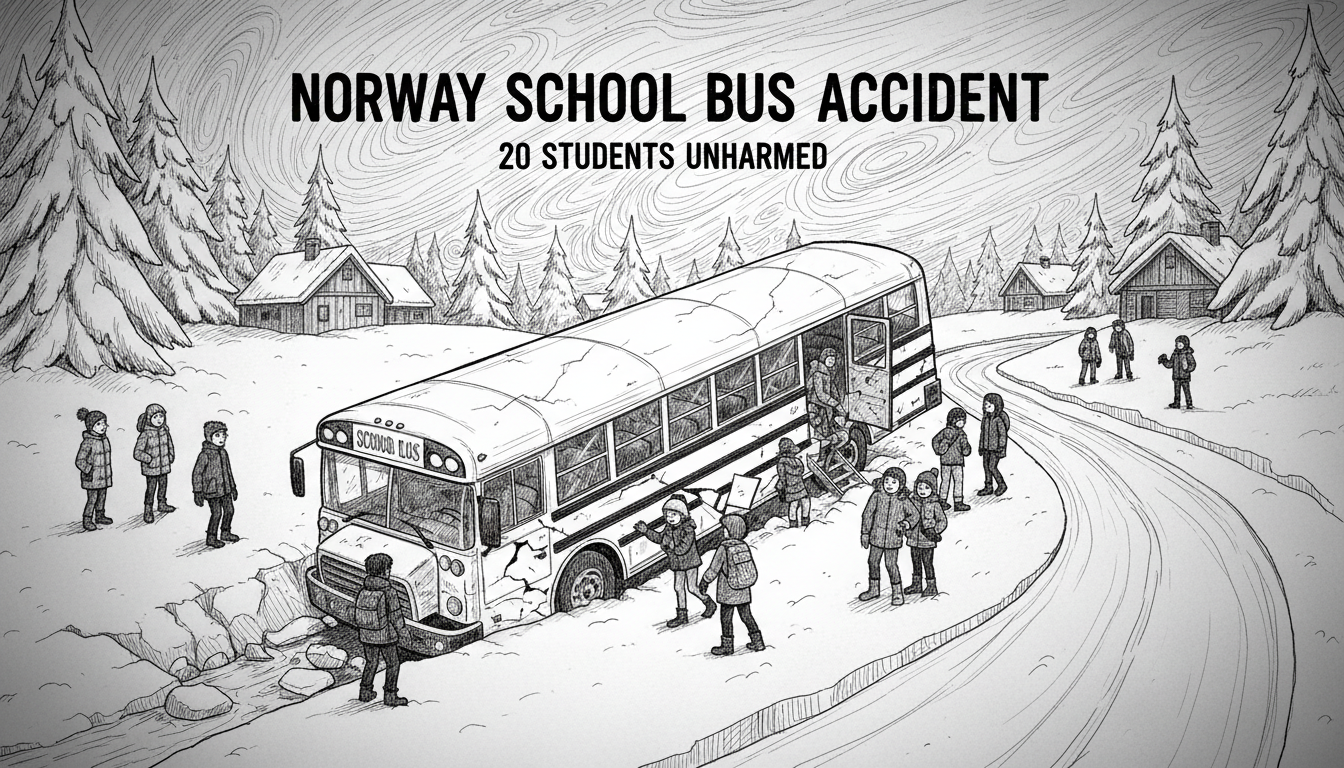
Norway school bus accident on Panoramavegen near Ulnes in Nord-Aurdal ended with a fortunate outcome. A school bus carrying between 15 and 20 students slid off the road on Tuesday morning. A separate trailer also left the roadway on the opposite side. Police confirmed no injuries resulted from the incident, which highlights the persistent winter challenges on Norway's rural routes.
Emergency services responded quickly to the scene on the mountain road. A replacement bus arrived to transport the students safely to their destination. Tow trucks were dispatched to recover the vehicles. The incident caused temporary disruptions but no serious harm, a testament to both luck and Norway's robust safety protocols.
A Narrow Escape on a Mountain Road
The accident occurred on Panoramavegen, a road known for its scenic views and, during winter, potentially hazardous conditions. The specific location near Ulnes in Nord-Aurdal municipality is in the inland county of Innlandet. This region experiences severe winter weather, with ice and snow presenting constant challenges for drivers from November through April.
Initial reports indicate slippery conditions were a likely factor. The simultaneous incidents involving two large vehicles—a school bus and a trailer—suggest a widespread loss of traction on that stretch of road. Police have not released details on potential causes but are investigating the circumstances. The absence of injuries is the most critical detail for parents and local officials.
Norway's Road Safety Record Under Scrutiny
This incident, while minor in outcome, touches a nerve in a nation obsessed with traffic safety. Norway consistently ranks among the world's safest countries for road travel. In 2022, Norway recorded 117 road fatalities, a historically low number for a population exceeding 5.4 million. The country's Vision Zero policy, aiming for no deaths or serious injuries on the roads, is a central tenet of its transportation planning.
School transportation safety is a particularly sensitive area. Norwegian law mandates strict standards for school buses, including seat belts for all passengers and rigorous driver training. The fact that this bus slid off the road without causing injury will likely lead to a review of procedures for that specific route. It also raises questions about road maintenance and the adequacy of winter preparedness on lesser-traveled regional roads.
Expert Perspective on Winter Driving Hazards
Road safety experts point to a combination of factors that can lead to such incidents. "Even with mandatory winter tires and experienced drivers, black ice and sudden changes in road surface conditions are a formidable challenge," said a traffic safety analyst with the Norwegian Public Roads Administration. "Mountain passes and exposed roads like Panoramavegen require extreme caution, especially during early morning hours when ice is most prevalent."
The analyst emphasized that technology and infrastructure play key roles. "We invest heavily in road weather information systems and anti-skid materials, but geography means some roads will always be vulnerable. The ultimate safety measure is adaptive driving behavior—reducing speed and increasing following distance significantly when conditions deteriorate."
This near-miss serves as a seasonal reminder for all drivers. Norway's mountainous terrain and long winters create a unique set of driving conditions. Roads can transition from clear asphalt to sheer ice within meters, particularly in shadowy areas or on bridges. Professional drivers operating heavy vehicles like buses and trailers face amplified risks, as their stopping distances are longer and control is harder to regain once lost.
The Human Element: Community Response
For the families of Nord-Aurdal, the news was a scare followed by relief. Local authorities activated their standard protocol for school transport incidents. Parents were notified promptly, and the school ensured the children received appropriate support upon arrival, despite the lack of physical harm. The psychological impact of such an event on young students is not overlooked.
"The first thing we do is ensure the children are safe and calm," explained a representative from the local municipality's education department. "Then we review the incident meticulously with the transport company and the roads authority. Our goal is always prevention. Every incident, even without injury, is a learning opportunity to make the journey to school safer."
This community-level response is part of a broader Norwegian culture of safety and transparency. Incidents are investigated not to assign blame primarily, but to improve systems. The data from this event will feed into regional winter maintenance plans and potentially influence decisions about route alternatives or the timing of school bus schedules during the deepest winter months.
Infrastructure and Investment in Rural Areas
The accident spotlights the ongoing debate about infrastructure investment in Norway's rural districts. While major highways and tunnels receive significant funding, secondary roads like Panoramavegen are vital lifelines for local communities. Maintaining them to the highest safety standard year-round is a costly and complex engineering challenge.
Norway's federal and county road authorities have extensive winter service operations, but resources are finite. Prioritization is based on traffic volume, which can leave lower-traffic scenic and access roads with less frequent mechanical clearing or salting. This economic reality clashes with the safety expectations of residents who rely on these roads daily.
Some analysts argue for accelerated investment in passive safety features on such routes. This includes improved guardrails, clearer signage warning of icy patches, and more robust road-edge barriers. Others advocate for technological solutions, such as mandating advanced stability control systems and connected vehicle technologies for all commercial and school transport vehicles.
A Look at the Bigger Picture
Statistically, Norway's roads are incredibly safe. The country's fatality rate per 100,000 inhabitants is less than half the European Union average. This success is built on decades of policy: strict drunk-driving laws, extensive use of speed cameras, a graduated driver licensing system, and a continuous campaign to improve vehicle safety standards.
Yet, as this incident shows, absolute safety is an elusive goal. The elements remain a powerful and unpredictable adversary. The Nordic winter demands respect from every driver, regardless of their vehicle's size or their own experience. The Nord-Aurdal accident is a case study in how multiple safety layers—from vehicle design to driver training to emergency response—can combine to prevent a minor incident from becoming a tragedy.
The Path Forward from a Warning Sign
As the investigation concludes, the focus will shift from response to prevention. The transport company will review its driver's actions and vehicle maintenance logs. The road authority will examine the specific stretch of Panoramavegen for any particular deficiencies in drainage or surface treatment. The school will likely reiterate safety protocols to students and parents.
This process, though routine, is what maintains Norway's world-leading safety standards. It is a system that treats every incident as a signal, however faint. The ultimate question remains: in a nation that has nearly perfected road safety, what more can be done to protect children on buses traversing icy mountain passes? The answer likely lies in incremental improvements—better tires, smarter road sensors, more training—and a collective acknowledgment that the fight against winter's dangers is never truly won, only managed day by day, mile by mile.