
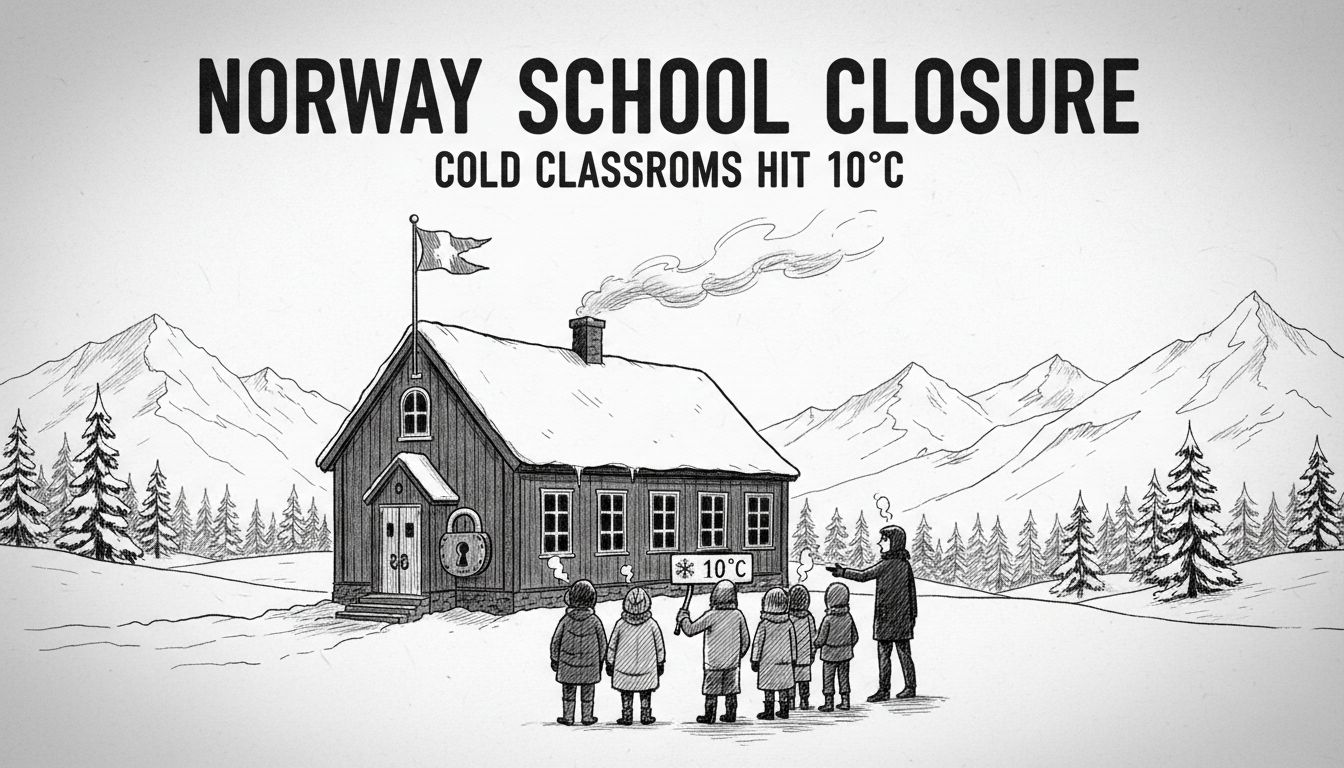
Norway school heating problems forced a secondary school in Øygarden municipality to close its doors this week. Classroom temperatures at Fjell ungdomsskole plummeted to as low as 10 degrees Celsius, prompting the school's safety representative to make the unprecedented decision to send students home. The incident highlights a growing tension between Norway's modern educational ambitions and the physical reality of its aging school infrastructure, particularly in municipalities facing budget constraints.
A Chilling Decision for Student Safety
At 10:30 AM on Wednesday, officials at Fjell ungdomsskole faced a situation they found unacceptable. With thermometers reading just 10°C (50°F) in some classrooms, the legally mandated safety representative, or verneombud, exercised their authority. They determined the environment was unfit for learning and potentially harmful to student well-being, ordering an immediate closure. This role, a cornerstone of Norway's robust workplace safety culture, carries significant weight. The representative's primary duty is to protect people from immediate risk, a responsibility that overrode the routine of the school day.
“The heat is supposed to be working, but we need to have someone look at it,” said division leader Nina Zandstra. She pointed directly to the building's age as a likely culprit. “This is an old building, so it might just be that the cold has become too much. We don’t know yet.” This admission points to a systemic issue rather than a simple mechanical failure. It suggests a building envelope—the windows, walls, and insulation—that can no longer retain heat effectively against the Nordic winter, regardless of the heating system's operation.
The Infrastructure Challenge Beneath the Surface
Norway's reputation for wealth and high living standards often overshadows the practical challenges of maintaining public infrastructure. The country's comprehensive education system, covering ages 6 to 16, is funded and administered at the municipal level. This decentralized model allows for local control but also ties school maintenance directly to the financial health and priorities of 356 individual municipalities. Øygarden, a coastal municipality west of Bergen, must balance school upkeep against other demands like roads, elderly care, and cultural services.
Older school buildings, constructed in the post-war boom years or earlier, present a particular dilemma. They were often built to different standards, with less focus on energy efficiency and long-term maintenance costs. Retrofitting them with modern insulation, windows, and heating systems requires substantial upfront investment—funds that many municipalities must carefully ration. An engineer specializing in building physics, who wished to remain anonymous as they are not directly involved with the school, explained the common issue. “In older structures, you often find thermal bridges—areas where heat escapes rapidly—and single-glazed windows. When outdoor temperatures drop sharply, the heating system can’t keep up, leading to cold spots and an overall drop in ambient temperature. It becomes a losing battle.”
Health, Learning, and the Right to a Suitable Environment
The closure raises immediate questions about the impact of cold on students. Educational and public health experts stress that adequate indoor temperature is not a mere comfort issue; it is a prerequisite for effective learning and health. “A classroom at 10°C is not conducive to concentration or cognitive performance,” said Dr. Ingrid Moe, a researcher in educational environments at the University of Oslo. “Students will be focused on keeping warm, not on the lesson. Furthermore, prolonged exposure to cold can increase susceptibility to common illnesses and cause discomfort that distracts everyone.”
Norwegian regulations and guidelines for workplace environments, which cover schools, recommend a minimum temperature of 20°C for sedentary work and learning. While not an absolute legal limit for schools, the 10°C reading at Fjell ungdomsskole falls far outside this acceptable range. The incident underscores the broader principle in Norwegian law: students have a right to a safe and healthy physical learning environment. When that environment fails, the educational process itself breaks down.
A Microcosm of a National Conversation
This single school closure in Øygarden is a localized event, but it taps into a national conversation about sustainable infrastructure and equitable public services. As Norway continues to debate its green transition and the future of its oil-funded wealth, the state of its foundational public buildings—schools, hospitals, libraries—remains a critical benchmark. Are the dividends of national prosperity being adequately reinvested into the basic facilities that serve every community?
Comparative data on municipal spending on school maintenance is not centrally aggregated, making it difficult to gauge the scale of the problem nationwide. However, anecdotal reports of similar issues, from poor ventilation to inadequate heating, periodically surface in local media across the country. They often follow a pattern: an extreme weather event stresses an old building, revealing deficiencies that routine maintenance has postponed. For Fjell ungdomsskole, the cold snap was the trigger.
The Path Forward: Repair, Replace, or Reimagine?
The immediate task for Øygarden municipality is clear: diagnose and fix the heating failure at Fjell ungdomsskole. The longer-term question is more complex. Municipal leaders must decide whether repeated investments in patching up an aging structure represent value for money, or if planning for a new, energy-efficient school building is a more sustainable solution. This calculation involves construction costs, long-term energy savings, educational outcomes, and demographic projections for student numbers.
Other Norwegian municipalities have grappled with this same decision. Some have chosen ambitious renovation projects, turning old schools into modern, low-energy “passive house” standard buildings. Others, in areas with declining populations, have consolidated schools into newer, centralized facilities. The choice for Øygarden will depend on its specific financial and demographic landscape. “This closure should serve as a wake-up call for a thorough assessment of our public building stock,” said a policy analyst from the Norwegian Association of Local and Regional Authorities (KS). “Preventive maintenance and planned upgrades are always more cost-effective than emergency closures and reactive repairs.”
As students at Fjell ungdomsskole await a return to warmer classrooms, their unexpected day off serves as a cold reminder. Even in one of the world's most developed nations, the quality of everyday life is deeply rooted in the physical condition of shared public spaces. Ensuring those spaces are fit for purpose, especially in the face of a challenging climate, is a continuous and essential task—one that requires foresight, investment, and a steadfast commitment to the well-being of the youngest citizens.