
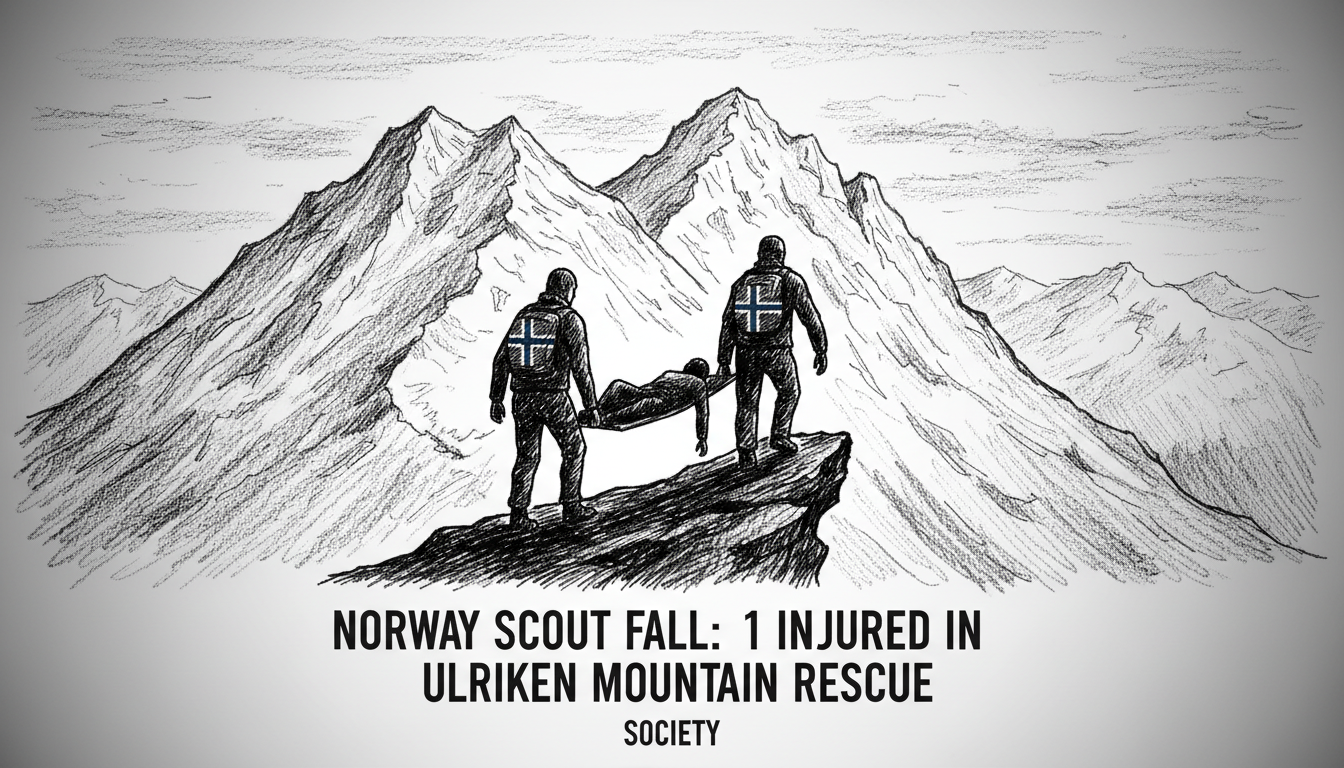
Norway hiking rescue teams airlifted one person to a major trauma center Sunday following a serious fall during a family scout trip on Bergen’s iconic Ulriken mountain. The incident, which triggered a complex air and ground operation, underscores the inherent risks of Norway’s beloved but demanding outdoor terrain.
Police Operations Manager Bjarte Rebnord confirmed the rescue in a statement Sunday afternoon. “The patient was hoisted out by helicopter and is being transported to Haukeland University Hospital,” Rebnord said. The fall occurred on a popular trail during an excursion involving scout leaders, parents, and children. A rescue helicopter and an air ambulance were dispatched to the scene shortly after police were alerted.
A Peak of Beauty and Peril
Ulriken, at 643 meters above sea level, is the highest of the seven mountains surrounding Bergen. Its accessible cable car and network of trails make it a prime destination for tourists and locals year-round. The panoramic views of the city and fjords are a major draw. Yet its steep, rocky slopes and unpredictable weather can quickly turn a routine hike hazardous. This accident adds to a history of incidents on the mountain, where slips and falls occasionally necessitate emergency responses.
Rescue operations in such terrain are logistically challenging. “Time is the critical factor in mountain medicine,” explains Lars Øyen, a former coordinator with the Norwegian Red Cross rescue service. “The goal is to stabilize the patient and get them to advanced care within the ‘golden hour.’ Using helicopters is often the only way to achieve that on steep, remote slopes.” Haukeland University Hospital, where the injured person was taken, serves as the regional trauma center for Western Norway, equipped to handle severe orthopedic and internal injuries.
The Scout Ethos and Outdoor Safety
The presence of scout leaders on the trip highlights a national cultural cornerstone. Norwegian scouting emphasizes friluftsliv, or “open-air living,” teaching children self-reliance and respect for nature from a young age. Tens of thousands of Norwegian children participate. Such trips are generally considered safe, led by trained volunteers. This incident, however, is a sobering reminder that even organized, family-oriented activities in well-traveled areas carry risk.
“Scout leaders undergo safety training, but they are not professional mountain guides,” notes Anna Larsen, an outdoor educator based in Oslo. “A moment of distraction, a loose stone, or a misplaced step can happen to anyone, regardless of experience. The group’s response—securing the area and immediately calling for professional help—is what the protocols are designed for.” The psychological impact on the children and other participants witnessing the accident is a significant concern, often requiring follow-up support.
Analysis: Balancing Access and Risk in Norwegian Nature
This accident opens a necessary discussion about risk management in a country where outdoor access is a cherished right. Norway’s allemannsretten (right to roam) allows anyone to hike and camp almost anywhere. This freedom is coupled with a principle of personal responsibility. While municipalities mark main trails, the maintenance level and safety signage can vary greatly. Ulriken’s trails are well-established but include sections with significant exposure.
Experts point to a potential gap between public perception and mountainous reality. “Many visitors, including Norwegians, may underestimate the terrain because a mountain is near a city or has a cable car,” says Øyen. “They might not have appropriate footwear or be prepared for sudden weather shifts. Education is continuous.” National campaigns like “Hold Sjel og Liv” (Keep Soul and Life) aim to promote preparedness, advising hikers to pack for unexpected overnight stays and to check avalanche and weather forecasts.
Investment in rescue services is a direct response to these ever-present risks. Volunteer organizations like Red Cross, Norwegian People's Aid, and the Norwegian Rescue Dogs work alongside the state-run Luftambulanse (air ambulance) and police helicopters. These groups train relentlessly for technical rescues on cliffs and in ravines. Their high state of readiness was demonstrated in Sunday’s swift response. The cost of such operations is substantial but is largely borne by the state, reflecting a societal consensus on the value of saving lives in the wilderness.
A Look Ahead for Hiking Safety
The immediate focus remains on the condition of the injured individual. No further details on their identity or medical status have been released, in line with Norwegian privacy regulations. The long-term implications may involve local reviews of trail safety information. Bergen’s municipality and hiking associations could reassess signage on Ulriken’s most challenging sections, perhaps adding more explicit warnings or recommending specific routes for family groups.
This incident is unlikely to deter Norwegians from their mountains. Instead, it serves as a critical, real-world case study. It reinforces the message that preparation is non-negotiable. Checking weather reports at yr.no, packing essential survival gear, and knowing one’s own limits are the foundations of safe friluftsliv. For the international tourists who flock to Norway’s dramatic landscapes, this event is a vital reminder: the beauty of the fjords and peaks is matched by their potential danger. Respect for nature must include a plan for when things go wrong. As rescue teams know all too well, their expertise is a vital backup for the personal responsibility that forms the bedrock of Norway’s outdoor culture.