
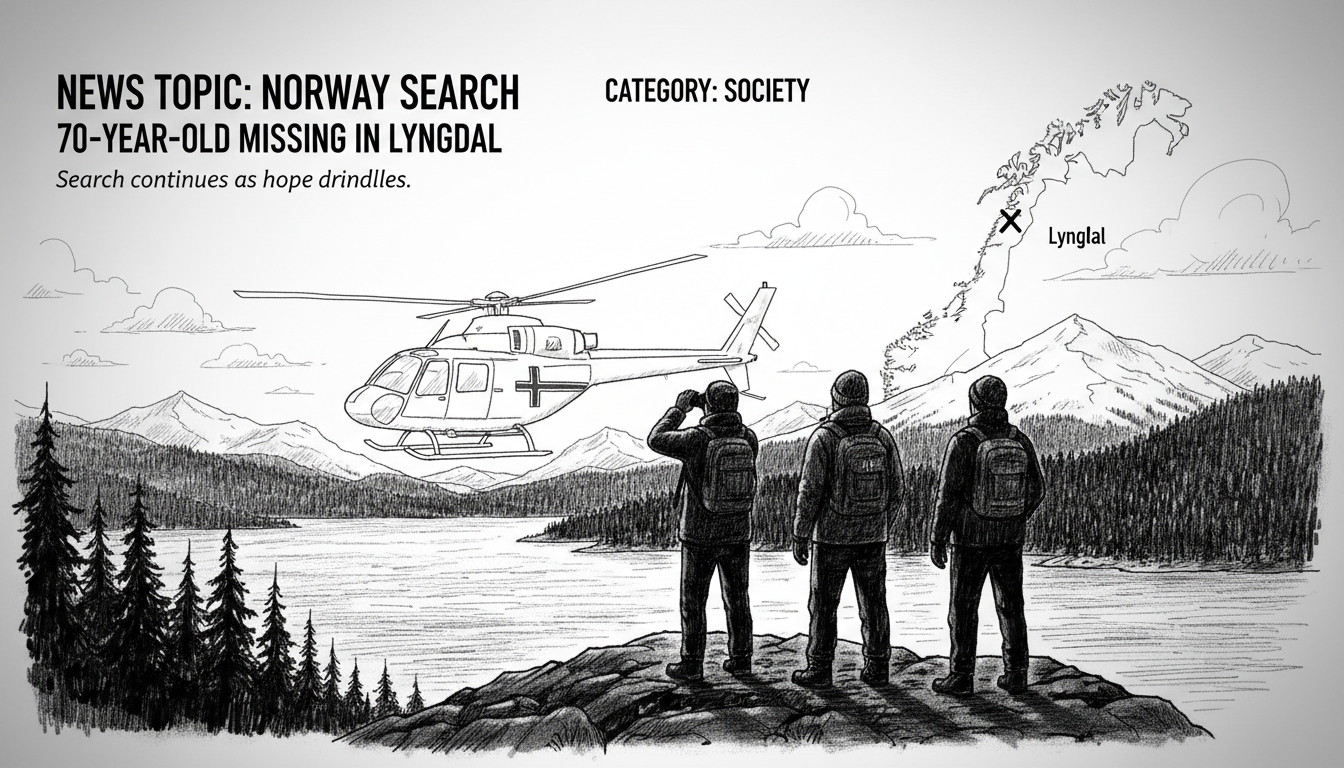
Norway's police and rescue services are conducting an extensive search for a woman in her 70s missing since Christmas Eve in Lyngdal. The operation involves police, civilian crews, dog units, and a helicopter scouring the rugged Agder county terrain in sub-zero temperatures. 'The search is mainly in the same area as before, but now in daylight. It has been below freezing and clear weather through the night,' said Operations Manager Linn Andresen of the Agder Police District on Thursday morning.
A Race Against Time and Temperature
The disappearance of the elderly woman during a holiday walk underscores the inherent risks of Norway's vast and beautiful wilderness, even close to home. Search and rescue operations in the Norwegian winter present a unique set of challenges. Clear, cold nights, while providing good visibility, bring life-threatening hypothermia conditions. The fact that the search entered a second day, with 'no findings so far' according to police, heightens concerns. Operations have been intensified with 'reinforced resources,' indicating the seriousness with which authorities are treating the case. The deployment of a helicopter is a critical asset, allowing teams to cover large, inaccessible areas of forest and rocky outcrops typical of the Lyngdal landscape.
The Machinery of Norwegian Search and Rescue
This operation is a standard demonstration of Norway's integrated search and rescue (SAR) system. While coordinated by the Agder Police District, such missions typically involve a seamless partnership between professional police and voluntary organizations. Groups like the Norwegian Red Cross and Norwegian People's Aid often provide trained civilian personnel and logistical support. In more remote or demanding cases, the Norwegian Armed Forces may contribute with additional helicopters or specialized personnel. This multi-agency approach is essential for covering the challenging Norwegian topography, where a missing person can be concealed in dense forest, deep valleys, or along a complex coastline. The use of dog teams is particularly valuable, as they can track scents over long distances and through difficult ground where human searchers might miss clues.
The Human Element in Harsh Terrain
Beyond the organizational response, every missing person case in Norway carries a profound human weight, especially during the Christmas holiday. The thought of a family awaiting news as celebrations are put on hold casts a somber shadow over the operational details. For the volunteers and professionals combing the frosty landscape, the mission is deeply personal. They are not just following a protocol; they are searching for a neighbor, a community member, whose routine walk took a tragic turn. The psychological toll on both the search teams and the family is immense, with hope diminishing slightly with each passing hour of sub-zero exposure. Community solidarity often manifests in these situations, with locals offering assistance or simply sharing information that could narrow the search area.
Analyzing the Challenges of Winter Searches
Expert analysis of such operations points to a critical factor: the first 24 hours are often the most decisive, especially in winter. The body's core temperature drops rapidly in freezing conditions, and survival becomes less likely beyond this window without adequate shelter or clothing. The 'clear weather' reported by police is a double-edged sword. It aids aerial surveillance but also means temperatures remain consistently low, with no insulating cloud cover. The terrain in municipalities like Lyngdal, while not mountainous in the extreme sense, is characterized by rolling hills, forests, and water bodies that can disorient even experienced individuals. An elderly person may have wandered off a path, suffered a fall, or experienced a medical incident, making them difficult to spot from a distance. The search strategy likely involves creating a detailed probability map based on the woman's known starting point, habits, and physical capability, then systematically eliminating sectors.
A Reflection on Safety and Preparedness
This incident serves as a somber reminder of the importance of outdoor preparedness in Norway, regardless of the season or perceived simplicity of the excursion. The Norwegian Trekking Association (DNT) consistently advises hikers to inform someone of their route and expected return time, to carry a fully charged mobile phone (though coverage can be spotty), and to dress appropriately for rapidly changing conditions. For elderly individuals, carrying a personal alarm or using a GPS tracking app can provide an extra layer of security. While the freedom to roam ('allemannsretten') is a cherished right, it comes with an inherent responsibility. Municipalities and volunteer groups frequently run safety courses, emphasizing that respect for nature includes acknowledging its dangers. The massive response launched in Lyngdal shows society's commitment to protecting its citizens, but prevention remains the most powerful tool.
The Path Forward for the Lyngdal Search
As the search continues into another day, the focus will remain on systematic, grid-based sweeps of the prioritized area. Police will evaluate any potential leads, such as possible sightings or items found. The dog units will work in concentric circles from the last known point. The helicopter, with its thermal imaging capabilities, is most effective during colder night hours when the temperature contrast between a human body and the environment is greatest, suggesting night flights will continue. The community's role may evolve from active searching to providing support for the operational base and the grieving family. The outcome of such operations is never certain, but the commitment of the Norwegian SAR apparatus is absolute. This tragic event highlights the silent contract between Norwegians and their landscape: a love for its beauty, an acceptance of its peril, and a collective promise to search for those it claims.