
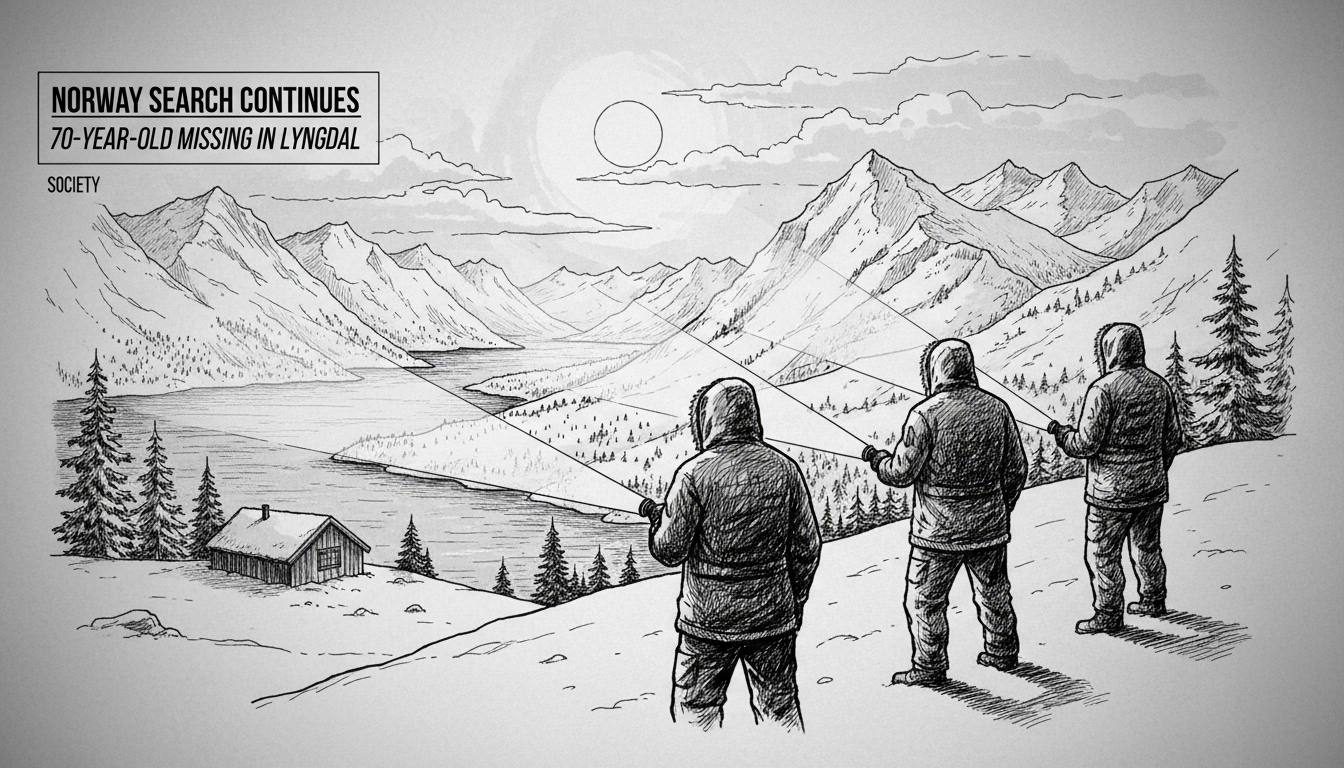
Norway's search and rescue teams continue their operation for a missing woman in her 70s who disappeared from a hiking group in Lyngdal on Christmas Eve. The Agder Police District confirmed the search resumed at first light on Friday with fresh personnel, following a night without any discoveries. The woman was reported missing just before 3 PM on December 24th after becoming separated from her companions during a walk.
A Christmas Eve Disappearance
The incident casts a shadow over the holiday period in the quiet municipality of Lyngdal, located in the traditional Lister district of Agder county. While many families gathered for festive celebrations, police and volunteer rescue organizations mobilized for a critical search operation. The terrain in the region, a mix of coastal landscapes, forests, and inland hills, presents specific challenges for searchers. Operations leader Arve Johan Myklebust stated that no findings were made overnight and that the search would continue throughout the day with new teams.
This case highlights the inherent risks of outdoor activities, even for experienced individuals in familiar settings. The woman was part of a group, a common safety practice, yet still became separated. The exact location and circumstances of her disappearance have not been publicly detailed by police, who are focusing their resources on the active search. The timing, during the short daylight hours of a Nordic winter, immediately complicated rescue efforts.
The Mechanics of a Norwegian Search
Search and rescue operations in Norway represent a unique blend of professional coordination and deep-rooted civic duty. The police hold overall command, but the operational backbone often consists of volunteer organizations like the Norwegian Red Cross, the Norwegian People's Aid, and local mountain rescue teams. These volunteers are highly trained and equipped, responding to pagers and alerts at all hours, in all weather conditions.
"The success of these operations hinges on speed, coordination, and local knowledge," explains a former search coordinator for Southern Norway, who spoke on background due to the sensitivity of the ongoing case. "The first 24 hours are absolutely critical, especially in winter. Hypothermia is a relentless threat. Teams are factoring in the individual's age, known health conditions, her familiarity with the area, and what she was wearing and carrying."
Weather is a decisive factor. Current conditions in Lyngdal, including temperature, wind, precipitation, and visibility, directly impact both the missing person's chances and the searchers' safety and effectiveness. Ground teams methodically comb likely areas, while police may deploy dog units trained in tracking. In suitable terrain and weather, helicopters with thermal imaging cameras can be deployed to cover large areas quickly.
The Human Element in the Harsh Landscape
Beyond the logistics lies a profound human story. A family's Christmas celebration has been upended by anxiety and hope. A community's holiday peace is interrupted by the sight of rescue vehicles and teams gathering. For the volunteers answering the call, it means leaving their own families during a time dedicated to togetherness.
Norway's strong tradition of dugnad—communal, voluntary work—is vividly embodied in its search and rescue culture. Thousands of Norwegians dedicate countless hours to training for precisely this type of event. They practice navigation in white-out conditions, first aid for cold injuries, and technical rope rescues. This collective preparedness is a national asset, but each activation is a sobering reminder of nature's indifference.
The age of the missing person adds another layer of concern for search managers. While many Norwegians in their 70s are exceptionally fit and active, the physiological resilience to cold and stress can be diminished. Searchers are likely operating with an acute awareness of the time pressure, knowing that exposure is a severe and escalating risk with each passing hour of a winter night.
The Broader Context of Outdoor Safety
This incident in Lyngdal occurs within a national context where friluftsliv—the love of outdoor life—is a central part of the identity. Norwegians are encouraged from a young age to explore nature, but with an equally strong emphasis on responsibility and preparedness. The Norwegian Trekking Association (DNT) promotes a simple code: be prepared, inform someone of your route, adapt your plans to your ability, and pack for changing weather.
Despite this ingrained safety culture, emergencies happen. Terrain can be deceptive, weather can change abruptly, and accidents can occur in an instant. The national emergency number, 112, receives calls year-round from distressed hikers, skiers, and boaters. The response is always the same: a swift, professional, and resource-intensive mobilization of the rescue apparatus.
This system, however, is not immune to strain. Volunteer organizations report challenges with recruitment and funding, even as the demand for their services remains high. Each major operation consumes fuel, equipment, and the personal energy of the responders. The search in Lyngdal is a real-time demonstration of this system's value and its human cost.
A Community Waits and Hopes
As the search entered its second full day, the atmosphere in Lyngdal would have been one of tense waiting. Local residents likely checked in with neighbors, offered assistance to the authorities, and looked out their windows at the passing search parties. Social media, often a tool for spreading information in such cases, would be monitored closely by both the public and the police for any potential leads.
The police's public communications in such scenarios are deliberately measured. They provide enough information to keep the public informed and to potentially jog memories—someone might recall seeing the woman or a vehicle—but they withhold specific details that are crucial to the integrity of the investigation and search. This balance between transparency and operational security is carefully managed.
For the family involved, this period is an unimaginable ordeal. The festive trappings of Christmas fade into irrelevance against the backdrop of a missing loved one. They rely on the expertise and determination of the search teams, clinging to stories of past miracles where individuals were found alive against the odds, even after days in the wilderness.
The Unforgiving Calculus of Winter
Winter in Southern Norway, while milder than in the north, is still a formidable force. Daylight is scarce, with the sun setting in the early afternoon. Temperatures hover around freezing, often combined with dampness from the coastal proximity, which can lead to a penetrating cold that standard clothing may not withstand for long. Rain or wet snow can soak a person in minutes, drastically accelerating heat loss.
Search planners use this environmental data to model "survivability" and to prioritize search sectors. They calculate how far a disoriented person might travel. They consider natural shelters like overhangs, cabins, or sheds. They look for deviations from the planned route. Every decision is a calculated guess informed by experience, statistics, and the scant available evidence.
The fact that the woman was last seen with a group is both a advantage and a puzzle for searchers. It provides a clear last known point, but it also raises questions about how quickly separation occurred and why it wasn't immediately noticed. The hiking group members themselves are key witnesses, likely having been interviewed extensively to provide clues about her state of mind, clothing, equipment, and intended direction.
Looking Ahead: The Path Forward
The continuation of the search into Friday signals the authorities' commitment to the operation. Police do not lightly sustain such resource-intensive efforts without reasonable hope. The deployment of new teams at first light indicates a shift into a sustained search pattern, possibly expanding the geographical area under scrutiny.
Possible next steps could include a more targeted appeal to the public for information, a review of local traffic or security camera footage, or the deployment of specialized resources like drones or additional canine units. The search may also begin to transition from a rescue operation to a recovery one, a grim but realistic possibility that authorities must plan for as time passes.
Regardless of the outcome, this event will leave a mark on the Lyngdal community. It serves as a stark, personal reminder of the respect nature demands, even on a routine Christmas Eve walk. It also showcases the silent contract that binds Norwegian society: a network of trained volunteers stands ready, at any moment, to answer a call for help from a stranger in the wilderness. As the light fades on another short winter day, that network remains at work, searching for one of their own.