
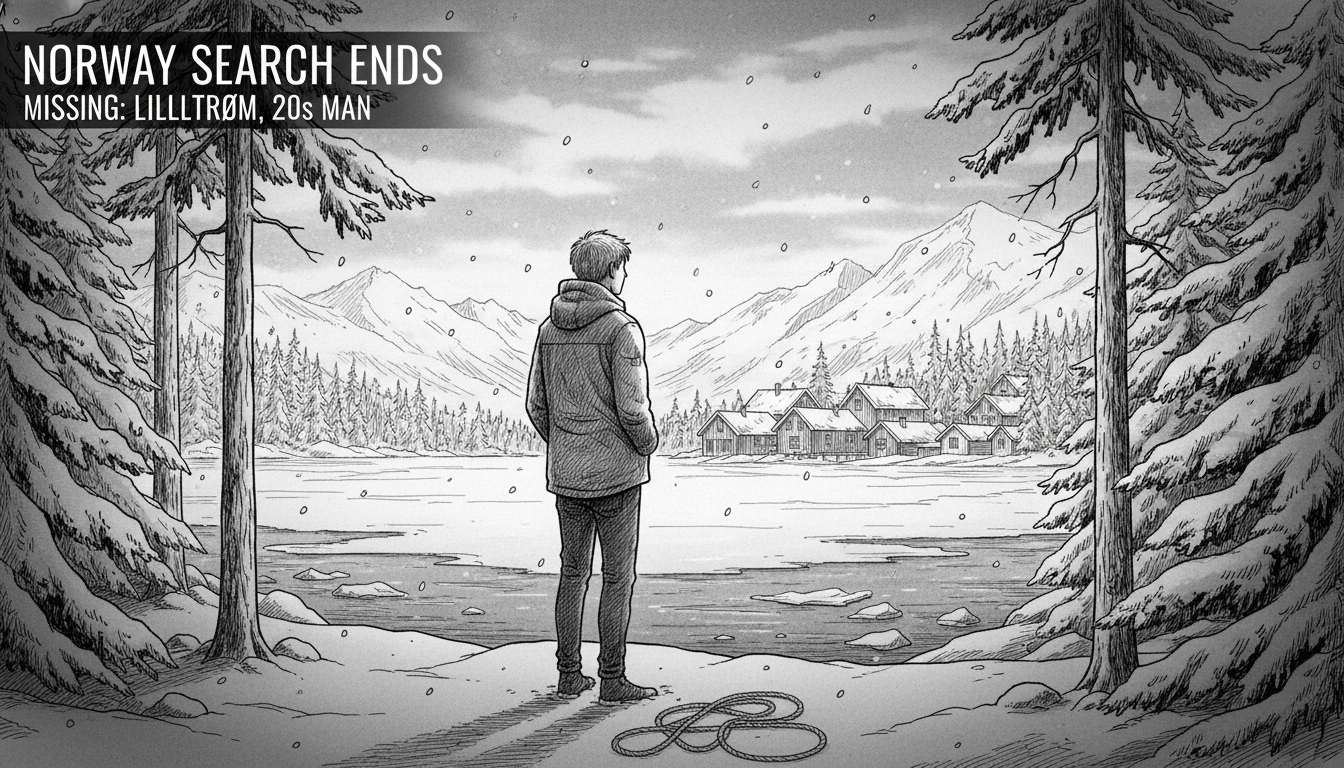
Norway's search and rescue operation for a missing man in his twenties has concluded without success. The man was last seen on Thursday evening in the Strømmen area of Lillestrøm, a municipality just northeast of Oslo. After a multi-day effort involving helicopters and riverboats, authorities have suspended the active search.
"In consultation with the Joint Rescue Coordination Centre, the operational rescue operation is concluded," said operations manager Andreas Paulsen of the East Police District. "Relevant search areas have been combed without result. The person is still missing and police want tips if anyone has information relevant to the case."
The decision marks a somber transition from a rescue mission to a missing persons investigation. It underscores the difficult calculations authorities must make when a search yields no trace.
A Coordinated Search Along the Nitelva
The search began in earnest from Friday night into Saturday. Emergency services, coordinated by Norway's national Joint Rescue Coordination Centre, focused their efforts on the Strømmen area and the adjacent Nitelva river. This waterway flows through the heart of Lillestrøm before joining the larger Glomma river.
On Saturday, the operation intensified. Two helicopters circled the region, providing an aerial overview of the terrain. By evening, a fleet of boats was deployed to search both on and in the Nitelva. The use of multiple assets—air, water, and ground teams—reflects standard procedure for a high-priority missing person case in Norway, where terrain can be challenging.
Lillestrøm, part of the densely populated Viken county, is a mix of urban centers, residential neighborhoods, and natural landscapes. The Nitelva river, while not large, presents specific search challenges with its currents and wooded banks.
The Difficult Decision to Stand Down
The conclusion of an active search is never taken lightly. It represents a critical juncture where resource allocation, statistical survival probabilities, and operational risk are weighed. Police have not disclosed the specific circumstances leading to the man's disappearance, which is common practice in ongoing investigations.
"The decision to scale down a search is based on a continuous assessment," explains a former rescue coordinator who wished to remain anonymous due to not being directly involved in this case. "You map the last known position, consider the individual's profile, the weather, and the environment. After covering the high-probability areas multiple times with appropriate resources, continuing a large-scale operation becomes less effective."
In Norway, the police assume responsibility for the case once the rescue coordination centre steps back. The investigation continues through other means: reviewing CCTV footage, conducting interviews, and following up on public tips. Police have released a photograph of the missing man and continue to appeal for information from the public.
Norway's Search and Rescue Infrastructure
This case highlights the robust but often strained system Norway has for finding missing people. The Joint Rescue Coordination Centre (Hovedredningssentralen) in Southern Norway (SRCC) and Northern Norway (NRCC) oversees major operations. They coordinate assets from the Norwegian Armed Forces, the Norwegian Society for Sea Rescue (RS), and numerous volunteer organizations.
These volunteer groups are the backbone of land searches. Organizations like the Norwegian Red Cross, Norwegian People's Aid, and local mountain rescue teams provide thousands of person-hours. Their involvement allows for extensive ground coverage that would be prohibitively expensive for state agencies alone.
However, even this well-developed system faces limits. Prolonged searches drain volunteer enthusiasm and tie up critical emergency resources. The shift from a rescue phase to an investigative one is a structured, though painful, part of the process.
The Human Impact and Community Response
Behind the operational details lies a human tragedy for the missing man's family and friends. The uncertainty following a suspended search is particularly agonizing. Community groups and neighbors in Lillestrøm and the wider Romerike region often mobilize in such situations, sharing information on social media and keeping eyes open.
Local police districts now bear the responsibility for the investigative follow-up. This involves meticulous work: re-interviewing those who last saw the individual, examining financial transactions or phone records if applicable, and systematically ruling out possibilities. It is a slower, less visible process than the dramatic search with helicopters and boats.
What Happens Next in the Investigation
With the active field search concluded, the case file remains open. The East Police District will assign investigators to pursue all leads. Public tips remain crucial; often, a single piece of information from a community member can provide a new direction.
Authorities may decide to conduct limited, targeted searches in the future if new evidence emerges. The geography of the area, particularly the river system, means that discoveries can sometimes be made weeks or even months later, far from the original search zone.
The case also enters the national missing persons registry. Norway maintains a centralized database, helping to ensure that cases are not forgotten and can be revisited if new technologies or methods become available.
For now, the people of Lillestrøm are left with an unresolved absence. The quiet river, the searched woods, and the everyday life of the town continue, marked by the unanswered question of what happened to a young man on a Thursday evening. The hope for resolution now rests with careful police work and the vigilance of the community.