
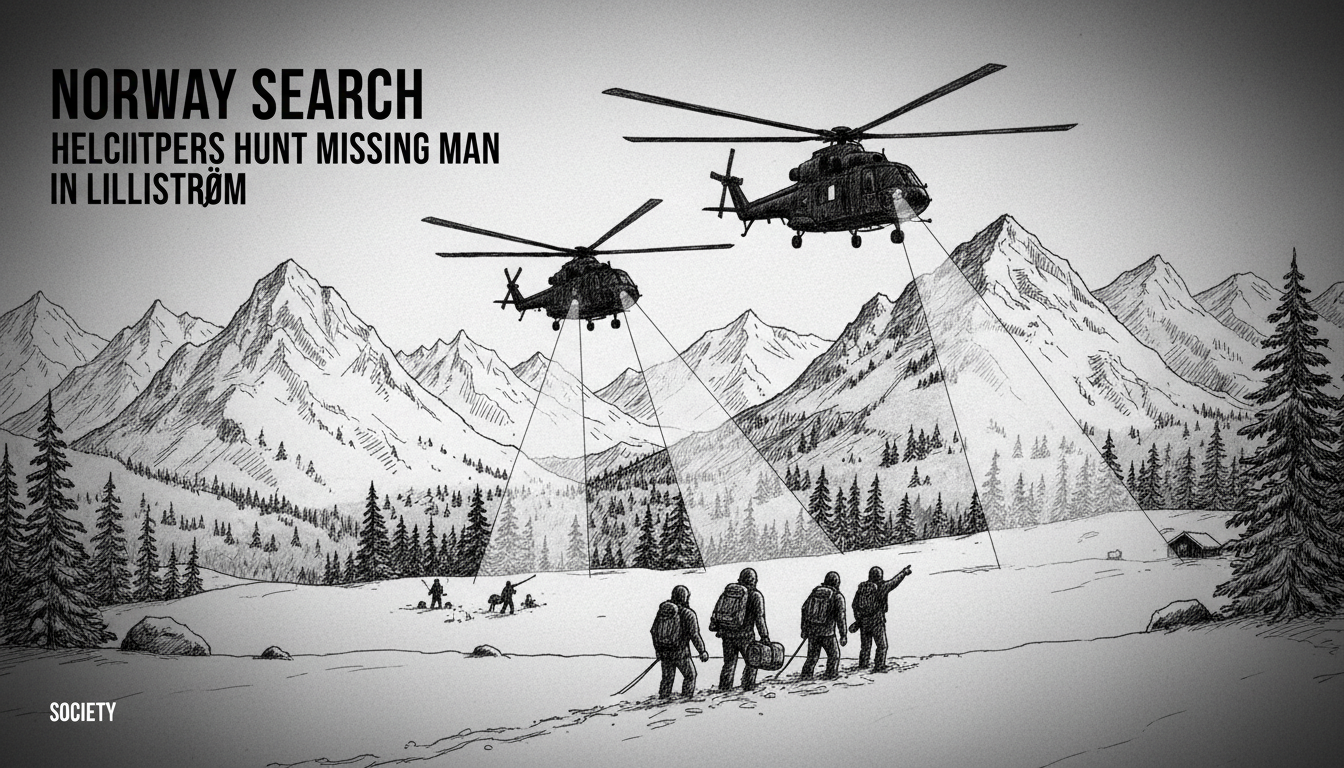
Norway's police have launched a major search operation for a missing man in his twenties in Lillestrøm, deploying helicopters and boats along the Nitelva river. The man was last seen in the Strømmen area on Thursday evening, with the intensive search involving emergency services and volunteer organizations commencing in the early hours of Saturday.
Two helicopters circled the area on Saturday, scanning the terrain from above. By Saturday evening, a fleet of boats combed the waters of the Nitelva, which flows through the heart of the municipality just northeast of Oslo. Police have released a photograph of the missing man and are appealing to the public for information.
“We have called in a number of volunteers,” said police operations leader Are Francisco Sørlie. “We are getting help from several volunteer organizations that have specialist expertise and equipment that we do not have.” He confirmed the fire service is also assisting to enable a thorough search of the targeted area. Police state all hypotheses remain open regarding the man's disappearance.
A Coordinated Response on Land and Water
The scale of the operation underscores the seriousness with which Norwegian authorities treat missing persons cases. The deployment of aerial assets so early in the search indicates a need to cover large or difficult terrain quickly. The Nitelva river, a central feature of Lillestrøm, presents specific challenges; its currents and depth require specialized equipment and knowledge to search effectively.
This is where Norway’s unique civil defense model comes into play. The police rarely operate alone in such scenarios. They act as the lead agency, coordinating a network of resources. The fire service provides technical rescue capabilities, while volunteer organizations bring critical mass and niche skills. Groups like the Norwegian Red Cross Search and Rescue Corps and Norwegian People's Aid are routinely mobilized. These volunteers are often locally based, trained in wilderness first aid, navigation, and water rescue, making them invaluable for sustained operations.
“The integration of volunteer organizations is not an ad-hoc measure; it’s a formal, drilled part of Norway’s emergency preparedness,” explains Lars Holen, a former emergency response coordinator. “These groups have equipment—from sonar for river searches to thermal drones—that supplements police resources. They allow the search to continue at an intensive level beyond what the police could manage alone.”
The Strategic Importance of Lillestrøm's Geography
Understanding the search area is key to grasping the operation's complexity. Lillestrøm is not a remote wilderness; it is a densely populated suburban municipality in Viken county, part of the greater Oslo metropolitan area. Created in 2020 from the merger of Fet, Skedsmo, and Sørum, it blends urban centers, residential neighborhoods, and natural waterways.
The missing man was last seen in Strømmen, a town within Lillestrøm that historically grew around the river and railways. The Nitelva river is thus not a remote waterway but an integral part of the urban landscape, running past homes, parks, and industrial areas. This complicates the search. A river in a populated area can be accessed from many points, and its banks may show signs of activity unrelated to the disappearance.
Search teams must therefore balance a focused, resource-intensive river search with broader ground efforts in the surrounding urban and semi-urban environment. The helicopters provide a crucial overview, potentially spotting anomalies over a wide radius that ground teams cannot see. The simultaneous use of boats suggests investigators have reason to believe the river is a area of high probability, though police maintain they are exploring all possibilities.
The Human Element in a Digital Age
Despite advanced technology, the human element remains paramount. The police’s decision to release the man’s photograph on Saturday evening is a standard but critical step. It transforms the search from a purely operational endeavor into a community effort. Residents in Lillestrøm, Strømmen, and neighboring areas become additional eyes, potentially recalling a fleeting sighting or piece of information that automated systems would miss.
This community engagement is a cornerstone of Norwegian search protocol. In a country with vast forests, mountains, and a long coastline, public assistance has historically been essential. Even in a suburban setting like Lillestrøm, the principle holds. A shopkeeper, a cyclist on a river path, or a person looking out their window may hold the key piece of information that directs the entire operation.
The psychological toll of such an event on the missing man’s family and friends is immense. The uncertainty, stretching from Thursday evening through the weekend, is a brutal ordeal. Norwegian support systems, including crisis psychologists and victim support organizations, are typically made available to families in such situations, working alongside the investigative and search teams.
What Comes Next in the Search Operation
As the search continues, the operational tactics will evolve. Initial wide-area scans by air and water will give way to more targeted actions based on findings or the lack thereof. If nothing is found in the primary search zone, the geographical parameters may be expanded significantly. Police may begin more detailed forensic work, such as reviewing CCTV footage from the Strømmen area from Thursday night, a time-consuming but vital process.
The involvement of volunteer organizations allows for a persistent search effort. Police units may need to rotate out for rest and other duties, but trained volunteers can maintain a presence, conducting systematic grid searches along riverbanks or in nearby wooded areas. This persistence is often what leads to a resolution, whether the outcome is hopeful or tragic.
The open-ended nature of the investigation, with police explicitly stating all hypotheses are open, is standard but important. It means they are not exclusively focused on a single scenario, such as an accident. They will also be conducting parallel, less visible lines of inquiry into the man’s personal life, recent activities, and contacts. This dual-track approach—high-visibility search and low-visibility investigation—is standard procedure.
A Reflection on Safety and Preparedness
This incident, happening in a seemingly ordinary Norwegian suburb, is a stark reminder that emergencies are not confined to the country’s famous wilderness. It tests the integrated response system in an urban-rural interface. The effectiveness of the coordination between police, fire services, and volunteers in Lillestrøm will be closely analyzed by emergency preparedness experts afterward.
For the international observer, it showcases a model where state resources and civil society are deeply intertwined for public safety. The sight of helicopters and boats in a coordinated search is a powerful manifestation of this system in action. The hope of everyone involved—from the police operations leader to the volunteer in a boat—is that this massive mobilization will bring answers and closure swiftly.
The coming hours are critical. The search along the Nitelva river continues under the watchful eyes of a concerned community, all waiting for a break in the case that will explain the disappearance of a young man last seen on an ordinary Thursday evening.