
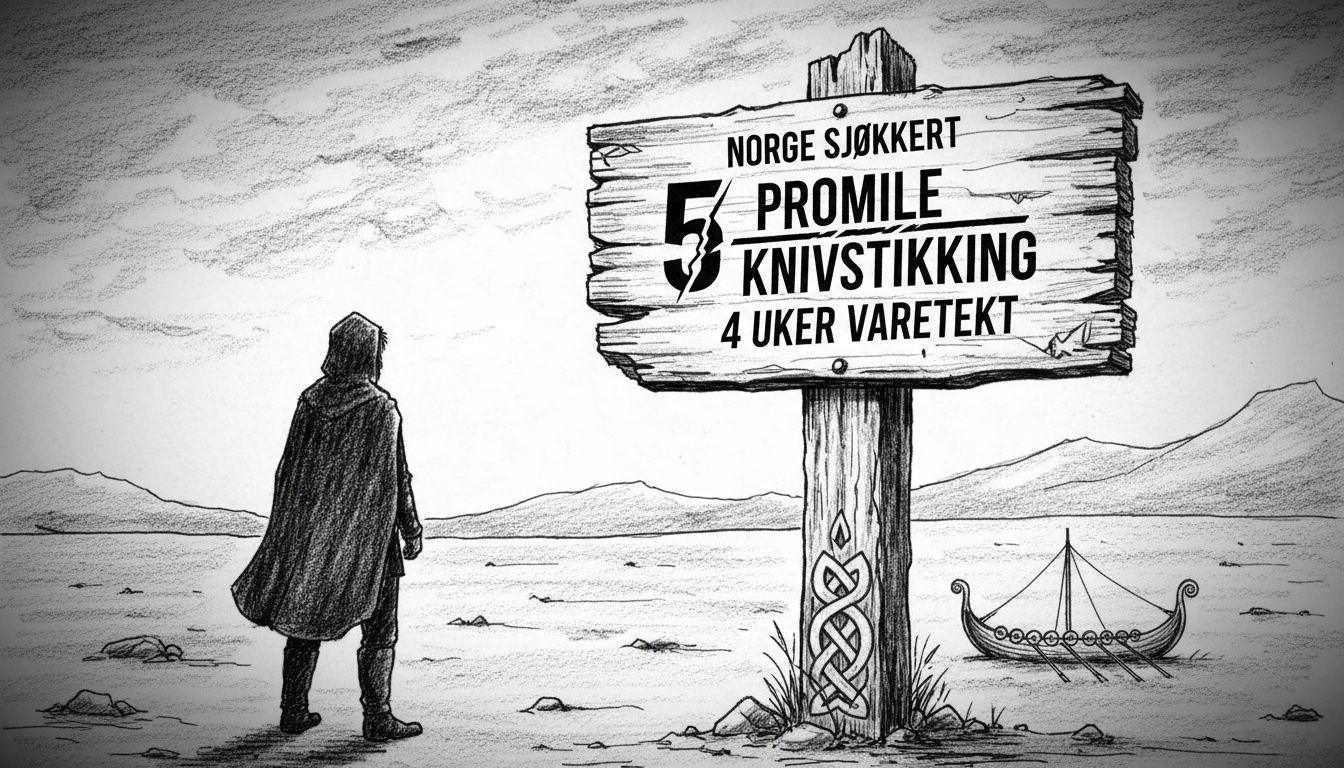
Norway's strict alcohol culture faces a shocking test after a man in Trondheim was arrested with a potential blood alcohol level of 5 promille during an alleged stabbing. Police have detained the man in his 40s for four weeks following a violent incident at his apartment in the Byåsen neighborhood. The case, involving a woman found with stab wounds in his bathroom, presents an extreme outlier in a nation with low violent crime and some of the world's toughest drunk driving laws.
An Unfathomable Level of Intoxication
The reported blood alcohol concentration of 5 promille is not just high—it is medically astonishing. Norway's legal limit for driving is 0.2 promille, a threshold 25 times lower. A level of 5 promille represents a degree of intoxication that toxicologists associate with severe risk of coma, respiratory failure, and death. For context, many medical resources list 4.0 promille as a commonly fatal dose. The fact the suspect was reportedly conscious and mobile enough to allegedly commit an act of violence at such a level is, according to experts, highly unusual and points to extreme tolerance built over years.
“This is an almost incomprehensible figure,” said Dr. Erik Larsen, a forensic toxicologist consulted for this article. “At 5 promille, the central nervous system is profoundly depressed. Most individuals would be unconscious or in a life-threatening medical crisis. It suggests not only massive consumption but potentially a long-standing pattern of extreme alcohol abuse.” The physiological reality makes the alleged violent act even more perplexing, raising immediate questions about the suspect's mental state and history.
A Violent Breach in a Quiet Neighborhood
The incident unfolded in Byåsen, a typically quiet, residential area of Trondheim known for its family homes and views of the Trondheimsfjord. Police were called to the man's apartment on Saturday, where they discovered a woman with cut and stab wounds, notably on her leg. Officers found her in the bathroom. Preliminary investigations suggest a knife was used. The woman received medical treatment, and the suspect was swiftly apprehended.
Violent crimes of this nature are statistically rare in Norway. The country consistently ranks among the nations with the lowest homicide rates globally. Incidents involving extreme alcohol levels and serious violence inside a private residence are particularly jarring to the public consciousness. They disrupt the prevailing sense of security and order that characterizes Norwegian society.
Legal Ramifications and the Intoxication Defense
The suspect's extreme level of intoxication now becomes a central element of the legal proceedings. Norwegian law operates on the principle of actus reus and mens rea—a guilty act and a guilty mind. While voluntary intoxication is generally not a defense to a crime, it can, in some circumstances, influence the assessment of intent, which is crucial for sentencing.
“The court will have to determine what, if any, intent can be established when a person is in such a profound state of intoxication,” explained legal scholar Ingrid Moe. “It does not absolve responsibility, but it may affect whether the act is classified as premeditated or as a less severe form of violence. The custody decision indicates the police and court view it as a very serious allegation, requiring the suspect be held while the investigation continues.” The four-week custody order is a preventive measure, indicating the court believes the man poses a flight risk or could interfere with evidence.
Norway's Complicated Relationship with Alcohol
This case strikes at the heart of Norway's regulated alcohol culture. Alcohol sales are controlled through the state monopoly, Vinmonopolet, with high prices and restricted hours. Public drunkenness is socially frowned upon. The drunk driving limit of 0.2 promille is so strict that a single drink can put a driver over the legal edge. This creates a societal framework where extreme, dangerous binge drinking is often hidden behind closed doors, in private homes, rather than in public venues.
“We have a paradox,” said sociologist Kari Nilsen, who studies substance use in the Nordic welfare state. “We have very successful policies limiting casual consumption and drunk driving. But for those who develop severe alcohol dependence, the stigma and the control can sometimes drive the problem underground. A case like this is a tragic, extreme symptom of that hidden side. It’s not a failure of the policy per se, but a reminder that addiction exists even in societies with strong controls.”
A Community Reckoning and the Path Ahead
In Trondheim, the reaction is one of shock and sober reflection. The violence and the staggering level of intoxication reported do not align with the community's self-image. The case will likely prompt discussions about support systems for severe alcoholism and whether the health service's focus on treatment and harm reduction is reaching those in the deepest crisis.
The police investigation continues, with forensic teams likely corroborating the exact blood alcohol level through medical tests. The victim's recovery and the full details of the relationship between the individuals involved are yet to be publicly disclosed. For now, the case stands as a grim anomaly: a burst of extreme violence fueled by a level of intoxication that defies belief, set against the backdrop of one of the world's most orderly societies.
It forces a difficult question. How does a society built on control, rationality, and social trust respond when confronted with an act born of such profound loss of control? The answer will unfold not just in the Trondheim District Court, but in the quiet conversations across a nation wondering if its famed social contract has a hidden, vulnerable clause.