
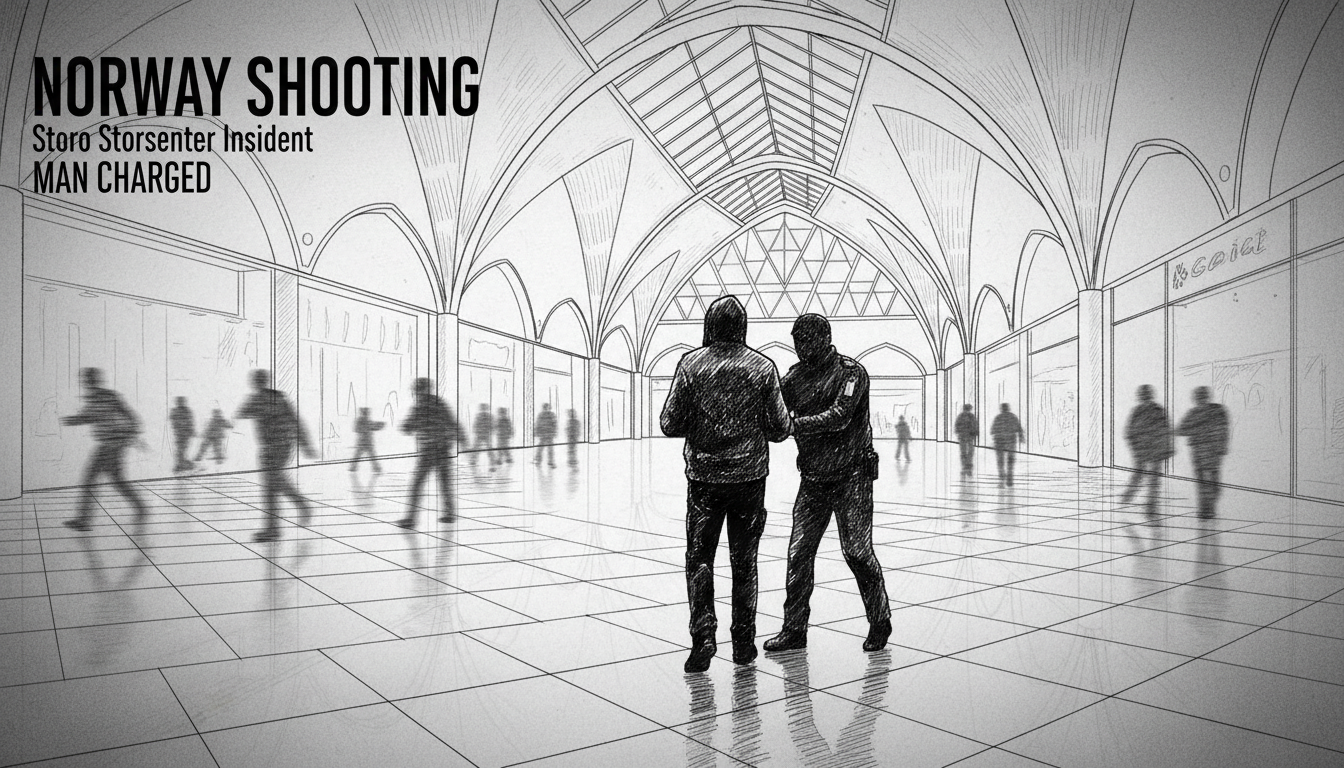
Norway gun laws face a new test after a young man was charged with gross illegal handling of a firearm following a shooting at Oslo's Storo Storsenter shopping center. Police apprehended the suspect at the scene on Tuesday. No injuries were reported, but the incident has sent shockwaves through a nation where public gun violence remains exceptionally rare.
A Swift Police Response at a Busy Hub
Officers from the Oslo Police District's criminal watch unit responded immediately to reports of a firearm discharge at the large shopping complex in the city's Nordre Aker district. The suspect, whose identity has not been released, was detained on-site without further incident. The charge of 'grov ulovlig befatning med skytevåpen' indicates prosecutors believe the possession or handling of the weapon was particularly serious or aggravated.
Storo Storsenter, a major retail and transportation hub, was temporarily secured as police conducted their investigation. Shoppers and employees were evacuated from affected areas. The quick containment prevented physical harm, but the psychological impact of a shooting in such a commonplace setting is significant.
"An event like this in a crowded shopping center naturally creates fear and concern," said security analyst Kari Fossum. "The immediate and effective police response is crucial, but it also forces us to examine the security environment in spaces we consider safe."
The Stark Contrast of Norway's Gun Reality
This incident stands in sharp contrast to Norway's overall statistics and cultural relationship with firearms. According to data from Statistics Norway, there were 32 firearm-related homicides in the entire country in 2022. In a nation of 5.5 million people, that figure underscores how uncommon lethal gun violence is.
Norway's firearm legislation is among the strictest in Europe. Ownership requires a license, which is granted only for specific purposes like hunting, sport shooting, or professional need. Applicants must pass a comprehensive background check, demonstrate a clean criminal record, and complete mandatory safety training. The process is administered by the police and is intentionally rigorous.
"The legal framework is designed to prevent firearms from falling into the wrong hands," explained law professor Henrik Lunde. "When an incident like Storo occurs, it almost invariably involves an illegally obtained weapon, which shifts the focus entirely to criminal enforcement and black market sources."
The Long Shadow of July 22, 2011
Any public shooting in Norway is viewed through the lens of the country's darkest modern-day tragedy. On July 22, 2011, right-wing extremist Anders Behring Breivik killed 77 people, most of them teenagers at a summer camp on Utøya island, using a legally obtained firearm and explosives.
That atrocity led to a comprehensive review of Norway's gun laws. Reforms implemented in 2018 further tightened restrictions, particularly on semi-automatic weapons. The trauma of that day remains a powerful societal force, making any public gun incident a trigger for collective anxiety.
"The memory of 2011 means our tolerance for any public firearm incident is zero," said political commentator Arne Jensen. "What might be a minor police report in another capital is a front-page story in Oslo. It reactivates a national conversation about safety, legality, and prevention."
Navigating the Path of Illegal Weapons
The central question for investigators will be the origin of the firearm used at Storo. The illegal weapons market in Norway is small but persistent. Sources typically include weapons smuggled from abroad, often from Eastern Europe, or older firearms that were never properly registered or were modified.
Police have dedicated units focused on disrupting these networks. The penalty for gross illegal possession of a firearm can be imprisonment for up to six years, reflecting the seriousness with which the justice system treats such crimes.
"The threshold for what constitutes 'gross' illegal handling is high," said prosecutor Eva Larsen, who is not directly involved in this case. "It involves factors like the type of weapon, the circumstances of its use, and the intent of the possessor. The charge suggests the prosecution believes they have evidence of a severe violation."
Security in Public Spaces: A Recurring Debate
The shooting at a major shopping center inevitably renews debate about security in soft-target locations. Storo Storsenter, like most Norwegian malls, relies on a combination of private security personnel, camera surveillance, and general public vigilance. It does not feature airport-style metal detectors or armed guards.
There is a conscious balance in Norway between implementing effective security measures and maintaining the open, trusting nature of public life. Incidents like this pressure that balance.
"We must be careful not to design our society based on single, rare events," said Fossum, the security analyst. "The goal is intelligent security that disrupts potential threats without turning every public space into a fortress. The effectiveness of the police response at Storo suggests the current protocols can work."
A Legal Process Underway
The suspect will now undergo formal questioning. The police have not suggested a motive, and it remains unclear whether the firearm was discharged intentionally or accidentally. The investigation will meticulously reconstruct the event, examine the weapon, and trace its history.
Under Norwegian law, the suspect is presumed innocent until proven guilty in a court of law. The prosecution will bear the burden of proving the charges beyond a reasonable doubt. Given the seriousness of the charge, a trial in the Oslo District Court is likely unless a plea agreement is reached.
The Broader Implications for a Peaceful Society
While statistically rare, this event highlights a challenging reality. Even the most comprehensive gun control laws cannot completely eliminate the risk of illegal weapons appearing in public. Norway's model focuses heavily on prevention through strict licensing, but its success ultimately depends on effective policing and border control to combat the black market.
The incident also demonstrates the high state of readiness within the Oslo Police District. Their ability to apprehend a suspect at the scene without injury is a testament to training and protocol. It will be cited as a case study in effective response.
For ordinary Norwegians, the shooting is an unsettling reminder that absolute safety is an illusion, even in one of the world's most peaceful nations. It breaches the social contract of trust that underpins daily life. The fact that no one was physically injured will be a source of profound relief, but the symbolic violence of the act resonates deeply.
As the legal process unfolds, the conversation will continue. It will touch on criminal networks, youth interventions, police resources, and the enduring task of safeguarding public spaces. Norway's commitment to a society free from gun violence remains unwavering, but each incident, however minor in outcome, is a call to reinforce that commitment. The true test is not just in the laws written, but in the vigilance maintained every day.