
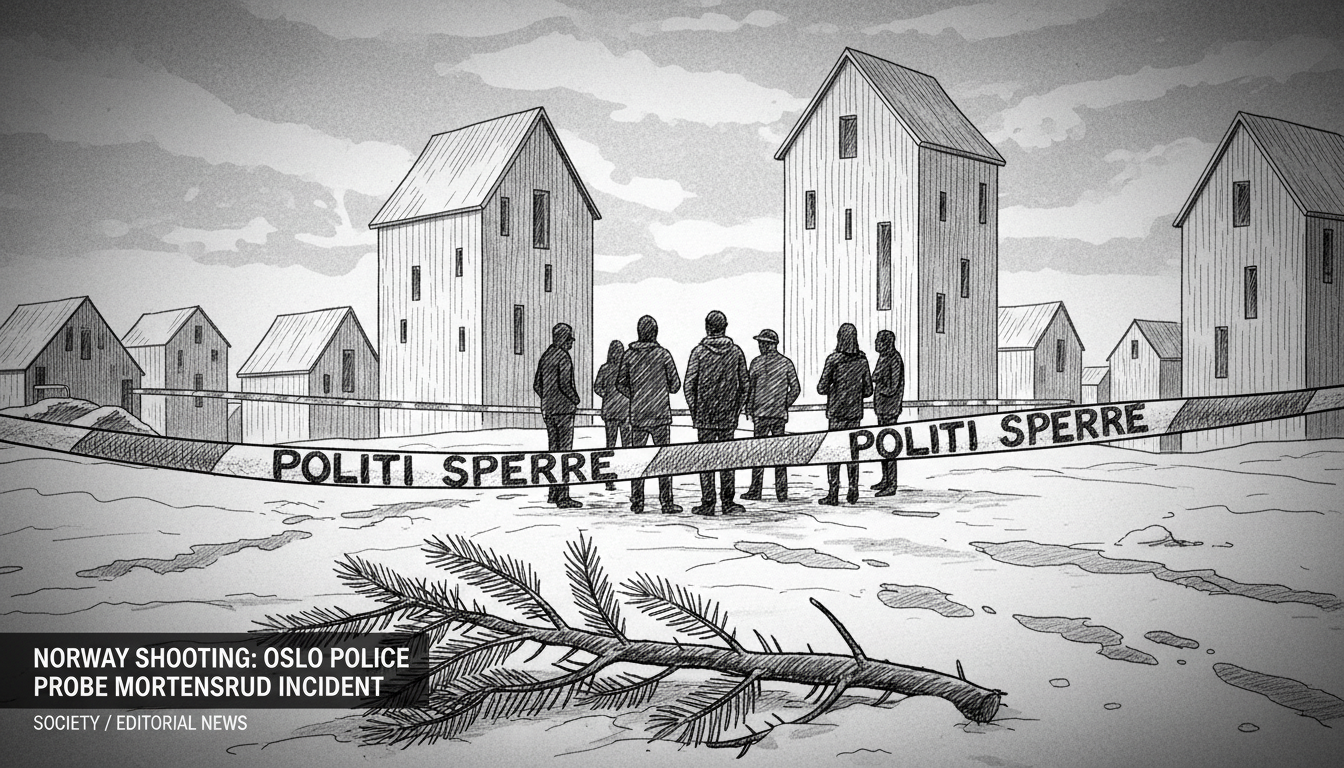
Norway police are investigating a shooting at a residential address in Oslo's Mortensrud district that prompted a major emergency response. Officers were called to the scene at approximately 11:30 PM on Sunday night following reports of gunfire directed at a home. By 6:15 AM Monday, police had concluded their initial on-site forensic work. "The situation out there is now almost back to normal," police attorney Andreas Kolstad said in a statement at that time. He confirmed the investigation is ongoing, with a focus on collecting video surveillance footage from the area.
The incident, while details remain sparse, has drawn attention to the rare but serious nature of gun crime in the Norwegian capital. Oslo, a city of nearly 700,000, maintains a low rate of violent crime by global standards. Yet any shooting triggers a significant and swift police mobilization, as seen with the deployment of "large resources" to Mortensrud. The residential neighborhood in Oslo's southeastern borough is typically quiet, making the late-night gunfire a jarring event for local residents.
A Swift Police Response and Ongoing Investigation
Police have not released information on potential motives, suspects, or whether anyone was injured in the shooting. The primary update from authorities confirms the transition from an active scene investigation to a broader evidence-gathering phase. "We have finished the investigations at Mortensrud," Kolstad stated. "We will continue working to obtain video surveillance." This methodical approach is standard in Norwegian police work, emphasizing thorough evidence collection even after securing a scene.
The timing of the incident—late on a Sunday night—and its location at a private dwelling raise immediate questions for investigators. Was the property targeted specifically, or was the shooting more random? The police's immediate pivot to video evidence suggests they are looking to trace vehicle movements or identify individuals in the vicinity around the time of the gunfire. Oslo has an extensive network of public and private surveillance cameras, which often play a critical role in solving such cases.
Norway's Strict Firearms Framework in Focus
Any shooting in Norway inevitably brings the country's stringent gun laws into the discussion. Norway has one of the highest rates of civilian firearm ownership in Europe, driven largely by hunting and sports shooting. However, access is tightly controlled through a licensing system managed by the police. Applicants must demonstrate a "valid reason" for ownership, such as hunting, sport, or collection, and self-defense is not considered a valid reason.
Prospective owners must pass a background check, complete mandatory safety training, and securely store their weapons. All firearms are registered. These controls, strengthened further after the tragic 2011 Utøya attack, are designed to prevent firearms from falling into the wrong hands and to minimize gun-related violence. The majority of illegal firearms in Norway are believed to be smuggled into the country from elsewhere in Europe.
"The Norwegian system is designed for prevention," said Dr. Ingrid Moe, a criminologist at the University of Oslo who studies comparative firearm policy. "It creates significant barriers to legal ownership for anyone with criminal intent. When shootings occur, they frequently involve illegally held weapons, which presents a different enforcement challenge for police." She notes that while no system can eliminate risk entirely, Norway's framework contributes to its position as a country with very low rates of gun homicide compared to most OECD nations.
Mortensrud and the Pattern of Oslo Violence
Mortensrud is a modern suburb developed from the 1990s onwards, characterized by apartment blocks, townhouses, and green spaces. It is not an area typically associated with high crime. Isolated incidents of serious violence, however, can occur in any part of the city. Oslo's police district logs incidents ranging from gang-related conflicts to domestic disputes, though the use of firearms remains relatively uncommon.
In recent years, police and researchers have tracked a concerning trend of increased violence among young men in urban areas, sometimes linked to gang activity or personal conflicts that escalate. These incidents often involve knives or, less frequently, illegal firearms. A shooting at a private home suggests a targeted action, which aligns more with a personal dispute or a targeted threat than with indiscriminate violence.
"Each incident must be investigated on its own merits," a senior Oslo police officer, who spoke on condition of anonymity as the investigation is active, told Nordics Today. "Our immediate priorities are always to secure the scene, ensure public safety, and identify those responsible. The fact that this happened at a home makes it a serious violation of personal security for those living there."
The Community Impact and Next Steps
For residents of Mortensrud, the sound of gunfire and the sight of a large police presence are profoundly unsettling events. Such incidents shatter the perceived safety of a neighborhood. While police indicated the area had returned to "almost normal" by morning, the psychological impact on witnesses and nearby residents can linger long after the police tape is removed.
Local community watch groups and housing associations often become more active in the wake of such events, coordinating with police on neighborhood safety measures. The police district's community liaison officers typically increase their visibility and engagement following serious incidents to address public concerns and gather any additional information residents might have.
The investigation's progression now depends heavily on forensic analysis and digital evidence. Ballistics from the scene, if any projectiles or casings were recovered, can provide crucial information about the weapon used. The video surveillance collection Kolstad mentioned is a painstaking process that involves requesting footage from public transit cameras, municipal systems, and private homeowners or businesses, then reviewing hours of material for relevant clues.
A Broader Look at Security in the Nordic Capital
This shooting occurs against a backdrop of ongoing national discussions about police resources, gang activity, and social integration in Oslo's diverse suburbs. The city's police force is perennially balancing its resources across preventive patrols, community engagement, and reactive investigations. A major incident like the Mortensrud shooting can strain available personnel, diverting attention from other duties.
Politically, any spike in violence leads to calls from opposition parties for tougher sentencing or more police on the streets. The governing coalition, led by Prime Minister Jonas Gahr Støre, typically emphasizes a dual approach of robust law enforcement combined with social programs aimed at preventing youth from turning to crime. The Ministry of Justice and Public Security monitors all serious violent incidents closely, though it is too early for any ministerial comment on this specific case.
Norway's overall crime statistics continue to show a safe society. The likelihood of being exposed to violent crime is low. However, as criminologist Moe points out, "Statistics are cold comfort to the community directly affected. The Norwegian expectation of safety is very high, so when it is breached, the public reaction is strong and the police pressure to solve the case is intense."
As Monday progresses, residents of Mortensrud and the wider Oslo public will await further updates. The critical questions—Who fired the shots? Why was this home targeted? Was anyone hurt?—remain unanswered. The Oslo Police District's next public statement will be scrutinized for any indication of a threat to the wider public or evidence of a targeted conflict.
The true test of the system now lies in the meticulous, often slow, work of investigation. Can the police piece together the events from digital trails and physical evidence? The outcome will not only determine potential prosecutions but will also influence the sense of security in a quiet Oslo neighborhood that found itself unexpectedly in the news for all the wrong reasons.