
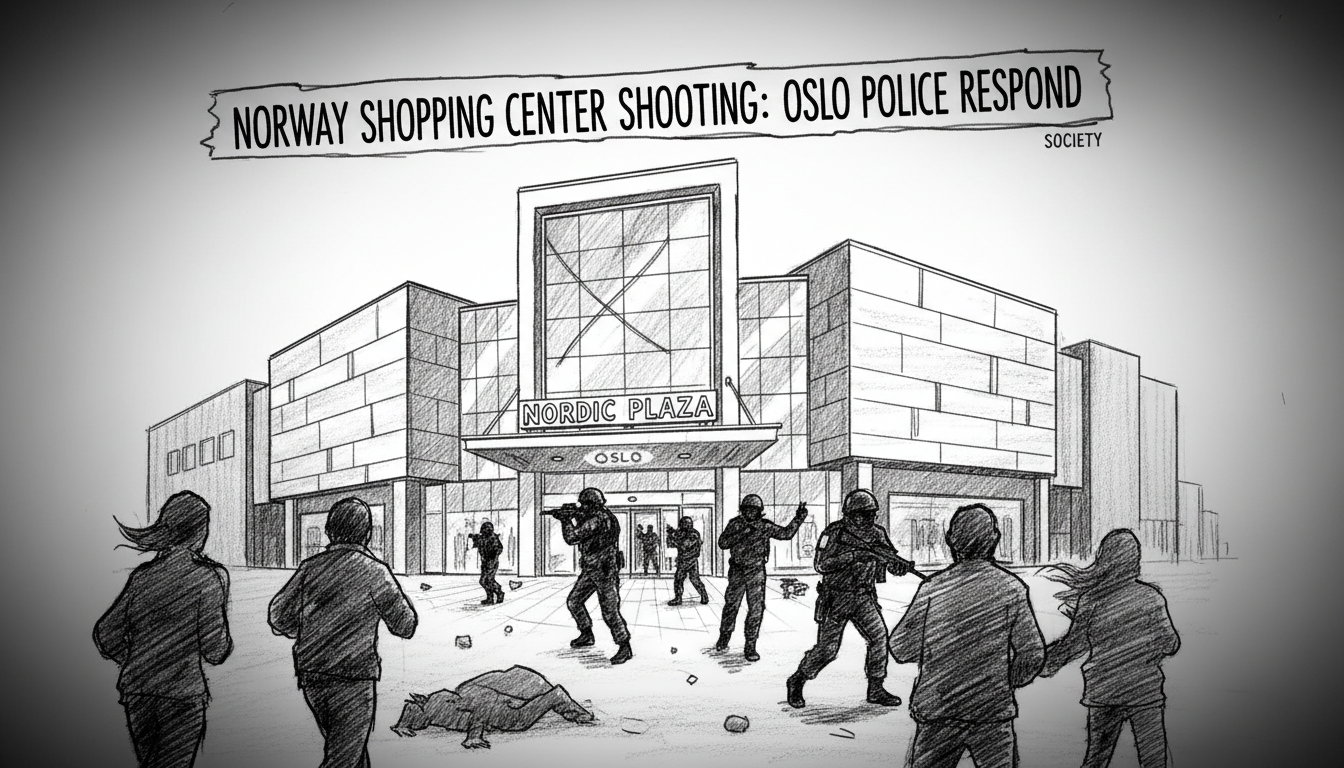
Norway's strict gun control framework was tested Monday when a young man fired a shotgun inside Oslo's Storo Storsenter shopping center. The incident, a rare public discharge of a firearm in the country, triggered a swift and professional police response that contained the situation within minutes, according to the center's operations manager who was first on the scene.
"I heard the bang first, and understood immediately that something was wrong," Tore Paulsen told reporters. Paulsen, the driftssjef for Storo Storsenter, was the first to arrive at the location where the individual discharged the weapon. He declined to provide detailed descriptions of the scene, citing the ongoing police investigation, but praised the authorities' rapid deployment. "I don't know exactly, just talk about minutes. They responded very quickly and took control of the situation in a very professional manner," Paulsen said.
The event sent shockwaves through the bustling commercial hub in the Storo district of Oslo, a city unaccustomed to such public gun violence. While details about the suspect's motives or whether anyone was injured remain under investigation by the Oslo Police District, the mere sound of a gunshot in a crowded public space represents a profound breach of the everyday peace Norwegians expect.
A Nation's Reflex to Gunfire
For Norwegians, the sound of gunfire in a public place carries a unique and traumatic resonance. The 2011 attacks by Anders Behring Breivik, who killed 77 people, fundamentally altered the national psyche regarding security and violence. While Monday's incident at Storo Storsenter appears to be on a vastly different scale, the immediate public and institutional response is conditioned by that collective memory. The efficiency of the police reaction described by Paulsen reflects a law enforcement apparatus that has trained extensively for rapid-response scenarios since the July 22nd tragedy.
"The protocol for an active shooter or a firearm incident in a public space is something Norwegian police drill for constantly," said security analyst Kari Nordseth, who studies police response tactics. "The goal is containment and neutralization within the shortest possible timeframe to prevent escalation. The description from the scene suggests that protocol was effectively activated." The quick containment likely prevented a panic from spreading further through the large shopping complex, which houses dozens of stores and restaurants frequented by families.
The Context of Norwegian Gun Laws
This incident immediately raises questions about firearm access in a country with some of the world's most restrictive gun laws. Norway's firearm regulations are centered on the principle of "need to own." Citizens must apply for a license, which typically requires membership in a shooting club for sport or demonstrating a need for hunting. All firearms must be registered with the police. Shotguns, like the one reportedly used in this incident, fall under these regulations when they have a barrel length above a certain limit.
"The legal barriers to owning a firearm in Norway are significant," explained legal scholar Henrik Lunde. "It is a privilege, not a right. Background checks are thorough, and storage requirements are strict. An event like this inevitably leads to an examination of how the weapon was obtained, stored, and potentially transported to a public place." The investigation will scrutinize whether the firearm was legally owned and, if so, how it was diverted to this use. Illegal weapons, while present, represent a small fraction of the firearms in the country compared to many other nations.
Statistics from the Norwegian Bureau for the Investigation of Police Affairs show that gun homicides are exceptionally rare in Norway, typically numbering in the single digits annually in a population of over 5.4 million. The vast majority of firearms deaths are suicides or domestic incidents, not public mass shootings. This context makes the Storo Storsenter event a statistical anomaly, which contributes to its shocking nature.
Community Impact and the Path Forward
The psychological impact on direct witnesses and the broader community is a primary concern for local health services. Even without mass casualties, the sudden violence can induce acute stress and anxiety. Oslo's municipal health services (OSS) have systems in place to offer crisis support following traumatic events, often deploying psychological first aid teams to assist those affected.
"For employees and shoppers, the sense of safety in a familiar, everyday environment like a shopping center has been violated," said Dr. Eva Moe, a clinical psychologist specializing in trauma. "It's important to acknowledge that fear and anxiety are normal reactions. The focus now should be on restoring a sense of security through clear information from authorities and available support." Storo Storsenter's management will face the task of reassuring tenants and customers that the center is safe, a process that extends beyond the police declaring the scene secure.
From a policy perspective, the incident is unlikely to trigger a major legislative overhaul, given the existing strict laws. Instead, it may fuel ongoing debates about police visibility, the monitoring of legal gun owners, and the challenges of intercepting illegal weapons. Some politicians may call for increased police patrols in large public venues, while others will emphasize the importance of social and mental health services as preventive tools.
A Test of Protocol and Resilience
Monday's events at Storo Storsenter served as an unplanned test of Norway's public safety protocols. The initial account suggests the systems worked as designed: a civilian identified the threat, police responded with speed and precision, and the situation was contained without, based on current information, mass loss of life. This outcome stands in stark contrast to the prolonged terror of Utøya, a difference that authorities will underscore as they work to calm public nerves.
Yet, the incident leaves lingering questions. It exposes the persistent vulnerability of soft targets in any open society. It reminds citizens that while Norway's gun laws minimize risk, they cannot eliminate it entirely. The investigation's findings on the perpetrator's background and weapon source will be critical in shaping the narrative around this event—whether it is viewed as a frightening but isolated failure of an individual, or a symptom of a broader, though still small, security challenge.
For now, the shopping center will clean up, the police will continue their investigative work, and the city of Oslo will absorb another jarring, if less catastrophic, reminder of violence. The professional response managed the immediate crisis. The longer-term task of restoring unthinking confidence in a trip to the mall is a more subtle challenge, one that falls to the community itself as much as to the authorities.