
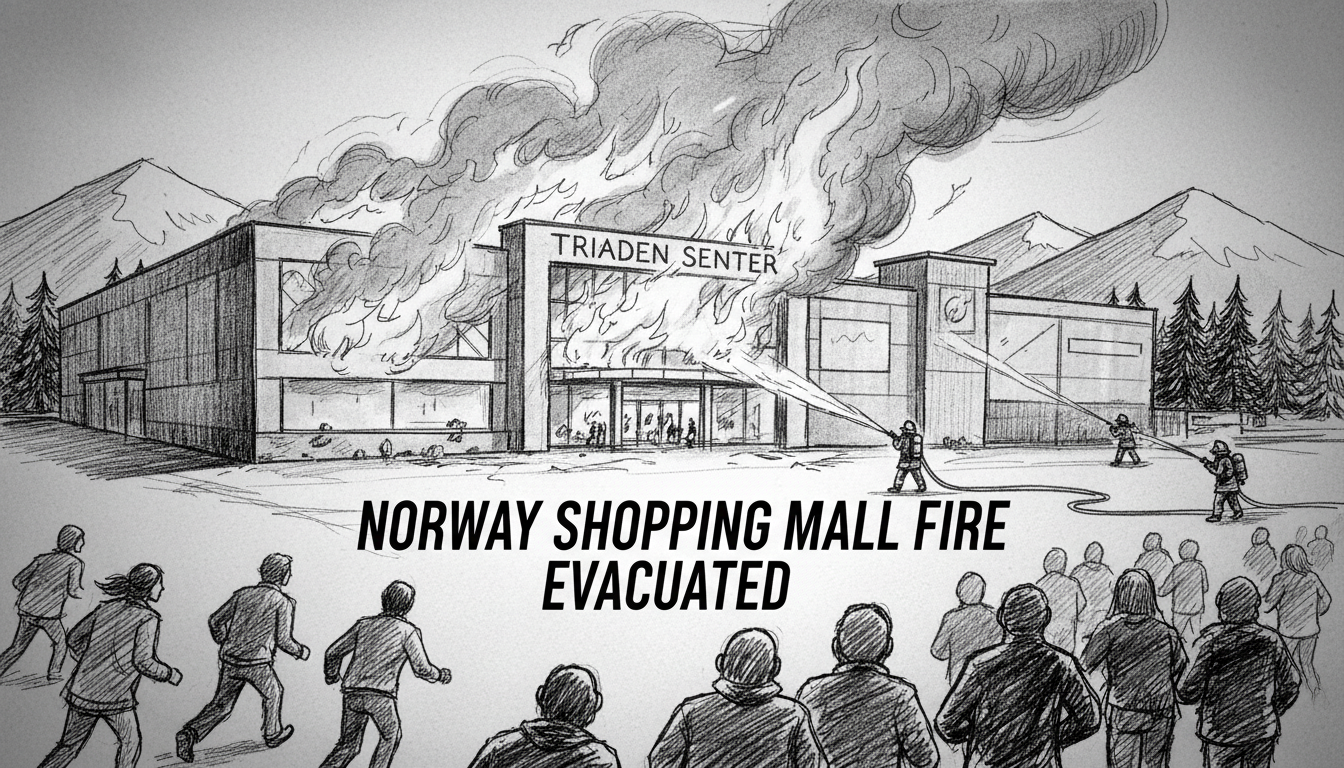
Norway shopping mall fire at the Triaden Storsenter in Lørenskog triggered a full evacuation and a major road closure on Tuesday. The blaze, which reportedly started in a single barrel, produced heavy smoke but caused no injuries. Emergency services declared the fire under control after a swift response, highlighting both the effectiveness of safety protocols and the vulnerability of suburban commercial hubs.
"The fire service reports that it burned in a barrel," said police operations leader Håkon Nilsen in a statement. "It has caused a lot of smoke. The fire is now extinguished and they report preliminary control." The incident led to the immediate closure of Skårersletta, a critical traffic artery connecting Lørenskog to Oslo and the eastern suburbs. This disruption underscored the center's role in daily regional logistics.
A Suburban Hub Disrupted
Triaden Storsenter is more than a collection of shops. It serves as a community focal point in Lørenskog, a municipality experiencing steady population growth. The center's location near Skårersletta makes it easily accessible but also places it at the heart of local traffic flows. When the full fire alarm sounded, the emergency plan activated instantly. Shoppers and employees evacuated themselves, a process observed and confirmed by police.
This self-evacuation points to effective public awareness and clear alarm systems. "Several have evacuated themselves," Nilsen noted. The absence of injuries is the primary success story from this incident. It suggests that routine fire drills and visible safety instructions within the mall functioned as intended. For fire safety experts, this outcome validates the Norwegian emphasis on building code compliance and public preparedness.
The Anatomy of a Contained Crisis
Initial reports described visible flames and significant smoke. Later updates clarified that only heavy smoke remained, with no open flames visible by the time of the final assessment. This sequence is typical for fires involving combustible materials in a confined space like a barrel. The smoke generation often outlasts the visible flame, creating a high-visibility, alarming situation that necessitates a full emergency response.
Police and fire services coordinated to secure the perimeter. Closing Skårersletta was a precautionary measure to ensure emergency vehicle access and public safety. It also prevented traffic congestion from hampering the operation. The decision, while causing temporary inconvenience, reflects a standard protocol for incidents near major roads. Traffic management experts stress that such swift closures, followed by efficient reopening, are key to minimizing overall regional disruption.
Fire Safety in the Norwegian Commercial Landscape
Norwegian building regulations for commercial centers like Triaden are stringent. They mandate automated alarm systems, sprinkler installations in many areas, and clearly marked evacuation routes. Tuesday's event acted as an unannounced live test of these systems. The fact that the alarm triggered correctly and people evacuated orderly indicates a well-maintained safety infrastructure.
However, the fire's alleged origin—a single barrel—raises questions about exterior storage and waste management protocols for shopping centers. Experts often highlight that fire risks in service areas and loading docks require as much attention as those inside the building. A thorough investigation will likely examine where the barrel was located, what it contained, and how it ignited. This will inform future guidelines for mall operators nationwide.
Economic and Community Ripple Effects
While the physical damage appears limited, a fire at a central mall has immediate economic consequences. Stores lose hours of business, perishable goods can be compromised by smoke or refrigeration failure, and employee schedules are disrupted. For a center like Triaden, which serves a local community, the event also creates a temporary void in daily life. It is a place for shopping, meetings, and errands.
The quick containment and reopening prevent these ripple effects from amplifying. Business continuity relies on the speed of the emergency response and the resilience of the building's systems. Mall management will now focus on damage assessment, cleaning any smoke-affected areas, and restoring full customer confidence. They must also cooperate with fire authorities to determine the cause and prevent recurrence.
A Model Response Under Scrutiny
The Lørenskog emergency services' response aligns with Norway's integrated crisis management model. Police handled traffic and public order, the fire service attacked the blaze, and a clear line of communication was maintained through the operations leader. This inter-agency coordination is drilled regularly and is designed for exactly this type of incident—a potentially dangerous situation that is brought under control before it escalates.
Yet, even successful operations warrant review. Investigators will piece together the timeline from the first alarm to the declaration of control. They will evaluate response times, the appropriateness of the resources deployed, and the effectiveness of on-site command. The goal is not to assign blame but to refine protocols. Lessons learned in Lørenskog can be applied to similar commercial centers in Bærum, Trondheim, or Bergen.
The Road Ahead for Triaden
Normalcy will return swiftly to Skårersletta and the Triaden Storsenter. The traffic will flow again, and shoppers will return. But the incident leaves a mark. It serves as a stark reminder that fire risk is ever-present, even in modern, regulated environments. For the mall's tenants, it may prompt internal reviews of their own staff training and stock security.
For the community, it is a testament to the professionals who manage public safety. The real story here is not one of catastrophe, but of a system functioning as designed. A localized threat was identified, contained, and neutralized with minimal collateral damage. In an era where news is often dominated by systemic failure, this event in a Norwegian suburb is a case study in quiet, effective crisis resolution. The question now is what the investigation into that single barrel will reveal about preventing the next small fire before it starts.