
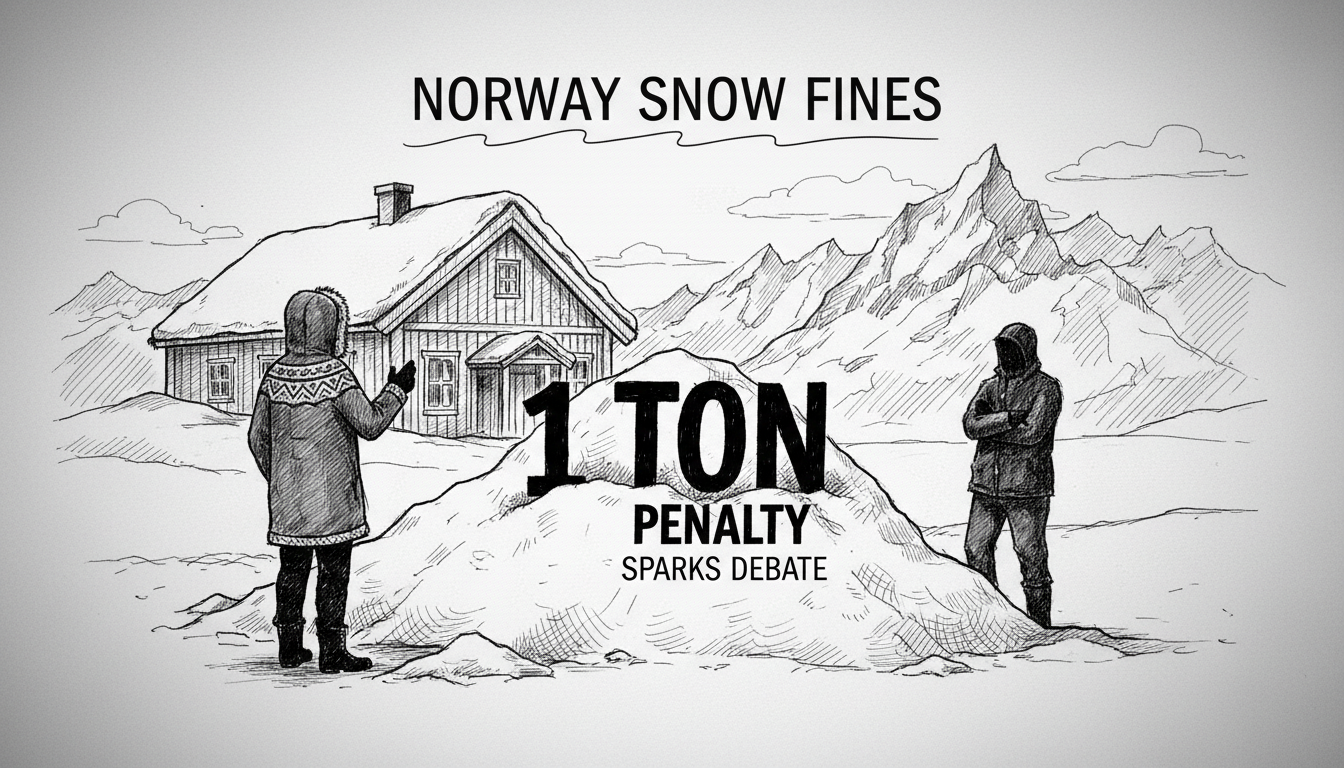
Norway winter driving laws faced a real-world test this week when a truck driver in Trondheim received a fine for carrying one ton of unsecured snow on his vehicle. The incident, which required police assistance after the driver became agitated, highlights the strict enforcement of regulations designed to prevent ice and snow from becoming dangerous projectiles on Norwegian roads. Statens vegvesen, the national road authority, ordered the vehicle immobilized until the hazardous load was removed, underscoring a zero-tolerance approach that is both praised for safety and criticized for being overly rigid.
A Routine Check Turns Confrontational
The confrontation occurred during a routine roadside inspection conducted by Statens vegvesen controllers on Tuesday evening. Officers from the Trøndelag police district were called to assist after the truck driver reacted strongly to being fined. Under Norwegian law, drivers bear full responsibility for ensuring their vehicles are clear of snow and ice that could detach and strike other road users. The truck was prohibited from moving until the driver cleared the estimated 1,000 kilograms of accumulated snow from its trailer. This enforcement action is not an isolated case but part of a systematic safety campaign. In 2023 alone, Statens vegvesen performed over 30,000 roadside checks targeting heavy goods vehicles for various violations, including unsecured loads.
The Physics and Peril of a Flying Load
Road safety experts explain the significant danger posed by seemingly benign snow. "When a slab of ice or compacted snow dislodges from a vehicle at highway speeds, it transforms into a lethal projectile," explains Lars Holm, a senior traffic safety researcher at the Institute of Transport Economics. "The kinetic energy is substantial. It can shatter windshields, cause drivers to swerve violently, and lead to catastrophic multi-vehicle collisions." Studies in Nordic countries consistently attribute a measurable percentage of annual winter road accidents to debris from unsecured loads. The Norwegian regulation is clear-cut: any load, including snow and ice, must be secured so it cannot fall, slide, or be blown off the vehicle. The fine for violating this rule typically runs into several thousand Norwegian kroner, a financial penalty intended to serve as a strong deterrent.
Between Safety and Practicality in a Winter Nation
This incident has ignited a familiar debate in Norway, a country where winter conditions persist for months. Many citizens and industry groups argue that the law, while well-intentioned, can be difficult to comply with practically. "Professional drivers are under immense time pressure," says Kari Nilsen, spokesperson for the Norwegian Hauliers' Association. "A snowfall can occur during a short loading period, or while driving over a mountain pass. The expectation to have a completely clean vehicle at all times, especially for large trailers, needs to be balanced with reality." Some suggest designated snow-removal areas near major highways or more leeway for en-route accumulation. However, authorities remain steadfast. "The law does not account for where the snow fell," states a senior Statens vegvesen controller. "The responsibility begins and ends with the driver. The risk to others is the same regardless."
A Reflection of Norway's Safety-First Ethos
Analysts view this strict enforcement as emblematic of Norway's broader societal commitment to preventative safety and rule-following. "This is the same principle that gives us strict alcohol limits, extensive crash testing, and visionary road design," notes political scientist Arne Jensen. "It's a utilitarian approach: individual inconvenience is outweighed by the collective reduction of risk." The system relies on a high degree of compliance and trust in state authorities like Statens vegvesen. The involvement of police in this Trondheim case, while likely due to the driver's reaction, also signals the seriousness with which the infraction is treated. It is not merely a parking ticket but a matter of public safety intervention.
The Cost of Compliance Versus the Cost of Collision
The economic argument also favors strict enforcement. The cost of a multi-thousand-krone fine and operational delay for a trucking company pales in comparison to the potential costs of an accident. These include human tragedy, massive insurance claims, traffic congestion, and emergency service deployment. Statens vegvesen's strategy is one of visible, random control to create a pervasive sense of accountability. Drivers aware of the 30,000+ annual checks are more likely to invest the time in thorough clearing. For the public, the sight of a truck being grounded for snow reinforces the message that the rules are enforced, potentially increasing their own sense of security on winter roads.
Looking Ahead: Technology and Tolerance
The future may bring technological solutions. Heated trailer covers, automated snow-removal systems at depots, and more robust designs are being discussed within the transport industry. Yet, for now, the primary tool remains the ice scraper, the broom, and the driver's diligence. The Trondheim incident serves as a stark, mid-winter reminder. As Norway continues to navigate its relationship with harsh climate and public safety, the image of a stationary truck shedding a ton of snow is a powerful symbol. It represents a collective choice where safety is prioritized over speed, and where the burden on the individual driver is significant but deemed necessary for the protection of all. The question remains: is the balance right, or does the weight of the law need to be chipped away, just like the snow on that trailer?