
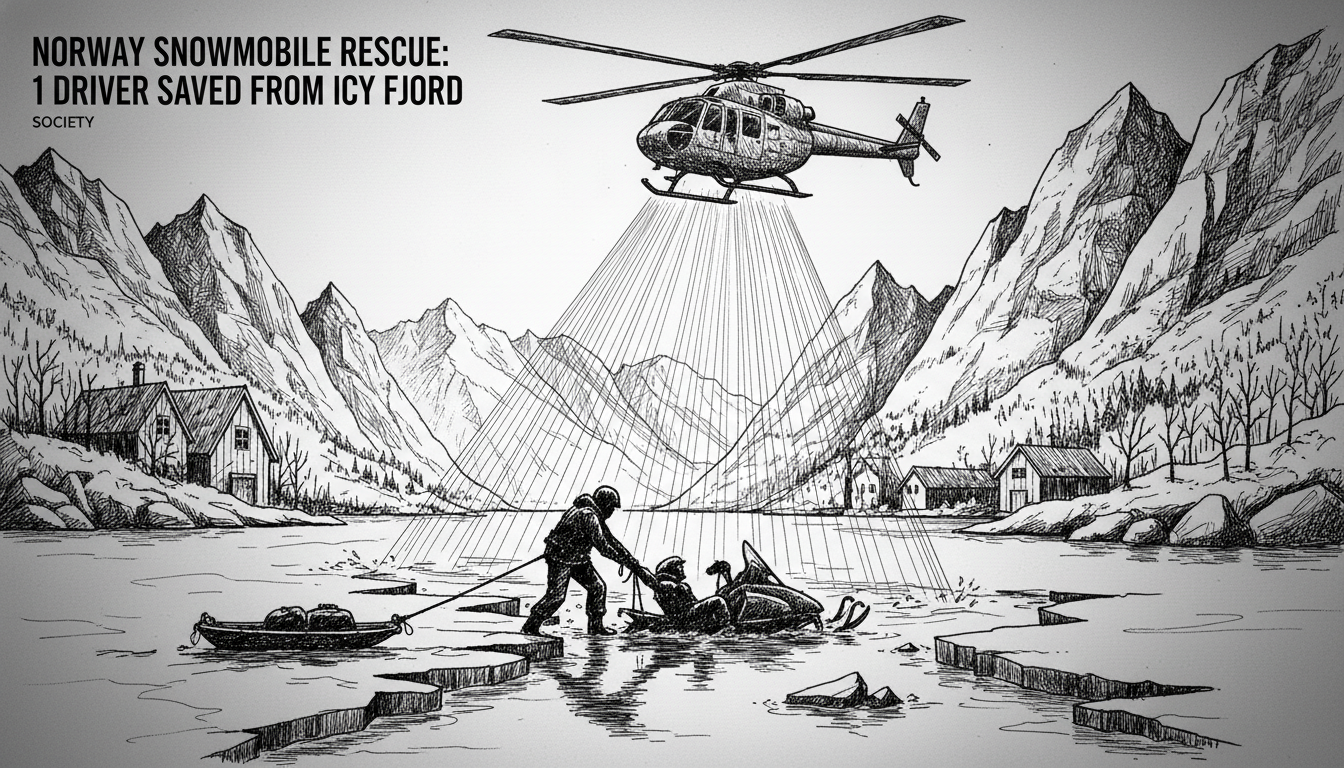
Norway snowmobiling risks were starkly illustrated Thursday when a vehicle broke through the ice on a fjord arm in Verdal. The driver managed to scramble onto a small islet, prompting a major rescue operation involving local emergency services and a rescue helicopter. The incident occurred on the inner part of the Trondheimsfjord, a vast and often treacherous body of water even in winter.
A Narrow Escape on the Trondheimsfjord
Initial reports indicate the snowmobile rider was traveling on the frozen surface of the fjord near Verdal in Trøndelag county when the ice gave way. In a fortunate turn, the individual was able to reach a nearby holme—a small islet—and await rescue. Police, fire services, and the Norwegian Society for Sea Rescue were mobilized. A rescue helicopter from the Norwegian Air Ambulance service was also dispatched to the scene, underscoring the seriousness with which authorities treat such incidents. The rider was successfully recovered and is reported to be in good condition, suffering only from cold exposure.
“This serves as a critical reminder that ice conditions are never 100% reliable, especially on moving or tidal waters like a fjord,” said a senior officer with the Trøndelag Police District in a statement. “The outcome could have been tragically different.”
The Allure and Peril of Winter Recreation
Snowmobiling is a deeply ingrained part of winter culture in many Norwegian regions, from the mountain plateaus to coastal areas. The Norwegian Environment Agency estimates there are roughly 120,000 registered snowmobiles in the country. For many, they provide essential winter transport and access to remote cabins. For others, they are a source of high-speed recreation. This access comes with significant responsibility and risk, particularly when riders venture onto frozen lakes and fjords.
Norwegian law requires snowmobile operators to be at least 16 years old and hold either a driver’s license for a car or tractor, or a specific snowmobile certificate. Riding is generally confined to designated trails and areas. Off-trail use, including on ice, is subject to strict regulations and often requires landowner permission. However, enforcement across vast, remote areas remains a constant challenge for authorities.
Unpredictable Ice: A Silent Hazard
Experts point to the incident as a textbook example of the hidden dangers of winter ice. “Ice on Norwegian fjords and lakes is notoriously variable,” explained Lars Fjelldal, a veteran instructor with the Norwegian Red Cross’s rescue training division. “It is not a uniform sheet. Currents, underwater springs, shifting temperatures, and snow cover creating insulation can create weak spots that are invisible from the surface. A thickness that is safe in one area can be dangerously thin just meters away.”
Fjelldal emphasizes a core safety principle: “No ice is completely safe ice. If you must go out, you must check conditions meticulously, never go alone, and carry proper safety gear.” That gear includes ice picks worn around the neck to help claw out of a hole, a flotation suit, and a reliable means of communication like a fully charged mobile phone in a waterproof case or a VHF radio. The Norwegian Directorate for Civil Protection and Emergency Planning (DSB) annually logs accidents involving snowmobiles, with ice breakthroughs representing some of the most severe outcomes.
Environmental and Regulatory Balancing Act
Beyond immediate safety, the incident touches on ongoing debates about snowmobiling’s environmental footprint. While providing economic activity for rural communities, the machines can disturb wildlife, particularly during sensitive winter months when animals conserve energy. Their use in certain protected or vulnerable areas is heavily restricted or banned.
“Every incident like this forces a conversation about balance,” noted Kari Nordseth, a researcher focusing on outdoor recreation policy at Trondheim University. “We have a public right to access nature, but it is coupled with a responsibility to act with caution and respect—for the environment and for the emergency services who respond when things go wrong. A rescue operation of this scale, with a helicopter, involves considerable cost and risk to the responders themselves.”
Local municipalities and the Norwegian Trekking Association (DNT) regularly publish advice on safe winter practices. Their guidance is unequivocal regarding ice: avoid traveling on frozen rivers, fjords, and lakes unless the ice is officially checked and declared safe, a rarity for large bodies of water.
A Community Familiar with the Sea’s Dangers
Verdal, primarily an agricultural municipality, lies on the shores of the great Trondheimsfjord. Its residents are no strangers to the power of the sea, though winter ice accidents are less common than summer maritime incidents. The swift response from multiple agencies reflects a well-drilled national preparedness system for search and rescue (SAR), coordinated by the Joint Rescue Coordination Centres of Southern and Northern Norway.
Norway’s SAR services are among the world’s best, relying heavily on volunteer organizations like the Norwegian Society for Sea Rescue and local Red Cross teams, backed by police and professional helicopter services. Their mission is unambiguous: save lives. However, officials repeatedly stress that prevention is paramount. “Our volunteers are always ready to respond,” said a representative from the Sea Rescue service. “But we would far prefer that people make decisions that mean we don’t get the call in the first place.”
The Aftermath and a Persistent Question
The rescued snowmobiler in Verdal will have a story of a frightening close call. The emergency services will log another successful operation. Yet, the broken ice left behind poses a lingering hazard for wildlife and potentially other recreational users until it fully melts or refreezes uniformly.
This single event encapsulates a perennial winter dilemma in Norway. How does a nation that celebrates its rugged outdoors and ‘friluftsliv’ (open-air life) culture effectively communicate and enforce the very real limits of that environment? As temperatures continue to fluctuate with changing climate patterns, making ice conditions even more unpredictable, the question becomes more urgent. The message from all experts is consistent: the beauty of a frozen fjord is undeniable, but its surface is a realm for extreme caution, not a marked trail. The next rider might not find a holme within reach.