
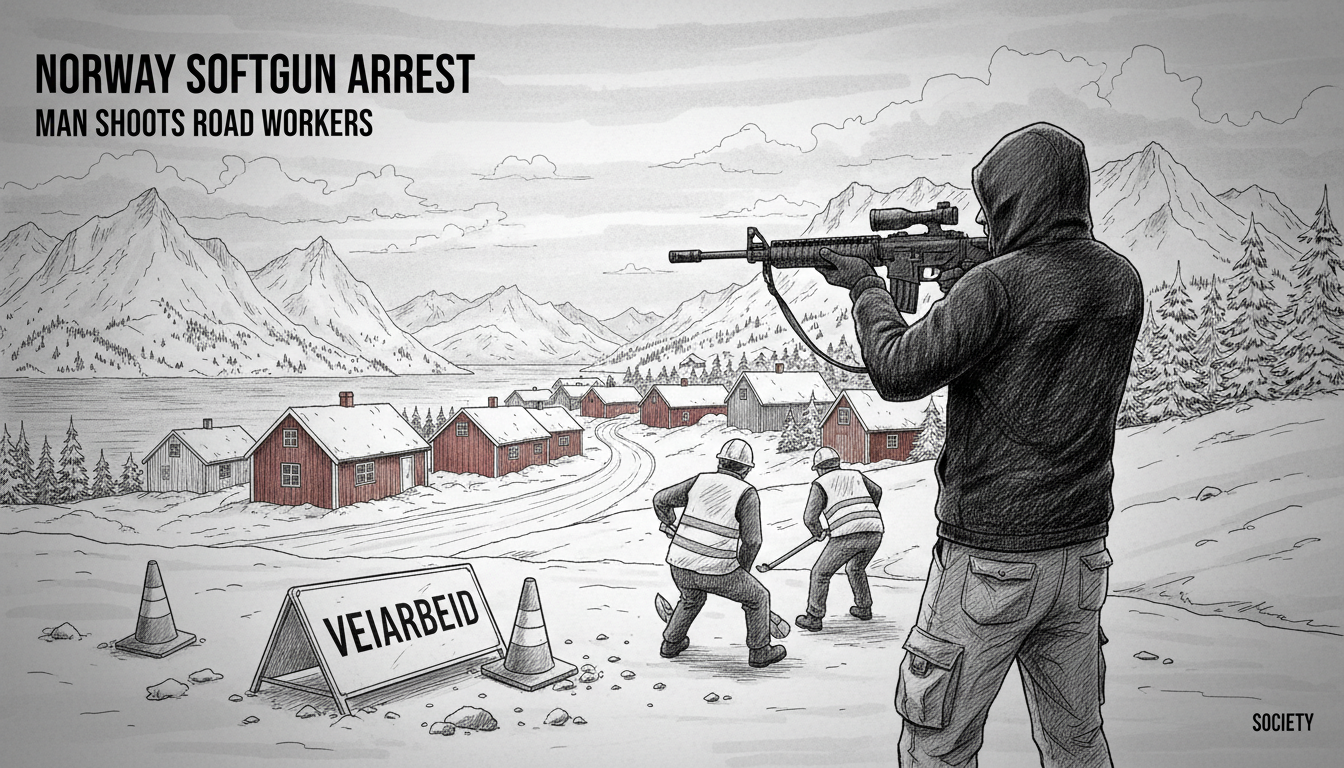
Norway police arrested a man in his 50s after he fired a softgun at road workers outside his home in Drøbak. The incident occurred on the eastern shore of the Oslofjord, where the man reportedly targeted municipal employees conducting maintenance work. One worker was struck by a projectile but was not injured, according to police statements. Officers seized multiple softgun weapons and pepper spray from the property. 'There is no danger to other people in the area,' said operations manager Nikolai Mathisen in a briefing. The arrest highlights the legal grey zone surrounding replica and low-energy projectile weapons in a country with strict firearm regulations. While not classified as traditional firearms, using softguns to threaten or intimidate can lead to serious criminal charges. This case in the quiet coastal town of Drøbak raises immediate questions about public safety and weapon regulation enforcement. Police have not released the suspect's name, citing standard procedure for ongoing investigations. The road workers were reportedly performing standard municipal maintenance when the confrontation began. Authorities have not detailed what sparked the incident, but early reports suggest a dispute over the work site near the man's property. The Oslofjord region, typically known for its tranquil summer homes and maritime history, is now the backdrop for a legal examination of non-lethal weapon misuse.
Understanding Norway's Softgun Regulations
Softguns, often called airsoft guns, occupy a specific legal category in Norway. They are generally legal to own for recreational use, particularly at designated arenas or on private property with proper safety measures. However, Norwegian law draws a clear line regarding their use in public spaces or in a manner that could cause fear or harm. The Våpenforskriften (Weapons Regulations) states that it is prohibited to use any object, including imitation weapons, in a way that unjustifiably creates fear or is suitable for assault. 'The crucial factor is intent and the perception of threat,' explains legal scholar Ingrid Moe, a professor at the University of Oslo. 'Pointing what appears to be a firearm at another person, even if it's a replica, can constitute a violation of penal code § 192, which covers threats, or more serious charges if the act is deemed reckless.' The presence of pepper spray adds another layer of legal complexity. In Norway, pepper spray is classified as a prohibited self-defense weapon. Private citizens cannot carry it without special permission, which is rarely granted. Possession alone can lead to charges under the Firearms Act. Combining an illegal weapon with the threatening use of a legal-but-misused device significantly escalates the potential penalties for the accused.
The Drøbak Incident and Public Safety Protocols
The response by Akershus police district followed established protocols for weapons-related incidents. Despite early confirmation that the weapon was a softgun, officers treated the call with high priority. 'Any report of a person being shot at, regardless of the weapon, triggers a serious response,' says former police inspector Lars Holte. 'The first officers on scene cannot immediately distinguish a softgun from a real firearm. They must assume the threat is genuine until proven otherwise.' This protocol explains the swift containment of the area and the arrest. The fact that a worker was struck, even without injury, transforms the incident from a simple threat into a potential assault. The projectiles fired from softguns can cause pain, bruising, and eye injuries, especially at close range. The psychological impact on the targeted workers is also a consideration for prosecutors. The tranquil setting of Drøbak, a town of 13,000 residents known for its Christmas house and ferry terminal, contrasts sharply with the nature of the arrest. Local officials have expressed surprise, noting such events are exceedingly rare in the community. The case now moves from police custody to the prosecuting authority, which will decide on formal charges.
Legal Consequences and Broader Implications
The man in custody faces a range of possible charges. The most likely are violations of the Penal Code's general provisions on threats (§ 192) and perhaps reckless conduct (§ 291). If prosecutors argue the softgun was used as a tool for assault, charges could be more severe. The illegal possession of pepper spray will be a separate, additional charge under the Firearms Act. Convictions can result in fines or imprisonment, with sentences depending on the defendant's criminal history, the perceived danger of the act, and the psychological impact on the victims. This incident occurs amid an ongoing national conversation about public disorder and respect for municipal workers. Road crews, parking attendants, and other public servants sometimes face harassment. 'While extreme, this case underscores the environment of confrontation some workers unfortunately experience,' says union representative Kari Nilsen of the Norwegian Union of Municipal and General Employees. 'A zero-tolerance approach to threats and violence is essential.' The case also serves as a public reminder of Norway's strict weapon laws. Many citizens may be unaware of the restrictions surrounding items like pepper spray or the legal boundaries for using replica firearms. Police occasionally run amnesties for surrendering illegal weapons, including such devices.
Expert Analysis on Motivation and Prevention
Criminologists and psychologists point to several potential motivations for such an act. 'It often stems from a sense of escalated frustration or a perceived infringement on one's personal domain,' says Dr. Erik Sørensen, a psychologist specializing in conflict. 'The individual may feel their immediate territory—their home—is being threatened by external activity, leading to a disproportionate response.' The use of a softgun, as opposed to a true firearm, might indicate an intent to intimidate rather than to cause lethal harm, but the legal system does not discount the fear inflicted. Prevention, experts argue, involves public education and clear communication from authorities conducting work near private properties. Municipalities often inform residents of upcoming projects, but tensions can still arise. From a legal perspective, Professor Moe suggests the case might prompt discussions about clearer labeling or storage requirements for softguns to prevent their misuse as tools of intimidation. However, she notes the existing law is robust. 'The framework is there. This is fundamentally an issue of enforcement and individual accountability,' Moe states. The case will test how the judiciary interprets the line between a recreational device and an instrument of crime.
A Calm Fjord Town's Unexpected Spotlight
For Drøbak, the incident is an unwelcome anomaly. The town, nestled in a bend of the Oslofjord, is more associated with sailing, summer tourism, and historical coastal defenses than with weapon arrests. Local community leaders emphasize that the event does not reflect the character of the town. The swift police response and the lack of any public danger have reassured residents. The broader takeaway for Norway is a reinforcement of its principle that all weapons, lethal or not, are subject to responsible use laws. The freedom to own a softgun for sport does not grant the freedom to use it to threaten fellow citizens. As the case proceeds through the legal system, it will clarify the consequences for crossing that line. It also reminds the public that even in one of the world's safest societies, conflict can erupt unexpectedly on a quiet street, turning a routine road repair day into a scene for police intervention. The final outcome will hinge on a detailed evaluation of the suspect's actions, his intent, and the precise circumstances that led a man to look out his window in Drøbak and see a threat that warranted what the law will likely define as a criminal response.