
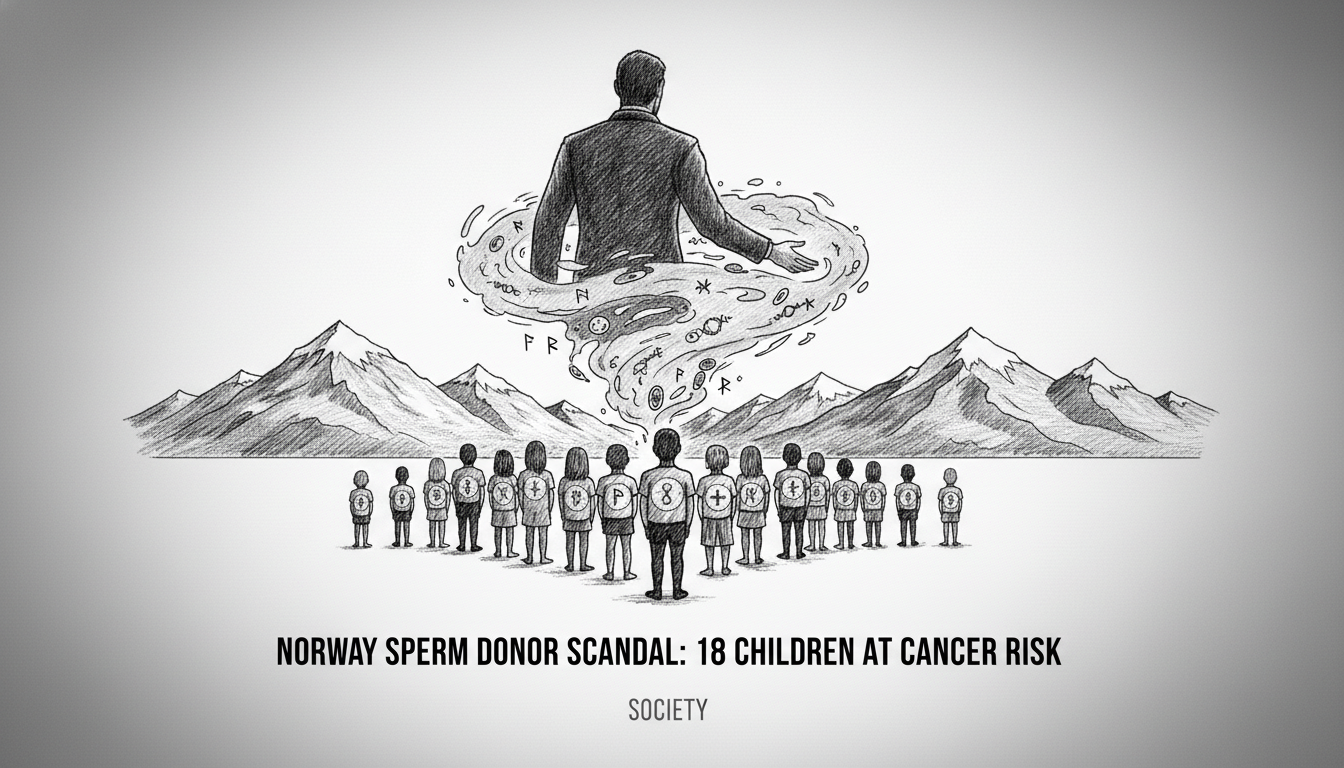
Norway's health authorities confirm 18 children have been born to 16 Norwegian women using sperm from a Danish donor with a serious cancer-linked genetic mutation. The Norwegian Directorate of Health received the information from Danish authorities, who are now contacting the affected families. The donor, used by the European Sperm Bank, has the TP53 mutation, which significantly increases the risk of developing various cancers. At least two children fathered by this donor have already developed cancer.
Senior advisor Anne Forus at the Norwegian Directorate of Health called the situation deeply regrettable. "It is highly regrettable that such incidents occur, and that it affects so many families and children," Forus said in a statement. The fertility treatments all took place at Danish clinics. Norwegian clinics could not have used this donor's sperm due to Norway's strict Biotechnology Act, which prohibits the use of anonymous donors.
A Cross-Border Tragedy Unfolds
The case exposes the complex and often unregulated world of cross-border reproductive care. Norwegian women, facing long waiting lists or stricter regulations at home, traveled to Denmark for treatment. Denmark has historically had more liberal rules around sperm donation, including allowing anonymous donors. This created a market where Norwegian patients sought services just across the border. The Norwegian Directorate of Health was first alerted by Danish authorities last week, but initially only about two unidentified Norwegian women. The full scale, involving 16 women and 18 children, was confirmed on December 7th.
"According to the information we have received, Danish authorities have identified all the women who have received treatment with this donor in Denmark, and they are getting information," Forus stated. The communication chain highlights the challenges when medical incidents span national jurisdictions. The Danish Medicines Agency (DMP) has been leading the dialogue with the clinics involved.
The TP53 Mutation and Its Dangers
The core of this scandal is the TP53 gene mutation. This is not a minor genetic variant. The TP53 gene is crucial for suppressing tumors. A mutation in this gene dramatically increases a person's lifetime risk of developing multiple types of cancer, often at a young age. Conditions like Li-Fraumeni syndrome, associated with TP53 mutations, carry a cancer risk of up to 90% for women and 70% for men. Cancers can include breast cancer, brain tumors, leukemia, and bone cancer.
The fact that at least two children from this donor cohort have already been diagnosed with cancer underscores the severe, real-world consequences. Genetic screening of donors is meant to prevent exactly this scenario. The failure to identify and disclose this mutation before the sperm was used for hundreds of treatments across Europe represents a catastrophic breakdown in donor vetting protocols.
Systemic Failure at a Major Sperm Bank
The donor was associated with the European Sperm Bank, one of the largest such facilities in Europe. The company has now been reported to the police in Denmark. Revelations show the donor, carrying the TP53 mutation, has fathered nearly 200 children internationally. This number far exceeds recommended or legal limits in most countries, which are designed to prevent accidental consanguinity and concentrate genetic risk.
The case raises urgent questions about the sperm bank's genetic screening processes. How was this mutation missed? Were any genetic tests performed? If they were, were the results ignored or misinterpreted? Furthermore, the scale of donations from a single individual points to potential profit-driven practices, prioritizing quantity and supply over rigorous health safeguards. The police report suggests Danish authorities are treating this as a potential case of serious professional negligence.
Norway's Laws and the Limits of Protection
Norwegian officials emphasize that this could not have happened within Norway's regulatory framework. The Biotechnology Act mandates non-anonymity for donors, meaning children have the right to know their biological origin when they turn 18. More importantly for this case, the law establishes strict controls and oversight for all assisted reproduction. Using an anonymous donor, as was the case in Denmark, is illegal for Norwegian clinics.
However, the law cannot protect Norwegian citizens who seek treatment abroad. This creates a regulatory gray zone. Patients exercising their right to cross-border care fall under the jurisdiction of the country where the treatment occurs. When things go wrong, as they have here, Norwegian authorities have limited power to intervene or access information. They become reliant on the cooperation and transparency of foreign clinics and health agencies, which can slow down crisis response and support for affected families.
The Human Cost and Ethical Reckoning
Beyond the statistics lie profound human stories. Sixteen Norwegian families are now living with devastating news. Parents who sought medical help to build a family must now grapple with the knowledge that their children carry a high risk of a serious disease. They face a future of vigilant monitoring, anxiety, and difficult medical decisions. The children themselves, as they grow, will need specialized care and genetic counseling.
The ethical breaches are manifold. There is the fundamental breach of trust: patients trust fertility clinics to use the safest possible biological material. There is the issue of informed consent: were the recipients ever informed of any genetic risks? Even if the mutation was unknown initially, what is the clinic's ongoing duty to re-contact recipients if new information emerges? Furthermore, the use of a single donor to father hundreds of children is ethically dubious, commodifying human reproduction and creating a network of biological half-siblings who may never know of each other's existence.
Expert Calls for Tighter International Rules
Medical ethicists and geneticists are calling this case a wake-up call. Dr. Kari H. Nordberg, a Norwegian bioethicist, stresses the need for international standards. "This tragedy shows that national laws are not enough in a globalized fertility market," Nordberg explains. "We need European-wide minimum standards for genetic screening of donors, mandatory genetic databases to track mutations, and strict, enforceable limits on the number of offspring per donor. Patient safety must trump commercial interests."
Experts also highlight the need for better patient information. "People seeking treatment abroad may not be fully aware of the regulatory differences and potential risks," says genetic counselor Martine S. Larsen. "Health authorities have a duty to provide clear guidance. Clinics have an absolute duty to perform exhaustive genetic screening. A mutation like TP53 is not something you can afford to miss."
Looking Ahead: Support and Scrutiny
The immediate focus is on supporting the affected Norwegian families. Danish authorities have taken responsibility for contacting them directly. These families will require extensive genetic counseling, psychological support, and a clear plan for medical follow-up for their children. The long-term medical and emotional support needed will be significant.
Meanwhile, legal and regulatory scrutiny will intensify. The police investigation into the European Sperm Bank in Denmark will be closely watched. In Norway, the Directorate of Health will likely review its communication protocols with other Nordic health authorities to improve responses to cross-border medical incidents. There may also be political pressure to discuss tighter regulations for advertising foreign fertility services to Norwegian citizens or to push for harmonized Nordic rules.
The Norway sperm donor scandal is more than a single medical error. It is a story of fragmented regulations, the vulnerabilities of cross-border care, and the profound consequences when commercial fertility services fail in their most basic duty of care. For 18 Norwegian children and their families, the search for a miracle of life has instead unveiled a lifetime of heightened risk, all stemming from a vial of sperm that should never have been used.