
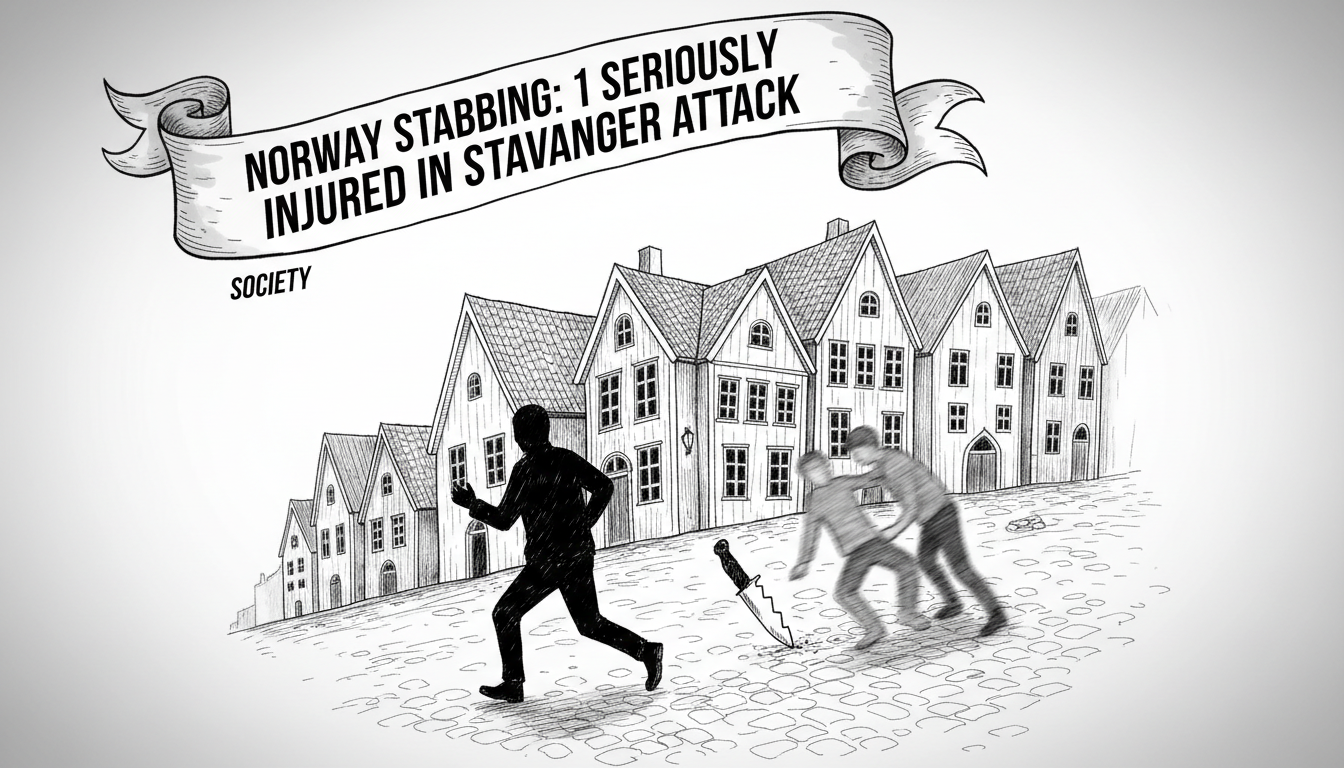
Norway's fourth-largest city, Stavanger, is confronting a violent incident that has shaken its reputation as a safe, orderly community. A person sustained serious cut injuries in an attack inside a grocery store in the Auglendsdalen neighborhood on Tuesday evening. Police were alerted just before 8:30 PM and immediately dispatched patrols and an ambulance to the scene. The suspect fled and remains at large, with authorities stating the individual may be known to police. The victim's injuries are described as serious but not life-threatening.
This act of violence in a commonplace setting—a local matbutikk—strikes at the heart of Norway's social contract, where public safety is a given. For residents of the oil-rich Rogaland county, the news from Auglendsdalen is a jarring disruption to the normal rhythm of life. The police response was swift, with multiple patrols deployed in a search operation. Operations leader Dag Steinkopf confirmed the basic details on the police log, while on-scene commander Anders Johannesen provided updates, expressing hope the perpetrator would be found quickly.
A Community on Edge
The Auglendsdalen neighborhood, like much of Stavanger, is typically characterized by quiet residential streets and a strong sense of community. The grocery store where the attack occurred would have been a place of routine for local families. The violence has transformed it into a crime scene, cordoned off by police tape, leaving residents to grapple with feelings of vulnerability. While violent crime statistics in Norway remain low by global standards, the psychological impact of such an event in a trusted, everyday space is profound.
Police have not disclosed the weapon used or a possible motive. The confirmation that the suspect may be known to law enforcement suggests this was not a random attack by an unknown assailant, a detail that offers some measure of public reassurance. However, the active manhunt means tension remains high in the area. Officers are conducting door-to-door inquiries and reviewing any available CCTV footage from businesses and residential buildings in the vicinity.
Context in the Oil Capital
Stavanger's identity is deeply intertwined with Norway's offshore energy industry. The city functions as the administrative and operational hub for the North Sea oil and gas sector, attracting a highly educated, international workforce. This economic backdrop typically correlates with stability and high living standards, factors that contribute to low crime rates. The city's safety profile is a key part of its appeal to multinational corporations and expatriate families.
Incidents of serious violence like this are statistical outliers. Norway's homicide rate consistently ranks among the lowest in the world, at approximately 0.5 per 100,000 people. For comparison, the average across European Union countries is typically around 1.0. Stavanger itself generally reports crime levels below those of other European cities of comparable size. This context makes Tuesday's stabbing not just a police matter, but a notable social event that challenges local perceptions of security.
Expert Analysis on Norwegian Crime Trends
Criminologists note that while Norway enjoys exceptional public safety, no society is immune to isolated acts of violence. "The Norwegian model, with its strong social welfare systems, high levels of trust, and proactive policing, is incredibly effective at preventing crime," says Dr. Lena Larsen, a sociologist at the University of Stavanger who studies urban safety. "However, it cannot eliminate every instance of interpersonal conflict or violence. What matters is the response—both the immediate police work to ensure justice and the community's resilience."
Dr. Larsen emphasizes that the location of the attack is significant. "A grocery store is a communal anchor point. An attack there feels like a violation of a shared, neutral space. The police's rapid containment and communication are crucial to preventing a spiral of fear and rumor." She points out that most violent crime in Norway occurs between individuals who know each other, often in private settings, making a public attack like this particularly alarming for bystanders.
The Police Investigation Unfolds
The Southwestern Police District has dedicated significant resources to the case. The search for the suspect involves both traditional ground units and specialized teams. Investigators are likely focusing on the victim's background and connections to identify a motive and, by extension, the perpetrator. The fact that the suspect fled on foot suggests they are familiar with the Auglendsdalen area's layout.
Police spokesperson Anders Johannesen has been careful with his public statements, providing enough information to keep the public informed without compromising the investigation. His assurance that the injuries are not life-threatening was a critical piece of information for a concerned community. The next 24 to 48 hours are critical for the investigation; the likelihood of apprehending a suspect decreases significantly after the initial response period if they have not already been located.
Broader Implications for Norwegian Society
This incident arrives during a period of national debate in Norway about police resources, sentencing for violent crimes, and the integration of immigrant communities—though there is no indication this case relates to the latter. The Storting frequently reviews penal code measures concerning knife crime and violence. Each high-profile incident adds fuel to these discussions, with political parties from the Labor Party (Arbeiderpartiet) to the Conservative Party (Høyre) weighing in on the balance between prevention and punishment.
For the average Norwegian, news of a stabbing in Stavanger reinforces a growing, if still relatively mild, anxiety that the country's famed tranquility might be under subtle pressure. It sparks conversations about visible police presence, youth outreach programs, and mental health services. Yet, the overall framework remains robust. Norway's institutional strength—from its healthcare system, now treating the victim, to its efficient police force—is designed to absorb such shocks without systemic failure.
A Look at Regional Safety Patterns
Analyzing crime data across the Nordic region reveals that Norway, alongside its neighbors Denmark and Sweden, maintains very low levels of lethal violence. However, non-lethal violent assaults do occur. The Nordic model focuses extensively on rehabilitation and addressing root causes like substance abuse and social exclusion, which is why any violent crime prompts analysis of social safety nets. Stavanger, with its unique economic profile, has different potential stress factors compared to Oslo, such as the cyclical nature of the oil industry affecting local employment and community dynamics.
The Path Forward for Stavanger
In the coming days, the focus will shift from the immediate crisis response to longer-term questions. The local government in Stavanger will likely face calls to review safety measures in public commercial spaces. Store owners' associations may discuss security protocols. The community will process the event, and normalcy will gradually return to Auglendsdalen's streets. The true test will be whether this incident becomes a forgotten anomaly or a reference point in local memory.
The victim's recovery is paramount. Norway's universal healthcare system ensures they will receive comprehensive medical and potentially psychological care. The police investigation will continue relentlessly, with the strong expectation of an arrest. For now, the people of Stavanger are reminded that even in the world's safest societies, the fabric of security is something that requires constant, collective vigilance. The attack in the grocery store is a stark interruption, but it is the steady, determined response that defines the character of a city and a nation.