
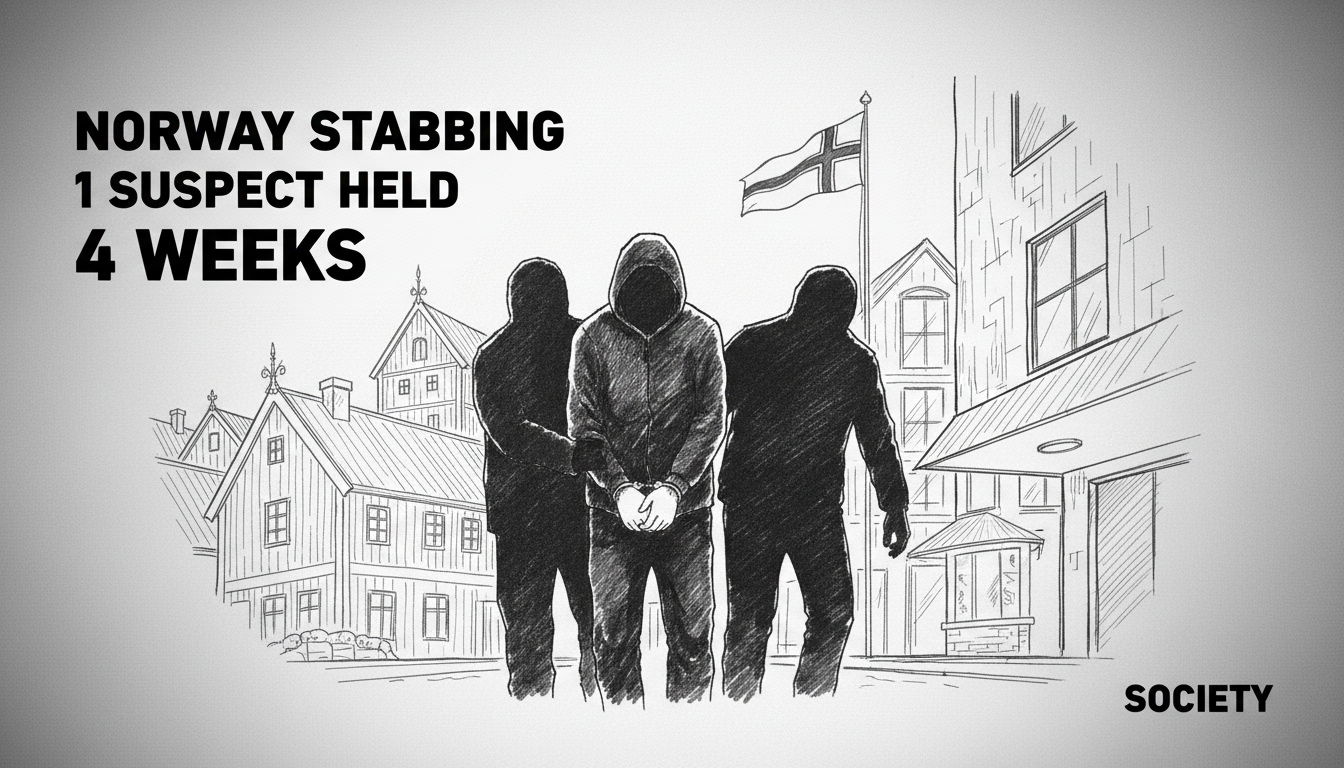
Norway police have remanded one suspect in custody for four weeks following a stabbing incident in Stavanger that left a 16-year-old boy injured. The suspect, a man in his 20s, will be held in isolation for one week with further restrictions on communication, as authorities cite a risk of evidence tampering. Two other individuals, another man in his 20s and a woman in her 40s, are also suspected in the case but have not been detained.
The violent episode occurred Thursday morning in the Tjensvoll district of Stavanger, Norway's oil capital. The teenage victim sustained stab wounds and was transported to a local hospital. He has since undergone surgery and is reported to be out of critical condition, according to a legal representative for the boy.
"This case is an enormous burden for him," said Maren Eide, the victim's counsel. She confirmed the boy had completed a police interview. The legal proceedings are now focused on the three suspects, whose defenses have begun to take shape in court.
A Custody Decision Based on Evidence Risk
During a remand hearing, the court agreed with police prosecutors that one suspect should be held in pre-trial custody, known as varetektsfengsling. The specific grounds cited were the danger of evidence being destroyed, removed, or influenced. This legal measure is not an indication of guilt but a procedural tool to secure an investigation.
The detained man's defense lawyer, Anne Kroken, stated her client denies criminal guilt. "He gets one week in isolation and two weeks with a ban on letters and visits. We must decide whether to appeal or not," Kroken said. The court ordered a four-week custody period, a significant duration that underscores the seriousness with which the court views the potential risks.
Defense counsel for the woman in her 40s, Sigurd Rønningen, said his client also denies guilt and rejects having any role in the violent incident. "I expect she will be released," Rønningen told reporters. The status of the second man in his 20s remains unclear, though he has not been remanded to custody at this stage.
Violence in a Low-Crime Society
The incident stands out in a Norwegian context, where violent crime rates are consistently among the lowest in the world. According to data from Statistics Norway and the European Union, Norway's homicide rate is typically less than one-quarter of the European average. Most urban violence, when it occurs, is linked to localized disputes or, increasingly, to gang-related activity and drug markets.
Stavanger, as a major economic hub fueled by the offshore energy sector, experiences the typical pressures of a wealthy, international city. Yet its crime levels remain modest by global standards. A sudden act of knife violence against a teenager in a residential area like Tjensvoll therefore generates significant police and media attention.
"Norway's justice system is built on principles of proportionality and rehabilitation, but it does not hesitate to use restrictive measures like pre-trial custody when investigators present a compelling need," explains a professor of criminology at the University of Oslo. "The threshold for varetektsfengsling is high. The prosecution must demonstrate a specific risk, such as flight, re-offending, or evidence tampering. The court's decision here suggests they found that argument persuasive."
The Legal Path Forward
The investigation is now entering a detailed phase. Police will work to reconstruct the events leading to the stabbing, examine forensic evidence, and interview witnesses. The conditions imposed on the detained suspect—isolation and communication bans—are designed to prevent collusion or influencing of other parties involved in the case.
Pre-trial custody is subject to strict judicial review. The defense can appeal the decision, and the custody period cannot exceed what is reasonable relative to the potential sentence for the crime. For serious acts of violence, pre-trial detention can last for several months, but extensions require renewed court approval.
The victim's recovery will be a parallel focus. Beyond physical healing, involvement in a violent crime as a victim, particularly for a minor, triggers access to support services from the Norwegian criminal injuries compensation authority. The boy's legal representative will manage his interests through the police process.
Community Reaction in an Oil Capital
In Stavanger, news of the stabbing has rippled through the community. Tjensvoll is a residential neighborhood, not an area known for significant criminal activity. The city's identity is deeply tied to the orderly, high-tech world of offshore oil and gas, making a violent street incident feel particularly jarring.
Local politicians often highlight Stavanger's safety and family-friendly environment as key advantages. While the city is not immune to the social challenges seen in other urban centers, including occasional drug-related violence, a daylight stabbing of a teenager is an uncommon event.
Police have not released any information about a possible motive or the relationships between those involved. It is unknown whether the victim and the suspects were acquainted prior to the incident. The lack of information has led to speculation but also a cautious public response, with many awaiting official updates from law enforcement.
A System Stressing Rehabilitation and Restraint
The Norwegian justice system's approach will be tested in this case. Its international reputation is built on low incarceration rates, a focus on rehabilitation, and humane prison conditions. However, its prosecutors and courts can be stringent when dealing with serious violent crimes, especially those involving weapons or young victims.
The use of pre-trial detention, while relatively common for serious charges, is always a balance between the rights of the accused and the needs of justice. The court's decision to impose a four-week term with strict conditions indicates it views the evidence-tampering risk as substantial.
Legal experts note that most criminal cases in Norway end with a guilty plea, often after a period of pre-trial custody during which the evidence is compiled and shared with the defense. The process is typically more transparent and collaborative than in many other jurisdictions, though no less rigorous.
Looking Ahead for the Victim and Suspects
The immediate future involves continued investigation and legal maneuvering. For the detained suspect, the coming weeks in custody will be a severe test, even within Norway's modern prison system. His defense will scrutinize every piece of evidence presented by the police.
For the 16-year-old victim, the path is one of physical and psychological recovery. The aftermath of violent trauma can be long-lasting, and Norwegian authorities generally provide comprehensive victim support services.
The case also places a spotlight on Stavanger. As a city that projects an image of prosperity and stability, it must now confront a random act of violence that contradicts its usual narrative. How the community and the justice system respond will reflect Norway's broader values of fairness, safety, and a deep aversion to violent crime.
Will this incident prove to be an anomaly in Stavanger's peaceful record, or does it signal a shift that the city's authorities need to address? The answer will unfold alongside the judicial process, as Norway's meticulous legal machinery works to determine exactly what happened on a Thursday morning in Tjensvoll.