
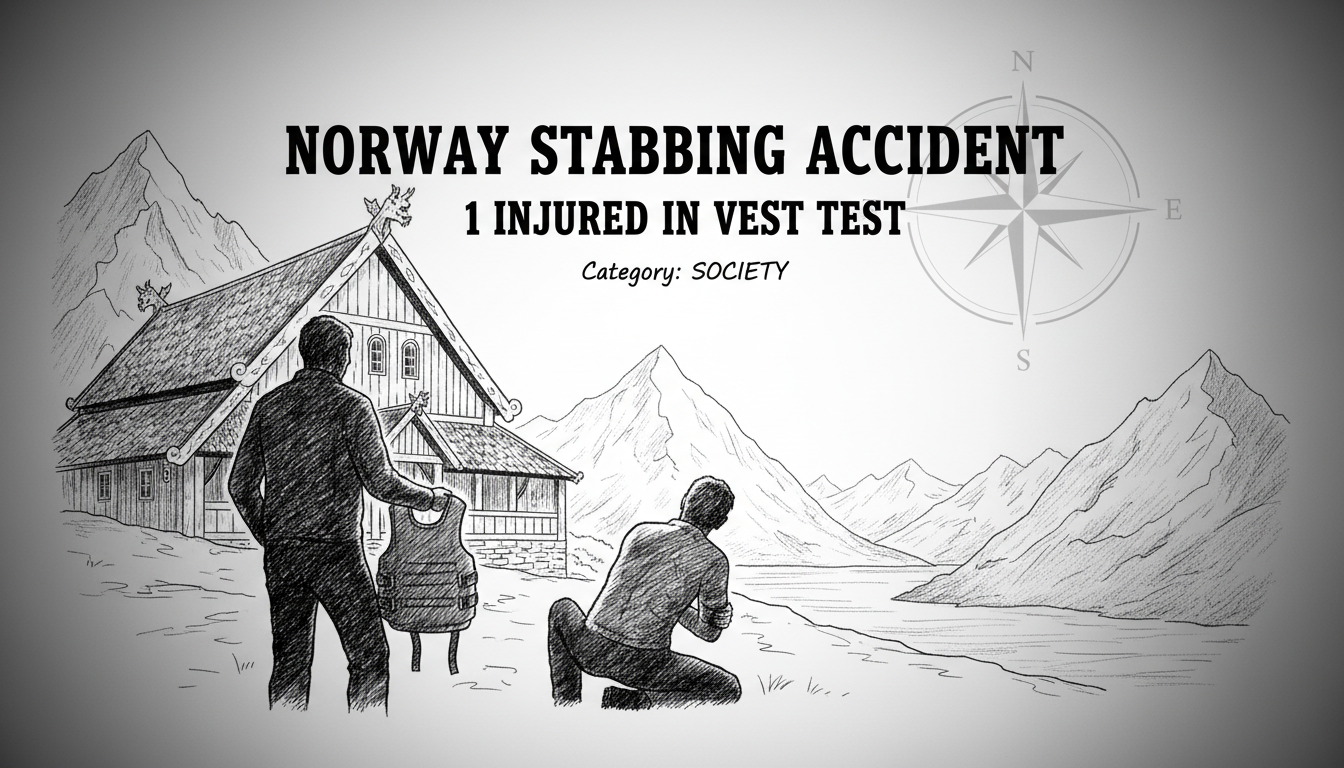
Norway police are investigating a bizarre stabbing incident in Moss where a man was hospitalized after a stab-proof vest test among four intoxicated friends went wrong. The incident occurred Saturday morning at a private residence in the coastal town, located about 60 kilometers south of Oslo. Police operations leader Atle Vesttorp said the group, described as three men and one woman in their 30s and 40s, were testing the vest's protective capabilities. The vest failed, resulting in one person sustaining a stab wound to the back. The injured man was transported to Sykehuset Østfold Kalnes for treatment. Police have seized both the vest and the knife used in the incident. No arrests have been made, but a formal investigation is underway.
A Dangerous Experiment
According to the police statement, the four individuals were intoxicated when they decided to conduct their impromptu safety test. The exact circumstances leading to the decision remain unclear, but the outcome demonstrates a severe lapse in judgment. Testing body armor requires controlled conditions, specific training, and an understanding of the equipment's limitations. Doing so while under the influence of alcohol in a private home represents a perfect storm of risk factors. The police have interviewed all parties involved. They are treating the incident as an accident, though the investigation will determine if any charges related to negligence or reckless behavior are warranted. The seizure of the vest will allow for technical examination to determine why it failed to stop the blade.
The Legal and Safety Gray Zone
This incident highlights a regulatory gray area in Norway concerning civilian ownership and use of protective equipment. While firearms are strictly controlled, regulations on body armor like stab-proof vests are less defined for private citizens. There is no specific license required to purchase such gear, unlike in some other European countries. This accessibility, combined with a potential misunderstanding of the product's guarantees, can create dangerous situations. A vest marketed as 'stab-proof' may be rated for specific blade types, attack angles, or force levels that an untrained person would not comprehend. Testing it outside a laboratory or certified training environment is inherently risky. Legal experts note that causing bodily injury, even accidentally, during such an experiment could lead to charges under Norway's penal code, particularly if intoxication is a factor.
Alcohol and Violence in a Low-Crime Society
Norway consistently ranks as one of the world's safest countries. In 2022, Statistics Norway recorded just 25 homicides nationwide. Incidents of serious violent crime are relatively rare, making events like the Moss stabbing stand out. However, research indicates that when violent incidents do occur, alcohol is frequently involved. A 2023 report by the Norwegian Institute of Public Health found alcohol to be a significant contributing factor in a substantial percentage of assaults and other violent crimes. This context is crucial for understanding the Moss incident. It was not a random act of street violence but a private, alcohol-fueled misadventure that escalated dangerously. The case serves as a stark reminder that safety risks can emerge from private settings and poor judgment, even in societies with strong social trust and effective policing.
Expert Warnings on DIY Safety Tests
Security and law enforcement experts express grave concerns about civilians testing protective gear. "Body armor is not a toy, and it is not a party trick," said a former police instructor who now runs a private security consultancy. "These products are designed for life-threatening professional scenarios. Testing them without proper ballistic dummies, certified testers, and medical personnel on standby is incredibly reckless." Experts explain that stab vests work by using layers of strong, woven fibers to catch and disperse the point of a blade. A vest can be compromised by previous damage, improper storage, or simply being of low quality. Furthermore, a test with a real person inside the vest ignores critical variables like the specific knife used, the angle of attack, and the force applied. The Moss incident perfectly illustrates the potential consequence: a false sense of security leading directly to injury.
Community Reaction and Police Procedure
The town of Moss, an industrial and commuter community of around 50,000 people, is known for its paper mills and quiet coastal atmosphere. News of the stabbing has circulated with a mix of concern and disbelief. Local residents describe the event as a tragic and foolish anomaly. Police procedure in such cases focuses on securing evidence, providing medical aid, and determining criminal intent. Since the injury was not fatal and appears to be the result of a consensual, albeit ill-advised, act among acquaintances, the likelihood of major criminal prosecution is lower. However, the police report will be sent to the local prosecutor for review. The case may also prompt discussions within the Justice Ministry about whether the sale of certain types of protective equipment to civilians needs clearer guidelines or restrictions, though no such review has been announced.
A Costly Lesson in Risk
The injured man's condition has not been disclosed, but treatment for a stab wound can involve surgery, risk of infection, and a significant recovery period. Beyond the physical cost, the individuals involved now face a police investigation and the social repercussions of their actions. The incident is a textbook example of how alcohol impairs risk assessment. What might have seemed like a bold or humorous idea in the moment resulted in a hospital visit and police intervention. It also wastes valuable emergency service resources that could have been needed for a genuine, unforeseen crisis. For Norway's police, the case is a straightforward evidence collection and interview operation, but it underscores a public safety education gap regarding weapons and specialized equipment.
The Broader Implications for Norway
While this is an isolated event, it touches on broader themes in Norwegian society: the relationship between personal freedom and regulation, the role of alcohol in accidents, and the limits of consumer product safety. Norway generally favors informing citizens over imposing bans. This philosophy extends to many areas of life, from outdoor access to consumer goods. However, when products designed for professional, high-risk use enter the consumer market, the assumption that buyers will use them responsibly can be flawed. The Moss stabbing may lead some policymakers to question if that assumption holds for items like body armor. For now, the police investigation continues, and a man in Moss is recovering from a wound inflicted by a friend, a stark outcome for a test meant to prove safety. The failed vest now sits in police evidence storage, a simple object at the center of a complex story about poor choices and unintended consequences in one of the world's safest countries.