
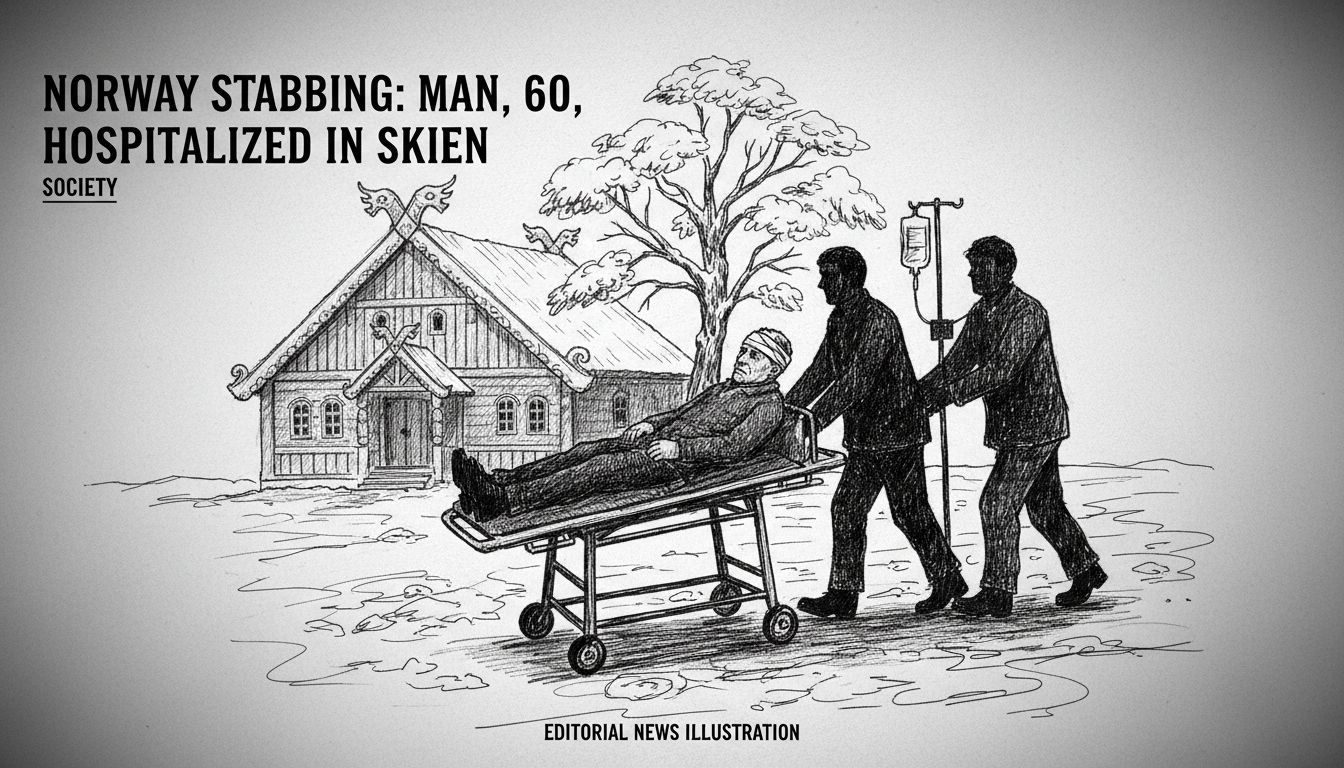
Norway police have arrested a man in his 50s after a stabbing incident in Skien left a man in his 60s hospitalized with serious injuries. The victim was transported to Skien Hospital with what authorities described as serious but not life-threatening cut wounds. Police responded to a private address in the city center following the report and are now working to establish the exact sequence of events.
This violent episode in a typically tranquil Norwegian city has prompted local reflection on the nature of crime in one of the world's safest nations. While violent crime rates in Norway remain low by international standards, incidents like this underscore that no community is entirely immune. The police have stated they are actively pursuing investigative steps to clarify the situation further.
A Quiet City Center Disrupted
Skien, the administrative center of Telemark county, is known for its historic wooden houses and as the birthplace of playwright Henrik Ibsen. The incident occurred at a private address in the city's center, an area usually associated with commerce and civic life rather than violent crime. Emergency services responded swiftly, ensuring the victim received rapid medical attention.
Police have not released the identities of either the victim or the arrested individual, nor have they speculated on a possible motive. The fact that both men are in their 50s and 60s distinguishes this case from the demographic profile often associated with street violence in other countries. This detail suggests the altercation may have arisen from a personal dispute rather than random criminal activity.
Norway's Violent Crime Landscape in Context
To understand this event, one must view it against Norway's overall crime statistics. According to data from Statistics Norway (SSB), reported cases of assault resulting in bodily harm have seen fluctuations but remain at a moderate level historically. Norway's comprehensive social welfare systems, strong community structures, and strict gun control laws contribute to its position as a country with relatively low homicide and violent crime rates.
Knife-related incidents, while occurring, are not a dominant feature of Norwegian crime reporting. The country's stringent firearm regulations mean that in instances of interpersonal violence, perpetrators may sometimes turn to knives or other weapons. However, the overall incidence of such events is significantly lower than in many other European nations. Most violent crime in Norway is linked to known relationships or specific contexts, rather than stranger attacks.
The Role of Prevention and Social Systems
Criminologists and social policy experts often point to Norway's robust social safety net as a key factor in mitigating crime. Access to healthcare, mental health services, substance abuse treatment, and social support can address root causes before they escalate into violence. While not a perfect shield, these systems provide intervention points that many countries lack.
In the immediate aftermath of the Skien stabbing, the focus of local authorities is on the specific investigation. However, broader discussions may follow regarding whether existing support mechanisms are reaching all individuals in potential crisis. Experts highlight that alcohol consumption or untreated mental health issues can be contributing factors in isolated violent episodes, even within a generally stable society.
Policing and Community Response
The police response to the incident appears to have followed standard protocol for a serious assault. Securing the scene, ensuring medical care for the victim, and making a swift arrest are the immediate priorities. The next phase will involve detailed interviews, evidence collection, and determining whether to press charges.
For the community of Skien, the event is a jarring reminder of vulnerability. Residents in peaceful nations often experience a heightened sense of shock when violence erupts close to home, precisely because it is so uncommon. The local police's communication has been measured, providing essential facts without sensationalism, which helps maintain public calm while the investigation proceeds.
Looking Beyond the Single Incident
A single stabbing in Skien does not indicate a trend or a shift in Norway's national security picture. Isolated acts of violence can and do happen anywhere. The more telling metric is how the society and its institutions respond: the efficiency of emergency medical services, the professionalism of the police investigation, and the community's ability to process the event without undue panic.
The arrested man will face the Norwegian justice system, which emphasizes rehabilitation alongside accountability. The victim's recovery will be supported by Norway's universal healthcare system. These institutional responses are the bedrock of Norway's approach to crime and its consequences.
A Society's Resilience Tested
Events like the Skien stabbing serve as a minor stress test for a society's foundations. The true measure of safety in a community is not the complete absence of crime—an impossible standard—but the strength and fairness of the response when crime occurs. Norway's low crime rate is a product of social investment, not mere luck.
As police continue their work to piece together the motives and circumstances in Skien, the public can be reassured by the system's overall capacity. The victim's non-life-threatening condition is a positive outcome in a serious situation. The rapid arrest indicates effective police work. The story, while distressing, is ultimately one of a system functioning as intended to contain and address an outbreak of violence.
Norway's reputation for safety remains intact, but this incident is a sobering footnote. It reminds us that social harmony requires constant maintenance and that individual crises can surface even in the most orderly environments. The coming days will reveal more about the relationship between the two men and the conflict that turned violent. For now, the community waits, hopes for the victim's full recovery, and trusts in the process that follows.