
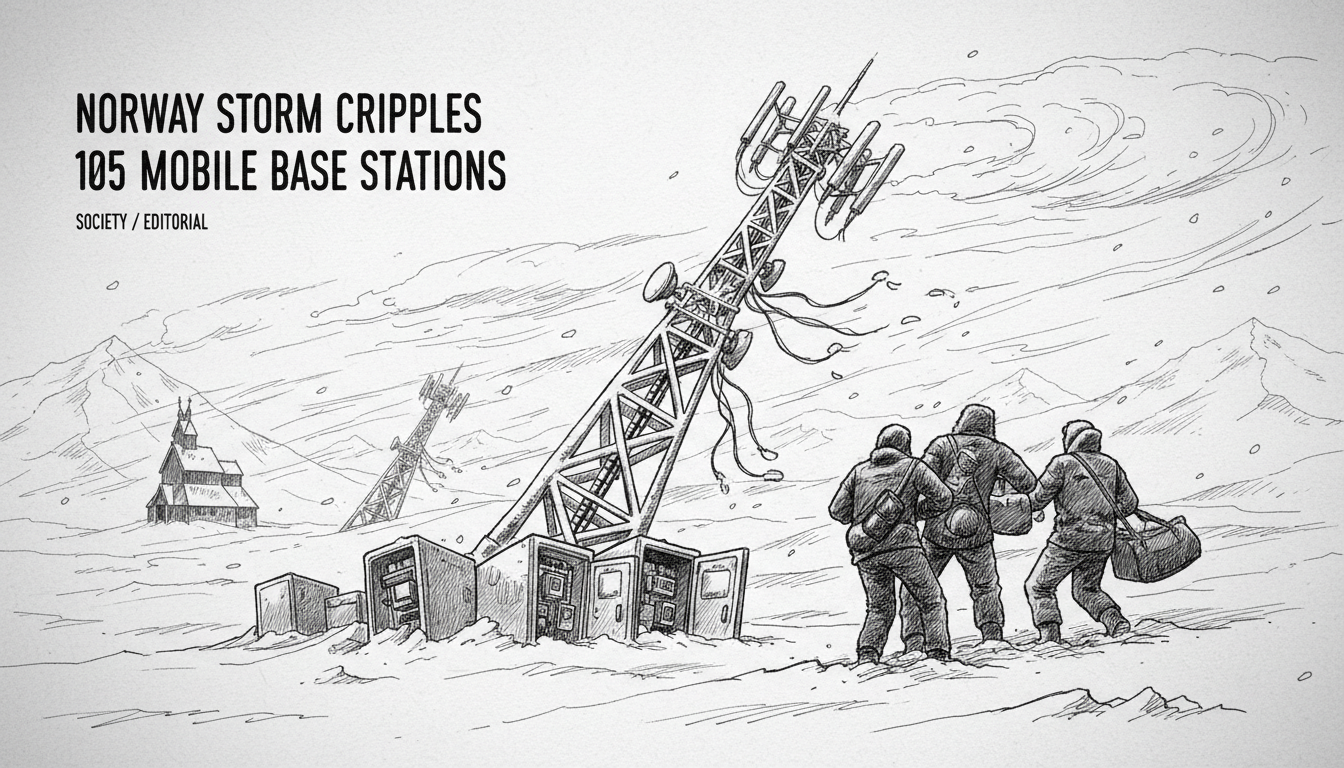
Norway's mobile network remains critically impaired days after a severe storm swept across the country. More than 100 Telenor base stations are still out of operation, with the northern county of Nordland bearing the brunt of the disruption. The outage is affecting municipal safety alarm systems and exposing deep vulnerabilities in the nation's digital infrastructure.
Forty-two of approximately 700 base stations in Nordland county are down, according to Telenor's coverage director Bjørn Amundsen. Nationwide, the figure stands at 105 stations offline. The areas hardest hit include the iconic Lofoten and Vesterålen archipelagos and Rana municipality on the Helgeland coast. This is not a simple inconvenience. In regions where Telenor is the sole provider, communities have been plunged into a communications blackout.
"Nordland is clearly the hardest hit," Amundsen said. "It is worrying, and we are vulnerable, especially in areas where we are the only operator."
A Stark Reminder of Geographic Vulnerability
This incident underscores a persistent challenge for Norwegian authorities and telecom providers. The country's dramatic landscape of deep fjords, steep mountains, and scattered island communities makes building and maintaining resilient networks extraordinarily difficult. Population density in Nordland is just 6.5 people per square kilometer, compared to a national average of 15. This sparse settlement pattern means infrastructure must cover vast, rugged areas with relatively few customers, creating economic and logistical hurdles.
When storms hit, the consequences are magnified. Base stations are often located on exposed mountain tops or remote headlands to maximize coverage. These locations are precisely where high winds, heavy snow, and ice cause the most damage, knocking out power lines and damaging antennas. Restoring service requires specialized crews to travel long distances, often in continuing poor weather, to reach isolated sites.
The Safety Net Frays
The most alarming aspect of the current outage is its impact on public safety infrastructure. In several affected municipalities, the failure of mobile base stations has also disabled parts of the 'trygghetsalarm' system. These are personal safety alarms, often used by elderly or vulnerable individuals living alone, which connect directly to emergency response centers. When the mobile network fails, these lifelines go silent.
This creates a dangerous gap in Norway's otherwise robust social safety net. Local emergency services are forced to rely on alternative, often slower, methods of communication and checking on residents. The situation highlights a critical dependency: modern digital safety systems are only as strong as the commercial networks they run on. When those networks fail, the vulnerability of remote communities is sharply exposed.
A Test of National Digital Ambitions
Norway's government has long championed bridging the digital divide, investing significant funds to ensure high-speed broadband and reliable mobile coverage reach every corner of the kingdom. The official goal is for all of Norway to have good mobile coverage, recognizing connectivity as essential for business, education, and daily life. This storm-induced outage represents a significant setback for that ambition in the affected regions.
Experts point to the increasing frequency and intensity of extreme weather events due to climate change. What was once considered exceptional disruption may become more commonplace. This reality demands a reevaluation of network resilience. Questions are being raised about the need for more robust physical infrastructure, such as hardened power supplies and wind-resistant towers, and greater redundancy in network design.
In areas served by only one operator, the failure of that single network means a total loss of service. The government's policy of encouraging competition, while beneficial for prices, can sometimes result in a lack of overlapping coverage in remote areas where building infrastructure is least profitable. This storm lays bare the risk of that model for community safety.
The Path to Restoration and Resilience
Telenor has mobilized repair crews, but the process is slow. Each site requires assessment, potentially by helicopter, followed by the transport of personnel and equipment. The priority, according to the company, is restoring service to areas with no alternative providers and reinstating safety alarm functionality. However, with over 100 sites nationwide needing attention, full restoration could take several more days.
The incident is likely to prompt discussions in the Storting, Norway's parliament, about the resilience of critical national infrastructure. Key figures on the Standing Committee on Transport and Communications have previously emphasized the need for fail-safes in telecommunications. This outage provides a concrete case study for their deliberations.
Potential solutions include mandating backup power systems at critical base stations, such as longer-lasting batteries or generators that can operate autonomously for days. Another approach is incentivizing or requiring network sharing between operators in remote areas, so that if one fails, another can provide a basic level of coverage. Investing in more satellite-based backup communication options for emergency services is also a possibility.
A Broader Lesson for the Connected North
Norway's struggle is a microcosm of a challenge facing the entire Nordic region and other nations with vast, sparsely populated areas. As societies become more digitally dependent, the reliability of communication networks transitions from a commercial issue to one of national security and civil preparedness. The outage in Lofoten, a major tourist destination, also carries economic weight, potentially affecting businesses that rely on digital payments and bookings.
The silent base stations along the Helgeland coast serve as a powerful reminder. Norway's breathtaking geography, which defines its identity, also makes it uniquely susceptible to digital isolation. Building a connected nation is one task. Keeping it connected through the fierce winters and storms of a changing climate is an ongoing, and now more urgent, challenge. How Norway responds will set a precedent for how Arctic nations safeguard their digital lifelines in an increasingly volatile world.