
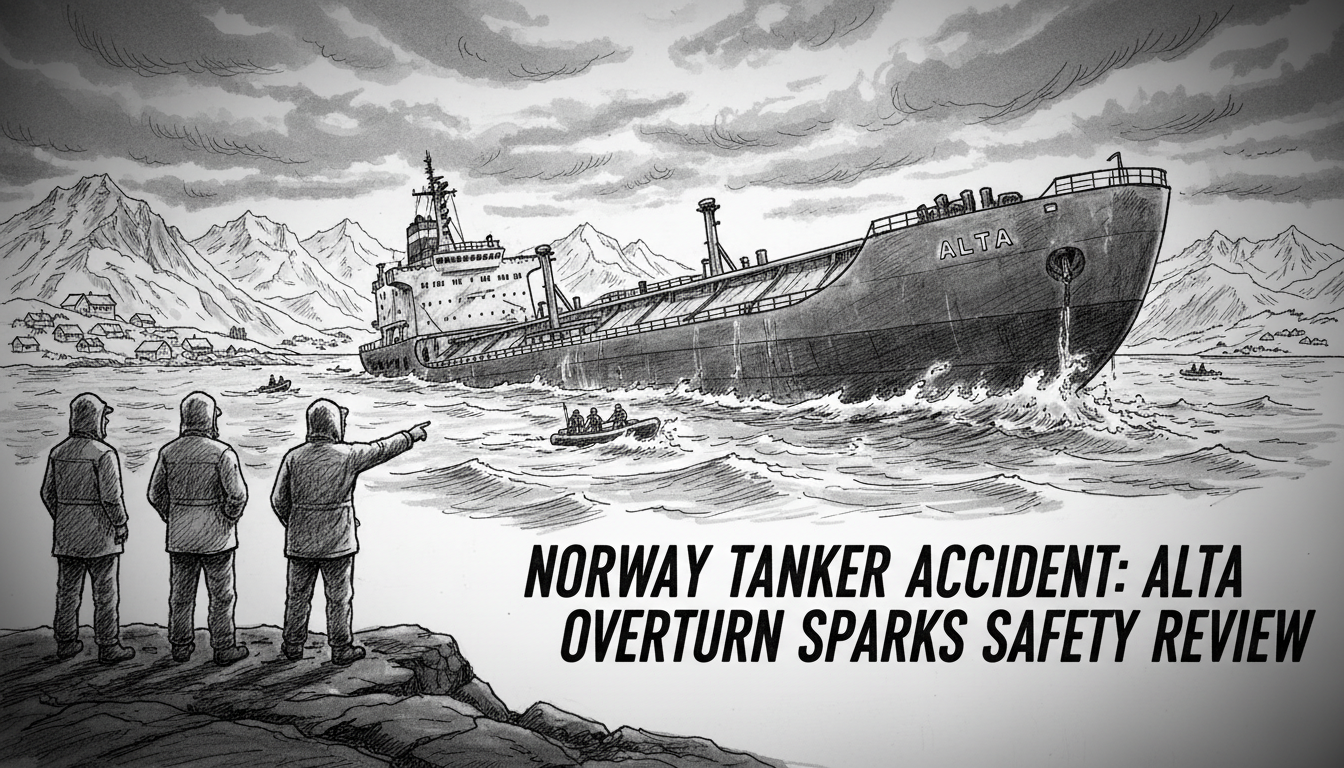
Norway's northernmost roads are under scrutiny after a loaded tanker truck overturned on a residential street in Alta, Finnmark. The incident on Kvenvikveien saw the large vehicle slide backwards into a ditch, though remarkably, no injuries were reported and the driver escaped unharmed. Emergency services responded swiftly to secure the scene, highlighting the ever-present risks of heavy transport in Norway's challenging Arctic terrain.
A Close Call in the Far North
The quiet of a Finnmark morning was disrupted by the groan of twisting metal. A tanker truck, navigating Kvenvikveien in the town of Alta, lost control. According to police, the vehicle became stuck on an incline, then slid backward before tipping into a roadside ditch. "The tanker overturned in the ditch after it got stuck on the ground and started to slide backwards," said operations manager Marte Isabel Frydenlund of the Finnmark Police District in a statement. The driver managed to exit the vehicle independently. This fortunate outcome belies the potential severity of such an accident in a community like Alta, a key transport hub where local roads often double as industrial arteries.
The Persistent Challenge of Arctic Logistics
The Alta accident, while minor in terms of human cost, opens a window into the complex logistics of northern Norway. Finnmark, Norway's largest and northernmost county, faces unique infrastructure challenges. Its economy relies on road transport for everything from fuel and groceries to construction materials and fish exports. These necessities often travel on roads not originally designed for the volume and size of modern freight traffic. Kvenvikveien is one such local road, now part of a larger network bearing the weight of regional commerce. Experts point to a constant tension between community accessibility and industrial necessity in the Arctic. "Every time a heavy vehicle like this has an incident on a local street, it forces us to ask if our infrastructure planning has kept pace with development," says Lars Molvig, a senior advisor on northern transportation with the Institute of Transport Economics. He notes that while Norway's main highways are excellent, the final leg of delivery often involves narrower, older routes through populated areas.
Weather, Weight, and Wear: A Risky Trinity
While the immediate cause of the Alta overturn appears to be a loss of traction on a hill, the underlying risk factors are systemic. Driving large vehicles in the North is a year-round test of skill. In winter, drivers contend with ice, snow, and polar darkness. In summer, they face loose gravel roads and the destabilizing effects of thawing permafrost on road foundations. The weight and high center of gravity of a tanker, especially when partially or fully loaded, make it particularly vulnerable to rollovers on uneven or sloped surfaces. "Driver training for these conditions is extensive, but the margin for error is slim," explains Solveig Haugland, a former long-haul truck driver who now trains heavy vehicle operators. "A moment of wheel spin on ice or soft ground, a slight misjudgment of a gradient—on a local street, that's all it takes. The community's safety depends on that margin every day." This incident occurred without the added complication of severe weather, suggesting that even in fair conditions, the risk profile remains significant.
Regulatory Scrutiny and Community Concerns
This event will likely trigger routine reviews by both the police and the Norwegian Public Roads Administration (Statens vegvesen). Investigators will examine vehicle maintenance records, driver logs, and the specific road conditions on Kvenvikveien. While major spills or casualties drive sweeping policy changes, minor incidents like this one accumulate, gradually shaping safety regulations and route planning. For Alta residents, the sight of an overturned tanker on a familiar street is a stark reminder of the industrial activity threading through their daily lives. It raises quiet questions about road wear, noise, and the latent risk of transporting hazardous materials near homes. Community councils in northern towns often debate heavy traffic routing, balancing economic needs with residential quality of life and safety. An accident, even a non-injurious one, brings those debates into sharper focus.
The Broader Picture: Norway's Northern Ambitions
This local accident intersects with Norway's national ambitions for the High North. Government strategies emphasize sustainable development and increased activity in the Arctic, from tourism and fishing to renewable energy and mineral exploration. All this growth predicates more transport. The government's National Transport Plan repeatedly stresses improving road safety (trafikksikkerhet) and reliability in the north. Yet, funding is always finite, and projects compete. Securing upgrades for specific local roads like Kvenvikveien requires demonstrating clear need—often evidenced by incident reports. "Safety improvements are frequently data-driven," notes political commentator Anne Berit Dahl. "Each police report from an incident adds to the statistical case for investment in guardrails, better grading, or even route reassessment. In that sense, the Alta overturn, though minor, becomes a data point in a larger argument about prioritizing northern infrastructure."
Looking Ahead: Prevention in a Harsh Climate
The successful emergency response in Alta demonstrates preparedness, but the ultimate goal is prevention. Technology offers some solutions. Electronic stability control (ESC) systems for heavy trucks, which help prevent rollovers, are becoming more widespread. Regular, mandatory route risk assessments for heavy transport companies could identify specific hazards on local roads. Some communities have implemented time-of-day restrictions for heavy goods vehicles. However, the fundamental geography and climate of Finnmark cannot be changed. The long distances, sparse population, and harsh environment will always make logistics expensive and complex. The people of Alta, and all of northern Norway, ultimately depend on the skill of individual drivers, the rigor of transport companies, and the continual, incremental improvement of the roads that connect their remote communities to the rest of the world.
The overturned tanker in Alta was righted, the road cleared, and traffic returned to normal. But the image lingers: a massive vehicle on its side, a few meters from where people live. It serves as a powerful metaphor for the precarious balance of modern life in the Arctic—a constant negotiation between progress and safety, between economic vitality and community well-being, on the edge of the continent.