
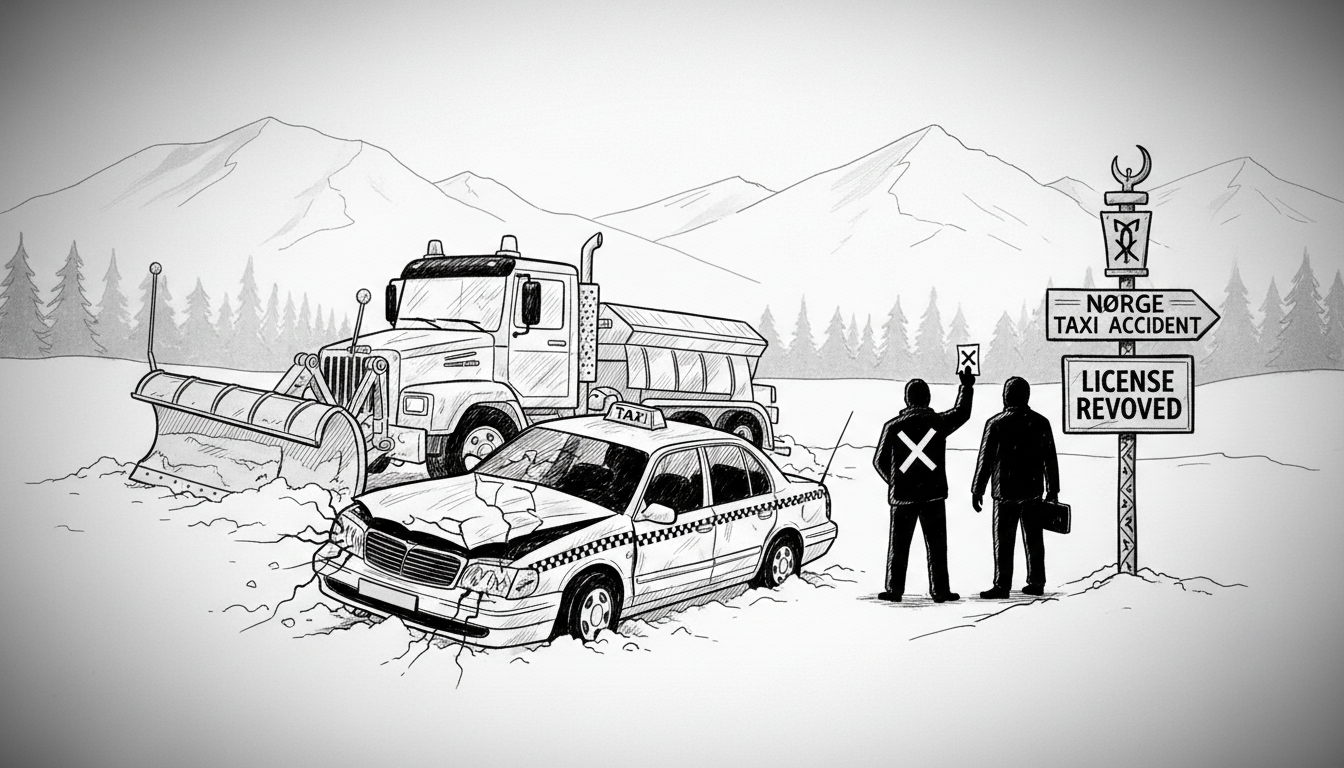
Norway road safety authorities are investigating a serious collision between a taxi and a municipal snowplow in Bærum. The incident occurred on the historic Gamle Ringeriksvei road, leaving the taxi driver injured and resulting in the immediate revocation of his professional driving license. Emergency services responded to the scene at Bærums Verk just before noon, where ambulance personnel provided medical care. The exact extent of the driver's injuries remains unclear, but the license suspension points to potential regulatory consequences beyond the immediate crash.
This accident highlights the perennial winter hazards on Norwegian roads, even in affluent and well-maintained municipalities like Bærum. Situated just west of Oslo, Bærum's mix of winding older roads and modern infrastructure creates unique challenges during snow clearance operations. The involvement of a snowplow, a vehicle critical for winter mobility but imposing in size, raises immediate questions about visibility, right-of-way, and the protocols followed by both drivers.
A Collision on a Historic Route
Gamle Ringeriksvei, or Old Ringeriks Road, is a key piece of transportation history. It served as a main artery before modern highways like the E16 were constructed, connecting the Oslo region with Ringerike. Today, it functions as a local road, often narrower and with more curves than contemporary thoroughfares. In winter conditions, these characteristics can amplify risk. Snowplows operating on such roads have limited space to maneuver, and their wide blades can extend beyond the vehicle's lane.
"Accidents involving snow removal vehicles are particularly complex to investigate," says Lars Holm, a senior advisor at the Norwegian Public Roads Administration. "The plow blade creates a cloud of snow, drastically reducing visibility for following drivers. Simultaneously, the plow driver's field of vision is often obstructed by the equipment itself. On older roads not designed for such large vehicles, the margin for error is minimal."
The police have not released details on the dynamics of the collision. Potential scenarios include the taxi attempting to pass the plow, the plow making a wide turn, or a loss of control on a slippery surface. The immediate license revocation for the taxi driver suggests police may have identified a preliminary violation of traffic rules, such as speeding for conditions, following too closely, or an unsafe passing attempt.
The Immediate Fallout: License Revocation
The decision to revoke the taxi driver's license is a significant administrative action. In Norway, police have the authority to withdraw a driving license on the spot if they believe a driver poses an immediate danger to traffic safety. For a professional driver, this is a severe blow, effectively halting their livelihood pending further investigation and potential legal proceedings.
"The revocation of a professional license following an accident is not automatic," explains attorney Kari Nilsen, who specializes in traffic law. "It indicates the responding officers found concrete evidence of serious fault or impairment. The driver will now face a dual process: a police investigation into potential criminal charges, and an administrative review by the Norwegian Public Roads Administration to determine if he can ever regain his professional driving privileges."
The taxi company involved has not been publicly named. Under Norwegian law, the company also bears responsibility for ensuring its drivers are properly trained and fit to drive, especially for winter conditions. The accident could trigger a review of the company's safety protocols by transport authorities.
Winter's Persistent Threat to Road Safety
Norway invests billions of kroner annually in winter road maintenance. Yet, accidents involving snowplows occur every season. Data from Trygg Trafikk, the Norwegian Council for Road Safety, indicates that while major incidents are rare, near-misses and minor collisions are frequent during intensive snow clearing operations. The problem is often one of perception and patience.
"Drivers sometimes see snowplows as moving obstacles rather than essential safety vehicles," says Ingrid Sundvor of Trygg Trafikk. "They take risks to get around them, misjudge the distance of the snow cloud, or fail to anticipate that a plow may need to stop or reverse. The rule is simple: maintain a very generous distance. If you can't see the plow's mirrors, the driver can't see you."
Modern snowplows are equipped with extensive lighting, reflective markings, and sometimes camera systems. However, on bright winter days with blowing snow, these can be rendered less effective. The contrast between dark taxi vehicles and the white snow spray is also a known visual challenge.
Bærum's Context: Wealth and Weather
Bærum is Norway's second-wealthiest municipality by median income. Its residents have high expectations for public services, including impeccable winter road clearance. The municipality operates a fleet of snowplows that work around the clock during storms to keep roads passable. This accident places the municipality in a difficult position, as it involves one of its own service vehicles in a harmful collision.
Municipal officials have declined to comment while the police investigation is ongoing, stating only that they are cooperating fully. An internal review of the snowplow driver's actions and adherence to operating procedures is likely underway. Snowplow drivers undergo specific training, emphasizing slow, predictable movements and constant awareness of surrounding traffic.
The accident site at Bærums Verk is a populated area with homes and businesses. Local witnesses reported hearing the collision and seeing the damaged vehicles. The taxi sustained significant front-end damage, according to initial reports, while the snowplow had damage to its rear and side areas.
What Comes Next: Investigation and Implications
The Eastern Police District will lead the criminal investigation. Officers will examine vehicle data recorders, if available, interview both drivers and any witnesses, and conduct a technical analysis of the vehicles and road conditions. The focus will be to determine whether any traffic laws were broken and if charges of negligent driving or worse are warranted.
For the taxi driver, the path forward involves medical recovery, legal counsel, and an appeal process for his license. The Norwegian Public Roads Administration will make an independent assessment of his fitness to drive, which may require medical checks and a re-testing of driving skills.
For the public, the accident serves as a stark, mid-winter reminder. Norway's battle with winter is fought not just by plows and salt trucks, but by every driver's decisions. The impatience of a single moment on Gamle Ringeriksvei has led to injury, a ended career, and another case file for safety experts who warn of the same dangers every year.
As the investigation continues, one question lingers for commuters and safety officials alike: in our demand for clear roads, do we grant the vehicles that provide that service the space and respect they need to operate safely? The answer, written in the aftermath of this Bærum crash, appears to be a work in progress.