
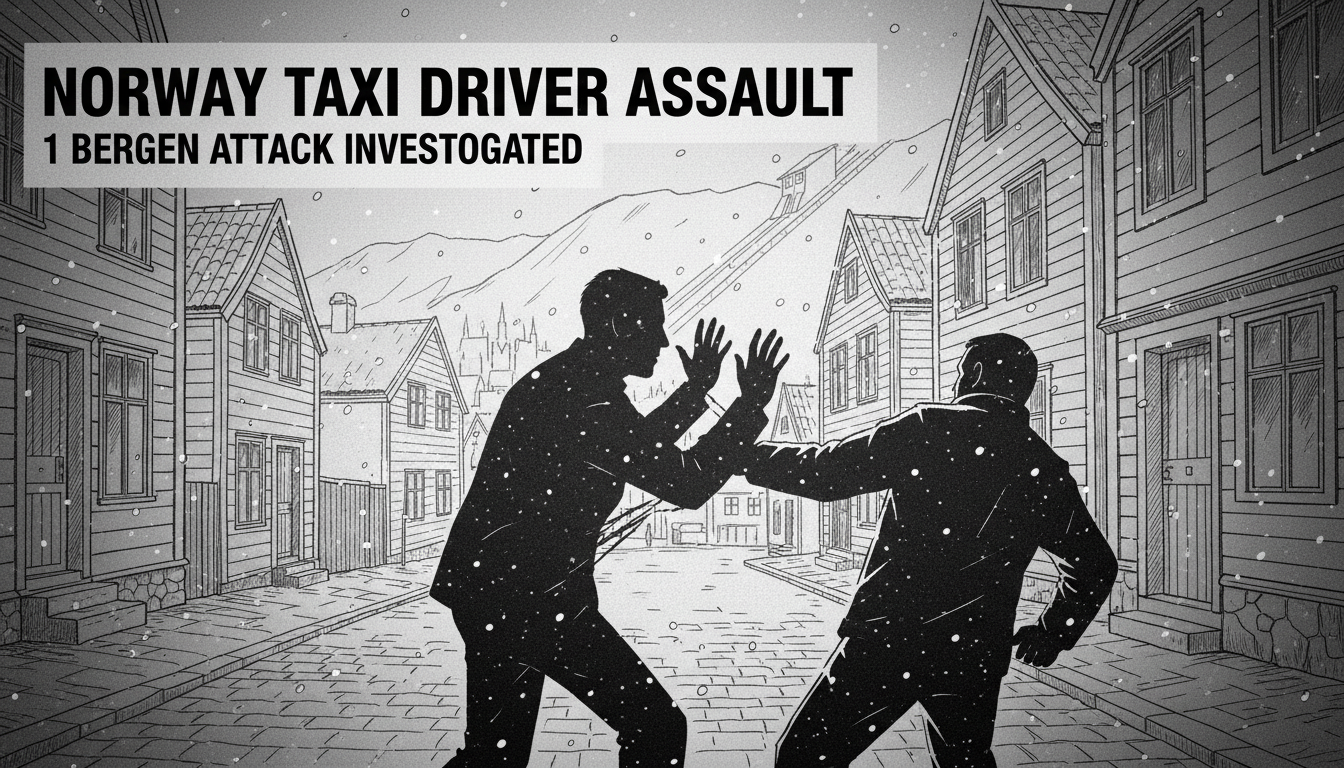
Norway taxi drivers face sporadic violence despite the nation's globally low crime rate. This reality struck in Bergen's Laksevåg borough early Thursday when a driver in his 50s was punched in the face by a stranger. The unprovoked assault, which also saw the taxi's window smashed and stones thrown at the vehicle, highlights ongoing safety concerns for service sector workers. Police have now identified and contacted a suspect, with the victim confirming his identity, leading to an official case being opened.
An Early Morning Attack
The incident occurred around 8:00 AM on Thursday. The taxi driver had arrived at a location in Laksevåg to pick up a passenger. Before he could begin his fare, an unknown man approached the vehicle. Without warning or prior acquaintance, the assailant punched the driver in the face through the open window. The attacker then proceeded to break one of the taxi's windows and pelt the car with stones before fleeing the scene on foot. The driver, though shocked and in pain, was not seriously injured. He was examined at a local emergency clinic and released, requiring no further medical follow-up for his facial injuries.
Police launched an immediate search for the suspect. By 11:00 AM, investigators reported they had been in contact with a man believed to be responsible. The victim positively identified him, allowing police to formally register the case. The investigation is ongoing, with officers working to establish a motive and the full sequence of events. The speed of the identification suggests local police had prior knowledge of the individual or used available CCTV footage from the area.
Bergen's Context and Crime Statistics
Laksevåg is a residential and industrial borough situated on a peninsula west of Bergen's city centre. Like many urban areas, it experiences a mix of quiet neighbourhoods and busier transit points. While Norway consistently ranks among the world's safest countries, its cities are not immune to random acts of violence. The annual crime report from the Norwegian Ministry of Justice and Public Security shows that approximately 7% of all solved violent crimes in Norway occur in public transport settings or against transport personnel. This category includes taxi drivers, who are particularly vulnerable due to their isolated work environment and frequent cash transactions.
Assaults on taxi drivers, while relatively rare in a national context, generate significant concern within the industry. The Norwegian Taxi Association has repeatedly called for better safety measures, including mandatory partition screens and improved GPS alarm systems linked directly to police. A 2022 survey conducted by the union indicated that nearly one in five taxi drivers in larger cities had experienced some form of physical threat or assault during their career. The majority of these incidents, like the one in Laksevåg, involved perpetrators unknown to the driver.
The Vulnerable Frontline Worker
"This is a stark reminder that safety cannot be taken for granted," says Lars Holm, a security researcher at the University of Bergen who studies workplace violence. "Taxi drivers are frontline service workers. They interact with the public in confined, mobile spaces, often at night or in isolated areas. This creates a specific risk profile." Holm notes that while Norway's overarching security is strong, targeted policies for specific professions are necessary. He points to successful programs in other Nordic countries where taxi stands in entertainment districts are monitored by security personnel during peak hours.
In Oslo, some taxi companies have implemented a 'code word' system for drivers feeling threatened, allowing them to discreetly signal for help via radio to their dispatch centre. Bergen's municipal government has discussed similar initiatives but has not yet funded a widespread program. The immediate response from police in this Laksevåg case will be scrutinized by industry representatives as an indicator of prioritization. The fact that a suspect was identified within hours is likely to be viewed positively.
Police Response and Industry Reaction
The West Police District, responsible for Bergen, confirmed the case is being investigated as an assault and vandalism. "Our officers are taking this very seriously," a police spokesperson said in a statement. "Violence against anyone performing their job is unacceptable. We are interviewing witnesses and gathering evidence." The police did not comment on whether the suspect had a previous criminal record, citing ongoing proceedings.
The local taxi operator, which has not been named publicly, is providing support to the driver, who is currently on paid leave. Industry insiders suggest such attacks can have a chilling effect, making drivers more hesitant to accept fares in certain areas or at specific times. This can reduce service availability, particularly in suburban boroughs like Laksevåg which rely on consistent transport links to the city core. The economic impact of a single assault, when accounting for vehicle repair, medical costs, and lost work hours, can run into tens of thousands of kroner.
A Broader Look at Urban Safety
The incident feeds into a broader discussion in Norwegian cities about maintaining safety amidst growing populations. Bergen, with nearly 300,000 residents, has seen its public debate occasionally focus on perceived increases in petty crime and anti-social behaviour in certain districts. City council budgets for street lighting and public space surveillance are perennially debated topics. Mayor Marte Mjøs Persen has previously stated that "safety for all citizens, including those who work at all hours, is a fundamental municipal responsibility."
Yet, statistics provide crucial context. The likelihood of being a victim of violent crime in Norway remains about four times lower than the European average, according to Eurostat data. Random attacks on strangers are exceptionally uncommon. This makes the Laksevåg assault notable precisely because of its rarity. It violates a strong social norm in Norwegian society, which expects a high degree of trust and safety in public interactions.
Will this isolated attack lead to tangible changes for Bergen's taxi drivers, or will it fade as a statistic in an otherwise secure nation? The answer may depend on the judicial outcome of the police case and the continued advocacy of the drivers' unions. For now, the driver in Laksevåg is recovering, his vehicle is being repaired, and police are building their case—one that tests Norway's reputation for safety at the most granular level.