
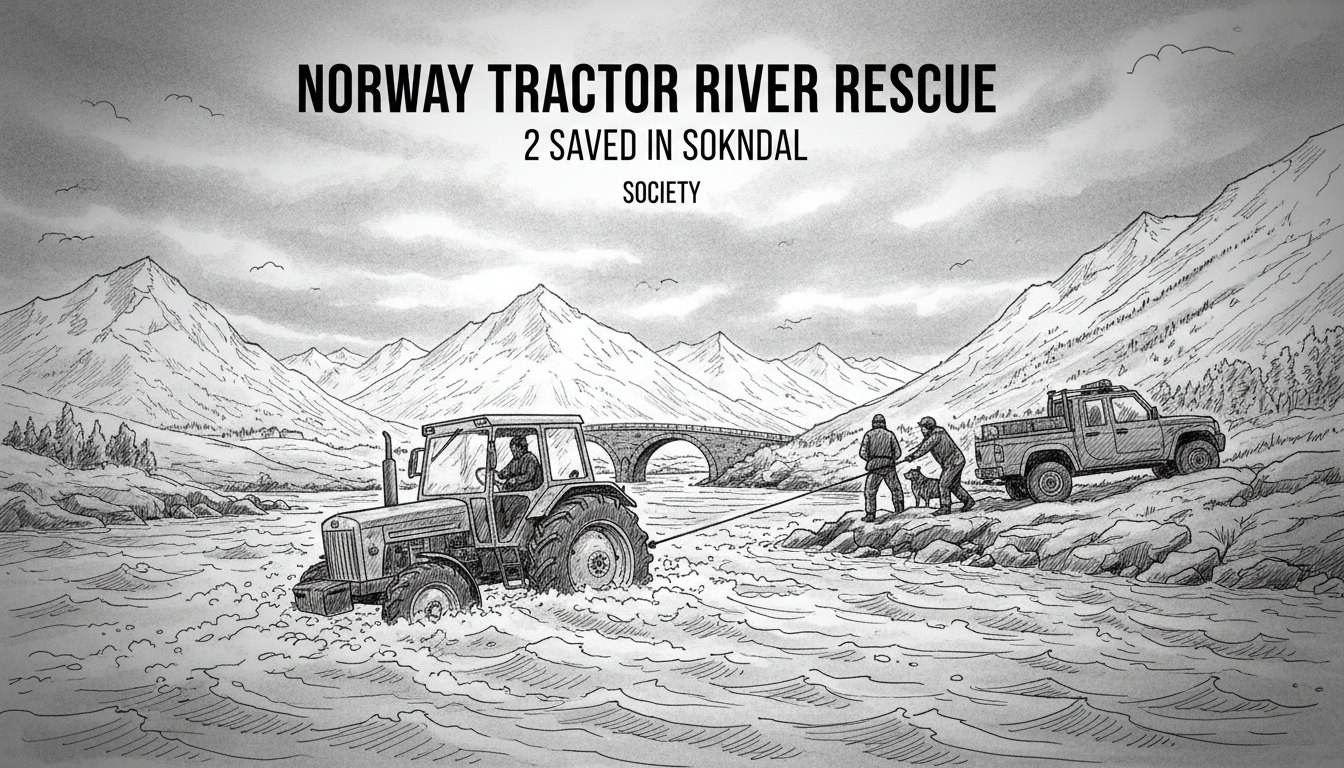
Norway tractor accident emergency services rescued two people from a submerged vehicle in a fast-flowing Sokndal river on Tuesday evening. The dramatic operation near Øynoveien involved firefighters reaching the stranded individuals by boat as they clung to the tractor's roof, with a rescue helicopter also scrambled to the scene.
A Dramatic Evening Rescue
Emergency services received the initial call just before 7:40 PM. Police first reported three people on the roof of the tractor, which had driven into the river. This was later corrected to two individuals. The strong current in the waterway presented an immediate danger, complicating rescue efforts. Fire and rescue service personnel launched a boat to reach the vehicle, which was partially submerged in the chilly water. By 7:52 PM, crews had successfully transferred both people from the tractor's roof into the boat and brought them ashore. Health personnel assessed them on the scene. Their current condition has not been disclosed, but the successful rescue prevented a potential tragedy.
The Challenges of Rural Machinery Accidents
Sokndal municipality, located in Rogaland county, is characterized by its agricultural landscape. Tractors and other farm machinery are common on rural roads, which often run close to rivers and fjords. Accidents involving such vehicles near waterways, while not frequent, present unique hazards. "A tractor is an extremely heavy piece of machinery," explained Lars Fjelldal, a veteran fire chief with experience in rural rescues. "When it enters fast-moving water, the force against it is immense. The priority is always life—extracting people from immediate danger. Stabilizing or recovering the vehicle comes later, often requiring specialized equipment and waiting for safer conditions."
The decision to leave the tractor in the river until water levels drop is standard procedure. Attempting an immediate recovery in strong currents risks further accidents and could cause environmental damage from fuel or hydraulic fluid leaks. Recovery operations will likely involve heavy cranes and low-loader trucks once the river subsides.
Anatomy of a Water Rescue Operation
This incident triggered a multi-agency response typical for rural Norwegian emergencies. Local police secured the area and managed communications. The fire and rescue service, with specific training for water operations, executed the boat-based rescue. The Norwegian Sea Rescue Society (RS) or the Norwegian Rescue Helicopter Service often provide air support, especially in remote locations, for aerial oversight and rapid medical evacuation if needed. The coordinated effort highlights Norway's integrated emergency response system, designed to cover vast and varied terrain from coastline to mountain.
Water rescues, particularly involving vehicles, are among the most technically demanding calls. Rescuers must contend with cold water temperatures, which can lead to hypothermia in minutes, unpredictable currents, and often limited visibility. The stability of the vehicle itself is a major concern, as it can shift or sink further without warning. Training for these scenarios is rigorous and continuous for Norway's emergency professionals.
The Broader Context of Agricultural Safety
While this incident had a fortunate outcome, it casts a spotlight on the inherent risks of agricultural work. Norway's Directorate for Civil Protection (DSB) and the Norwegian Labour Inspection Authority work to promote safety protocols for farming operations. These include guidelines for machinery maintenance, safe driving practices on uneven terrain, and awareness of environmental hazards like steep slopes and bodies of water. Many farms in regions like Rogaland are family-run, where operational pressures can sometimes conflict with strict safety routines.
"Every accident is one too many," stated a representative from the Norwegian Farmers' Union. "We continuously work with our members and authorities to improve safety culture. This event is a stark reminder to always assess the route, especially near water, and to be aware of weather conditions that can change ground stability and water levels rapidly." Seasonal factors play a role; melting snow or recent rainfall can swell rivers, making familiar paths more hazardous.
What Happens Next: Recovery and Review
The immediate aftermath now shifts to the recovery phase. The tractor, a significant asset for any farm, remains an environmental and navigational hazard in the river. The owner, in coordination with local authorities and likely insurance assessors, will plan its removal. This process requires permits and careful execution to prevent pollution from fuels or oils. The cost of recovery and potential loss of the vehicle can be a substantial financial blow to a farming operation.
Officially, the police will investigate the circumstances leading to the tractor entering the river. This is standard procedure to determine if any technical failure, human error, or external factor caused the accident. The findings can contribute to broader safety advisories. For the two individuals involved, the psychological impact of such a traumatic event can be significant, even with a physical escape unscathed.
A Close Call in the Norwegian Countryside
The Sokndal river rescue ended not with a statistic, but with two people safe on dry land. It underscores a quiet reality in Norway's picturesque rural areas: daily life and work carry real risks, mitigated by skilled emergency responders and robust systems. The sight of a tractor in a river is a jarring disruption to the pastoral calm. It speaks to sudden misfortune, but also to the swift, professional response that is a cornerstone of Norwegian public safety. As the community reflects on this close call, the tractor will eventually be pulled from the water. The memory of the rescue, however, will linger as a testament to both vulnerability and resilience in the face of Norway's powerful natural elements.