
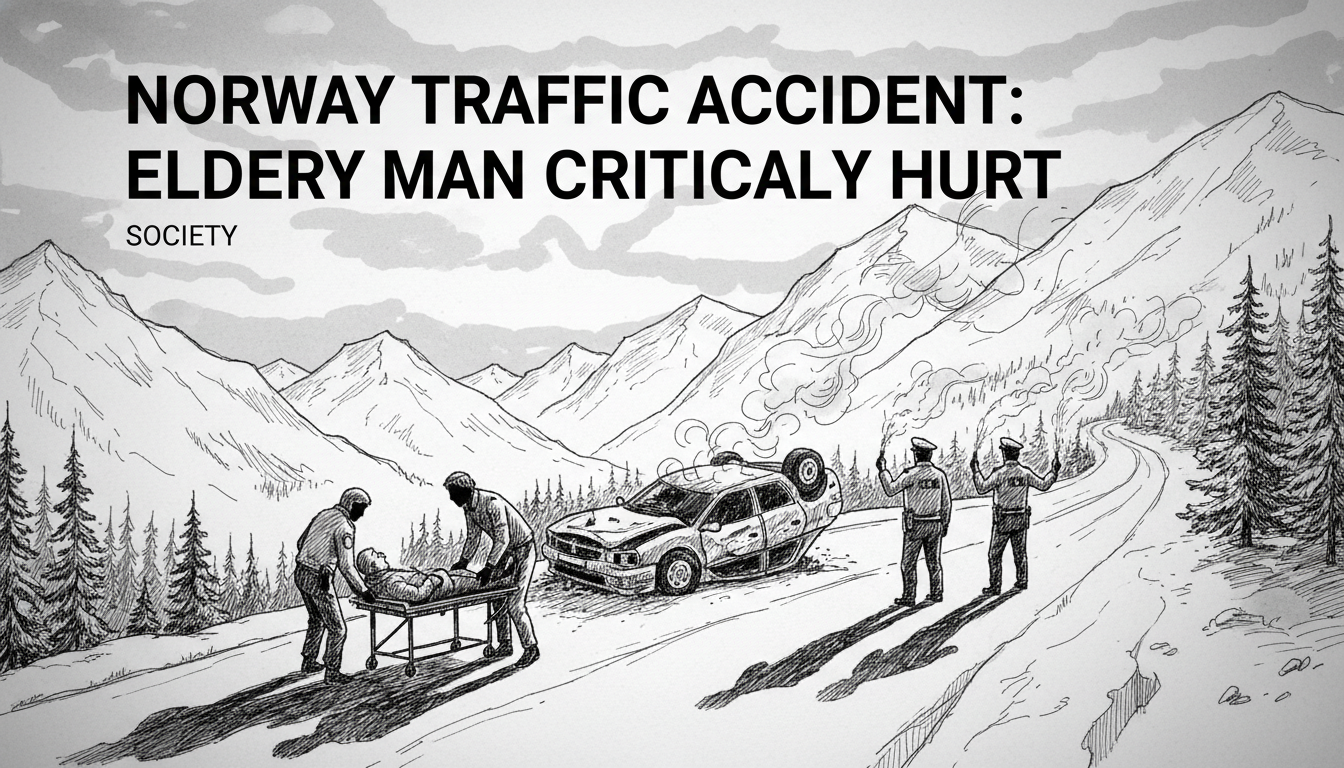
Norway emergency services responded to a serious head-on collision in Eidsvoll on Thursday morning. Two cars collided front-to-front on a road in the municipality north of Oslo. One man, in his 70s, was transported to hospital with critical injuries.
Operational manager Ørjan Hustad confirmed both drivers were conscious after the impact. Initial police reports indicate one vehicle likely crossed into the oncoming lane. The exact cause remains under active investigation.
Both cars sustained significant damage and required recovery from the scene. The road was closed for several hours as police forensic teams documented evidence. Traffic was diverted around the crash site, causing local disruptions.
Emergency Response and Investigation
Police and ambulance crews arrived at the scene shortly after the collision was reported. The critically injured man received immediate medical attention before being rushed to a major trauma center. His current condition has not been disclosed.
"The investigation is in its early stages," a police spokesperson said in a statement. "Our traffic accident investigators are now working to establish a precise sequence of events." This process typically involves measuring skid marks, examining vehicle damage patterns, and interviewing any witnesses.
Investigators will consider multiple factors, including driver attention, possible mechanical failure, and road conditions at the time. The stretch of road where the accident occurred is now subject to technical scrutiny.
Eidsvoll's Roads in Focus
Eidsvoll, with a population of approximately 27,000, is a key municipality in Akershus county. It is bisected by major roads, including the European route E6, one of Norway's busiest highways. While this accident did not occur on the E6, it highlights perpetual road safety concerns in the region connecting Oslo to the north.
Local authorities have previously discussed traffic safety measures on municipal roads. This incident near a community steeped in national history—where Norway's constitution was signed in 1814—brings a somber note to the area.
Residents often express concerns about traffic speed and safety on certain local routes. This serious collision will likely renew those discussions at the municipal council level.
Norway's Road Safety Record
Norway maintains one of the world's lowest rates of traffic fatalities, a result of decades of strict policy. Vision Zero, a strategy to eliminate all serious road injuries, is a cornerstone of Norwegian transport policy. Yet, serious accidents persist, particularly on rural and municipal roads outside the major highway network.
Single-vehicle accidents and head-on collisions represent a significant portion of severe trauma cases in Norway. Experts consistently point to human error as the predominant cause, often involving a lapse in attention or misjudgment.
"Every serious accident is a tragedy and a reminder that safety work never stops," said a transport analyst familiar with Nordic road data. "The focus is always on infrastructure, vehicle technology, and driver behavior. Even on familiar local roads, the risk is present."
Advanced vehicle safety systems, like automatic emergency braking and lane-keeping assist, are becoming more common in Norway's car fleet. Their role in potentially preventing or mitigating such collisions forms part of modern accident analysis.
The Human Impact Beyond the Crash
For the families involved, the aftermath of a critical collision is a life-altering event. The immediate crisis response transitions into a long period of medical care, potential rehabilitation, and psychological trauma.
The community of Eidsvoll is also affected. News of a severe local accident resonates deeply in smaller municipalities where people often have personal connections. It shatters the ordinary rhythm of a weekday morning.
First responders, while trained for such events, also carry the weight of these incidents. Their swift work at the scene is the first critical link in the chain of survival for the seriously injured.
Looking Ahead: The Inquiry's Findings
The police investigation will now follow a meticulous protocol. If the vehicle that crossed the centerline is equipped with an event data recorder, investigators may download information on speed, braking, and steering inputs in the seconds before impact.
Weather data for the time of the accident will be reviewed. Road surface conditions, including any potential gravel, moisture, or ice, will be assessed. A final report could take several weeks or months to complete.
Depending on its findings, the case may be forwarded to the public prosecutor for consideration of charges. More broadly, the findings could inform local road safety assessments, potentially leading to recommendations for physical alterations like improved lane markings, rumble strips, or signage.
Norway's commitment to Vision Zero means every fatal or serious injury accident is analyzed for systemic lessons. While the primary focus remains on the injured individual and his family, the data point from Eidsvoll will eventually feed into the national effort to make roads safer.
The quiet roads of a historic Norwegian municipality have become the latest setting for a sudden, violent crash. This incident underscores a universal truth: the task of preventing human tragedy on the roads is never finished, demanding constant vigilance from drivers, planners, and policymakers alike.