
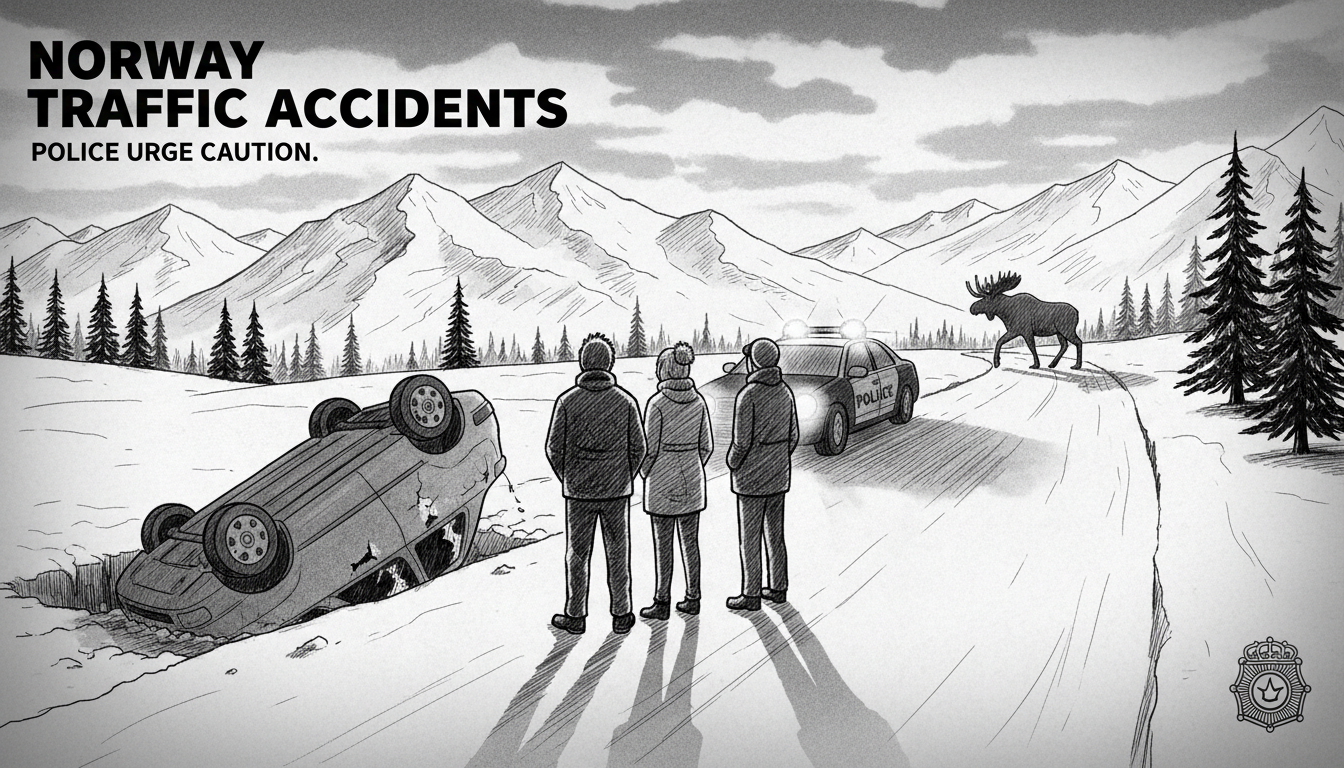
Norway police reported multiple traffic accidents across the Østlandet region Tuesday morning, urging drivers to adjust to slippery conditions. Operasjonsleder Kjetil Elnan Ringseth in the Øst police district issued a direct plea via police logs. 'We ask everyone to take it easy and drive according to the conditions,' Ringseth said in a statement. Between 6:00 and 9:00 AM on January 6, 2026, emergency services responded to incidents in the municipalities of Rælingen, Jevnaker, Eidsvoll, and Kløfta. No fatalities were immediately reported, but the cluster of collisions has spotlighted perennial autumn road safety challenges in Norway's most populous area.
Police Respond to Morning Chaos
The Øst police district, one of twelve in Norway, coordinated the response to the scattered accidents. Officers emphasized that initial reports pointed to weather-related factors. Early morning temperatures hovered near freezing, with rain and frost creating hazardous black ice on many roads. This rapid response highlights standard protocol for multi-accident events, where police prioritize clearing scenes and issuing public warnings. The affected municipalities—Rælingen, Jevnaker, Eidsvoll, and Kløfta—are all located within the broader Oslo metropolitan area. They now fall under the counties of Akershus, Buskerud, and Østfold, following the dissolution of the former Viken county in 2024.
Police logs indicated property damage and minor injuries, though full assessments were ongoing. The operational focus remained on preventing further incidents. 'When we see a pattern like this in a short timeframe, the immediate goal is to get the message out to all motorists,' a police spokesperson noted. Authorities routinely monitor weather forecasts and road sensor data, but sudden shifts in conditions can outpace warnings. Tuesday's events serve as a stark reminder that the transition into deeper winter requires constant vigilance from drivers.
Østlandet: Norway's Traffic Heartland
Understanding the impact of these accidents requires context about the Østlandet region. This southeastern part of Norway is the nation's demographic and economic core. It encompasses the capital Oslo and its sprawling suburbs, home to approximately 2.8 million people. According to Statistics Norway (SSB), this represents just over 50 percent of the country's total population of 5.5 million. The region's extensive road network, including the E6 highway that connects many of the affected areas, handles immense daily traffic volumes. Commuters from these suburbs flow into Oslo for work, making morning rush hour a critical period for safety.
The geography of Østlandet contributes to its tricky driving conditions. The terrain mixes coastal lowlands with forested hills, leading to microclimates where ice can form unpredictably. Roads winding through areas like the Rælingen outskirts or near Jevnaker's lakes are particularly susceptible to sudden frost. Municipalities invest heavily in winter maintenance, but salting and plowing operations cannot cover every road simultaneously. This reality places a significant onus on individual driver preparedness and judgment.
The Numbers Behind Norway's Roads
While Tuesday's accidents were non-fatal, they occur against a backdrop of national traffic safety statistics. According to the latest complete annual data from Statistics Norway, 117 people died in road traffic accidents in 2023. This figure represents a slight increase from 2022 but continues a long-term downward trend in fatalities. The number of people seriously injured in road traffic incidents was 592 in 2023, a decrease from the 607 recorded in 2022. Preliminary data for 2024 is still being compiled, but authorities indicate that winter months consistently show a spike in collision reports.
Norwegian road safety targets are ambitious, aligned with the Vision Zero policy that aims to eliminate all traffic fatalities and serious injuries. The recent incidents highlight the gap between policy goals and on-ground realities. Investment in safer road infrastructure, such as improved lighting and barrier systems, has progressed in urban centers. However, secondary roads in suburban and rural parts of Østlandet often lack these upgrades. The economic cost of traffic accidents, including emergency services, healthcare, and lost productivity, runs into billions of kroner annually.
Winter's Toll on Norwegian Drivers
Expert analysis consistently points to driver behavior as the most significant variable in winter traffic safety. 'The single most effective action a driver can take is to reduce speed and increase following distance when conditions are poor,' explains transport safety researcher Marianne Hauge. She notes that many drivers fail to adjust their summer habits, even when faced with clear warnings. Modern vehicle safety features like anti-lock brakes and stability control can create a false sense of security on ice. Hauge emphasizes that no technology can overcome the laws of physics on a slippery surface.
Seasonal tire regulations are strictly enforced in Norway, requiring winter or all-weather tires with adequate tread depth from November to April. Yet compliance checks still find vehicles with worn tires. Beyond equipment, distraction remains a critical issue. The use of mobile phones while driving, even hands-free, diverts cognitive attention needed for hazard perception on unstable roads. The police message to 'drive according to the conditions' encapsulates this broader need for situational awareness. It means accounting for reduced visibility at dawn, glare from low winter sun, and the presence of vulnerable road users like cyclists and pedestrians.
Policy Responses and Infrastructure Gaps
The cluster of accidents invites scrutiny of governmental and municipal road safety strategies. At the national level, the Ministry of Transport and Communications sets guidelines, but implementation falls to local agencies. Following the dissolution of Viken county, the redistributed responsibilities among Akershus, Buskerud, and Østfold have required coordination adjustments. Some traffic safety advocates argue that winter maintenance budgets have not kept pace with suburban expansion. Roads in newer housing developments may receive less frequent salting than major arteries.
Investment in real-time information systems has increased. The Norwegian Public Roads Administration operates a network of weather stations and webcams, providing public data on road conditions. However, uptake among drivers is inconsistent. There is also ongoing debate about lowering speed limits on certain routes during winter months. Such variable limit systems, used in other Nordic countries, face hurdles in Norway due to cost and enforcement questions. The Storting's standing committee on transport frequently reviews these issues, with partisan divides often centering on funding sources versus personal responsibility.
A Look Ahead: Safety in a Changing Climate
As Norway grapples with climate change, winter road conditions may become more volatile. Milder autumns can lead to more freeze-thaw cycles, creating black ice more frequently. This environmental shift could challenge existing safety frameworks. Research institutions like the Institute of Transport Economics are studying how changing precipitation patterns might affect accident rates. Their preliminary models suggest an increase in certain types of collisions if adaptation measures are not enhanced.
For now, the immediate task falls to drivers navigating the Østlandet roads. The police warning from Tuesday morning echoes decades of similar advisories. Yet the persistence of these accident clusters suggests that cultural and behavioral change is slow. Educational campaigns in schools and through media continue to target young drivers. Insurance companies offer discounts for vehicles equipped with advanced safety features, providing a financial incentive for preparedness.
The ultimate question remains: how can Norway better protect its citizens on the roads during the most dangerous seasons? The answer lies in a combination of technology, infrastructure investment, and a collective commitment to cautious driving. As the sun set on a chaotic Tuesday, the hope was that the message of caution would resonate long after the tow trucks had left the scene.