
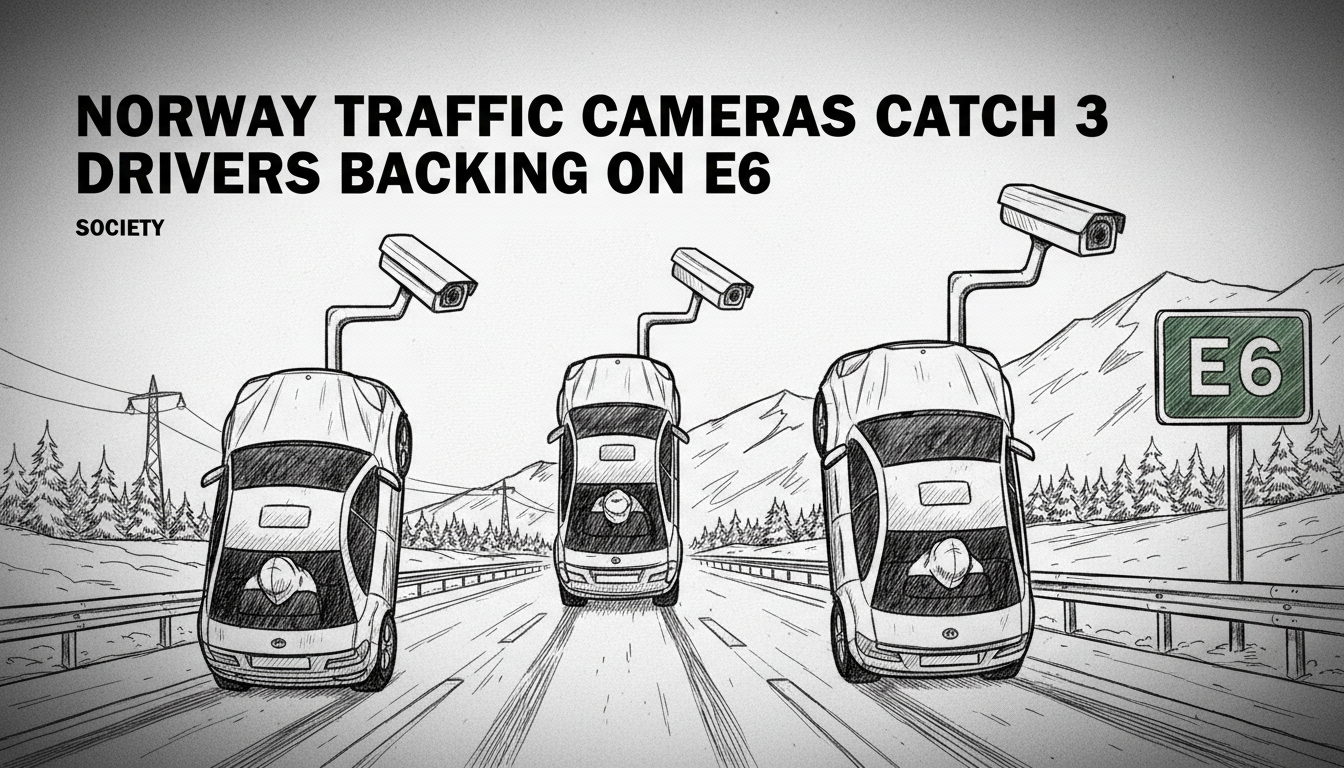
Norway traffic laws are facing a critical enforcement test after three drivers were caught on camera performing a dangerous and illegal maneuver on one of the country's busiest highways. Police in the Innlandet district have identified three vehicles that reversed against the flow of traffic on the E6 motorway near Ringsaker. The incident, captured by the Norwegian Public Roads Administration's traffic monitoring system, will likely result in driver's license suspensions and substantial fines for those involved.
"This will be followed up by a police lawyer, but in principle it is quite clear that if you turn around or reverse on a motorway, it is associated with a driver's license seizure, in addition to a fine," said Frode Øvreås of the Innlandet Police District. He described the potential fine only as "high," underscoring the serious view authorities take of such violations. The E6, a vital north-south artery, sees high-speed traffic where any wrong-way movement creates an immediate and severe collision risk.
A High-Stakes Gamble on Norway's Main Artery
The specific stretch of the E6 in Ringsaker, north of Oslo, is a controlled-access motorway where speeds regularly exceed 100 km/h. Reversing or making a U-turn in such an environment is considered one of the most severe traffic offenses under Norwegian law. The automatic camera systems, part of what police call the "road traffic center's excellent camera service," are designed for traffic management but also provide crucial evidence for prosecuting dangerous driving.
Legal experts confirm the police's initial assessment. "The law on this is unambiguous," says legal analyst Henrik Mjelde, who specializes in traffic law. "Operating a vehicle against the lawful direction of travel on a motorway is a direct violation of the Road Traffic Act. The prescribed sanction is almost always a mandatory license suspension, typically for a period of months, and a significant fine. The courts have very little discretion here because the danger is so absolute." The license seizure is immediate upon the final ruling, and drivers must often retake parts of their driving test to regain their license.
The Technology Behind the Traffic Watch
The Norwegian Public Roads Administration (Statens Vegvesen) operates an extensive network of cameras along major highways like the E6. These are primarily used by the National Traffic Control Center to monitor congestion, accidents, and weather conditions. However, as this case demonstrates, the recorded footage can be and is used forensically by police to investigate specific violations, especially those posing grave public safety risks.
This integration of traffic management and law enforcement represents a modern approach to road safety. "The cameras are there for safety and flow," explains a spokesperson for the roads administration. "When we observe behavior that endangers others, cooperation with the police is a natural step. The goal is deterrence and prevention, not just prosecution." For drivers, the message is clear: on Norway's monitored motorways, dangerous actions are likely to be recorded and investigated.
Why Reversing on a Motorway Triggers Severe Penalties
Traffic safety researchers stress that the extreme penalty fits the extreme risk. "On a high-speed road, other drivers are not expecting a vehicle to be stationary, let alone moving in the opposite direction," says Dr. Anette Thomassen, a traffic psychologist at the Institute of Transport Economics. "The closing speed in a head-on collision can be catastrophic. A driver who has missed an exit and decides to reverse is prioritizing minor personal convenience over the fundamental safety of every other road user. It is a conscious decision to create an enormous hazard."
The act indicates a profound failure in risk assessment, she argues. "It suggests the driver is either unaware of the basic rules of the motorway or willfully ignores them. In either case, removing that driver's license is a proportionate measure to protect public safety." Common reasons for such maneuvers—missing an exit, realizing a wrong turn—are not considered mitigating circumstances under Norwegian law due to the magnitude of the danger created.
The Legal Process and Consequences for Drivers
The three drivers identified now face a formal legal review. A police jurist will examine the camera evidence and prepare the case. The offenders will receive a formal charge, leading to a court hearing. While they can present a defense, the visual evidence from the traffic cameras makes a successful challenge difficult.
The fine is determined by the court based on guidelines and the driver's income, but for a violation of this severity, it often runs into several thousand Norwegian kroner. The driver's license suspension is mandatory. The length of the suspension can vary but typically starts at three months for a first offense of this nature. Insurance implications are also severe, with premiums likely to rise dramatically following such a conviction.
A Broader Message on Road Safety Culture
This incident on the E6 is not an isolated case but part of a pattern Norwegian authorities are determined to break. Each prosecution sends a message about the non-negotiable standards required on high-speed roads. Norway has consistently invested in both physical road safety and strict enforcement to achieve its low traffic fatality rates.
"The system worked as it should here," says Øvreås. "The dangerous behavior was detected, evidence was secured, and the legal process is moving forward. We hope this serves as a clear reminder to all drivers: if you miss your exit on a motorway, continue to the next one. The alternative is not a shortcut—it is a fast track to losing your license, a heavy fine, and potentially causing a tragic accident."
The case underscores a zero-tolerance policy for actions that transform a safe road into a lethal environment. As camera technology and police integration advance, the likelihood of being caught for such reckless acts increases. For the three drivers caught in Ringsaker, the price of a momentary lapse in judgment will be high, serving as a stark warning for anyone considering a similar gamble on Norway's highways.