
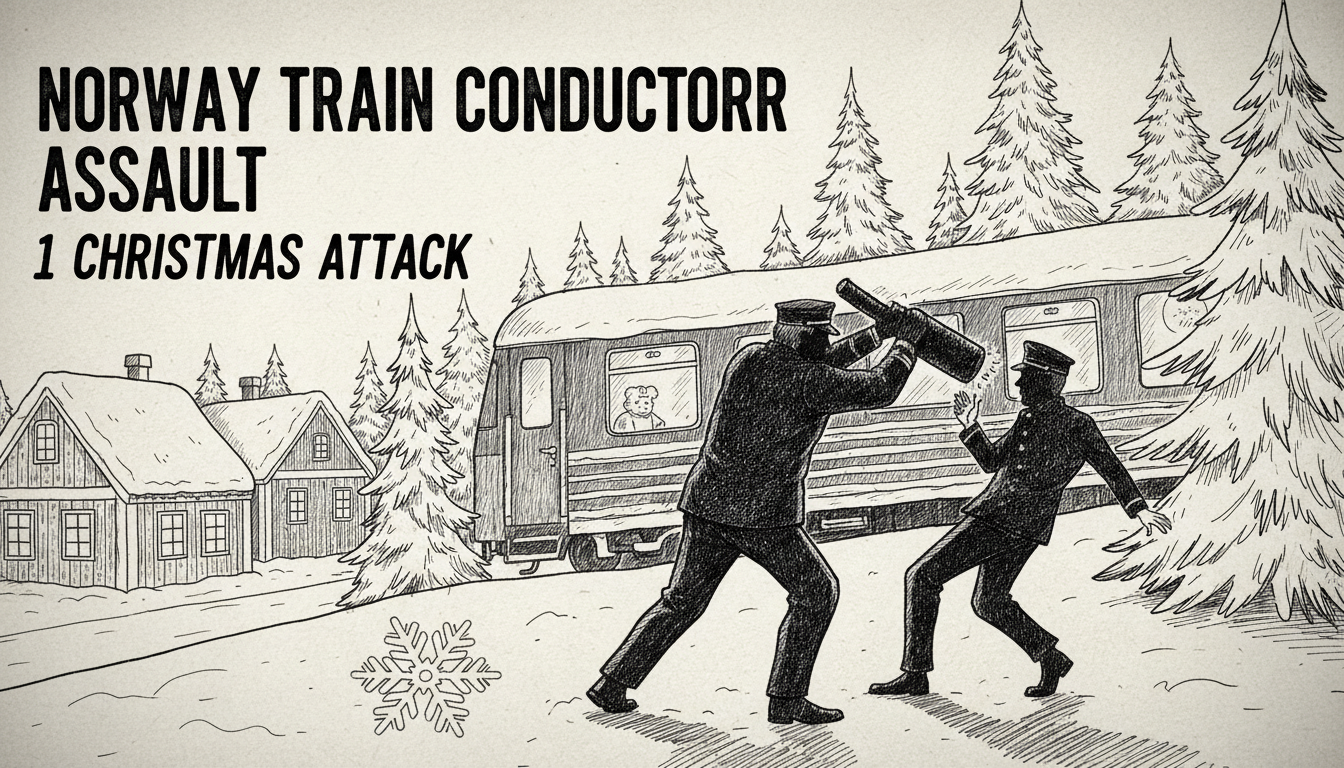
Norway's generally safe public transport system recorded an unusual violent incident on December 24th, when an intoxicated passenger attacked a train conductor at Nydalen station in Oslo. The assault on the Gjøvik-bound train operator has sparked immediate concern among transport unions and prompted a police investigation, raising questions about worker safety during holiday operations.
A Violent Interruption to Christmas Travel
The incident unfolded just after 7:00 PM on Christmas Eve, a time when many Norwegians were completing their final journeys to celebrate with family. The train, operated by state-owned Vy, was traveling from Oslo Central Station towards Gjøvik, approximately 130 kilometers north. According to police logs, the conductor heard noise outside the driver's cabin and stepped out to investigate on the platform at Nydalen, a major suburban station. He was then, as police described it, 'apparently unprovoked' struck by a man who appeared to be heavily intoxicated. The assailant attempted to flee along Ring 3, one of Oslo's main motorways, but was apprehended by responding officers and taken into custody. The conductor received medical treatment at an emergency clinic, while a replacement driver was dispatched to continue the service to Gjøvik after significant delays.
The Ripple Effect on a Critical Line
The Gjøvik Line (Gjøvikbanen) is a vital transport artery connecting the Norwegian capital to towns in the interior of Viken county. It serves commuters from areas like Lillestrøm, Jaren, and Hønefoss, and its punctuality is closely monitored. Vy, the national railway company, reported that the attack caused substantial disruptions to the evening schedule. While such direct violence against staff is statistically rare, a single incident can create cascading delays across the network, affecting hundreds of passengers. 'The safety of our employees is our absolute highest priority,' a Vy spokesperson said in a statement following the event. 'Any attack on our staff is unacceptable and will be reported to police.' The company has protocols for supporting assaulted employees, including immediate medical care and psychological follow-up.
A Broader Look at Safety and Security
This Christmas Eve assault forces a difficult conversation about security on Norway's open-access public transport systems. Norwegian trains and stations typically have minimal visible security presence, relying on a general culture of trust and low crime rates. Statistics Norway (SSB) data shows that while overall assault rates in Oslo have seen fluctuations, they remain low by international standards. However, specific statistics on violence against transport workers are not systematically published, making broader trends harder to track. Transport unions have long highlighted the vulnerability of conductors and drivers, who often work alone and interact directly with the public in confined spaces. 'Our members should not have to fear for their physical safety when doing their job,' said a representative from the Norwegian Union of Railway Workers (Norsk Jernbaneforbund). 'This incident, especially on Christmas Eve, is a grim reminder that we cannot take safety for granted.'
The Intersection of Substance Abuse and Public Disorder
Experts point to the role of substance abuse as a recurring factor in such random acts of public violence. The police description of the suspect as 'intoxicated' aligns with a pattern seen in other disruptive incidents on public transport. Sociologists note that urban centers like Oslo, despite their wealth and social support systems, still struggle with public intoxication and associated anti-social behavior, particularly around holiday periods when support services may have reduced hours. 'An incident like this is often a symptom of deeper individual and social issues,' noted Dr. Erik Larsen, a sociologist at the University of Oslo who studies urban environments. 'While Norway has a strong welfare system, acute intoxication can lead to unpredictable violence, and public transport hubs are where different parts of society intersect, sometimes with conflict.'
Industry Response and Preventative Measures
In response to previous incidents, the transport industry has explored various preventative measures. These include increased surveillance camera coverage on trains and at stations, the use of emergency alarm systems that directly link staff to security centers, and campaigns encouraging passenger reporting of concerning behavior. Some regions have experimented with dedicated security patrols on late-night services. However, implementing widespread physical security presence is costly and conflicts with the Norwegian preference for open, accessible public spaces. The debate often centers on finding a balance between security, cost, and maintaining the welcoming nature of the transport network. Following this attack, union leaders are expected to renew calls for a formal risk assessment of solo working practices and for clearer legal consequences for assaulting public servants.
Looking Ahead: Policy and Protection
The Christmas Eve attack will likely prompt internal reviews at both Vy and the Norwegian National Rail Administration (Bane NOR). Key questions will focus on whether existing de-escalation training for staff is sufficient and if station design at busy hubs like Nydalen can be improved to offer staff safer retreat options. Politically, the incident may put pressure on the Ministry of Transport to examine industry-wide safety standards. While major policy shifts are unlikely from a single event, it adds weight to ongoing union advocacy. For the traveling public, the incident is a jarring reminder of the human element behind their daily commute. The conductor, now recovering, represents thousands of transport workers who ensure mobility across Norway's challenging geography, often during unsocial hours and holidays. His assault underscores that their security is fundamental to the system's operation. As Norway reflects on this event, the challenge will be addressing real safety concerns without eroding the social trust that makes its public transport a model for others. Can Norway maintain its open, accessible systems while ensuring no employee faces violence for simply doing their job? The answer will shape the future of travel in the Nordics.