
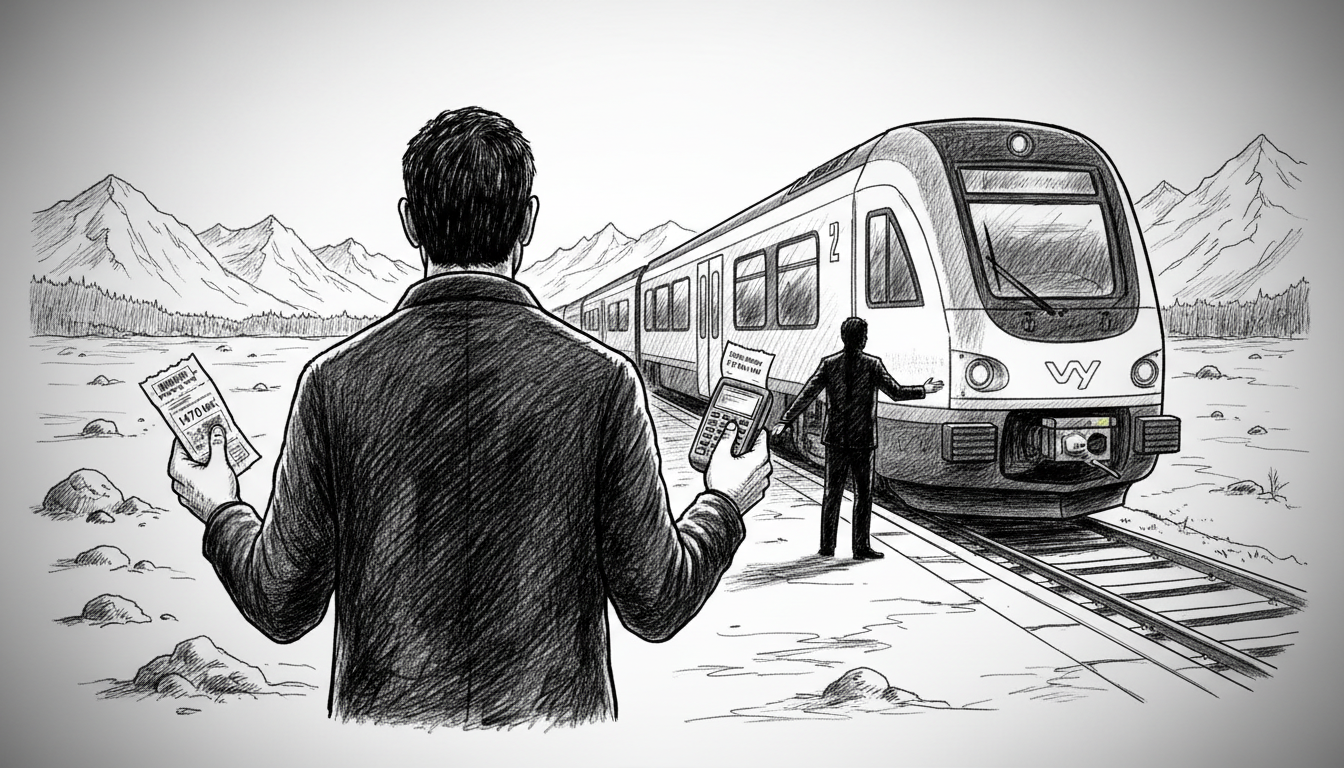
Norway's public transport system penalized a commuter with a 1470 NOK fine despite his possession of a valid monthly ticket. Oskar Asdøl Aalde's phone battery died minutes before a ticket inspection on his Vy train from Asker to Oslo. This incident exposes the rigid enforcement of digital ticketing rules that many passengers may not fully understand.
Oskar's Wednesday morning commute began like any other. He boarded the train for his 40-minute journey to work. Four minutes before his stop, ticket controllers appeared. He reached for his phone to display his digital monthly pass. The screen remained black. His battery was dead. The controllers issued an on-the-spot fine of 1470 Norwegian kroner.
"It was my fault that I didn't have battery on my phone, and I understand that I got a fine," Oskar said. He accepted the penalty notice, assuming the matter would be resolved quickly. He had, after all, purchased and paid for a valid monthly travel card. He believed common sense would prevail.
A System With No Room for Error
Later that same day, Oskar emailed Vy's customer service. He explained the situation and provided documentation proving his active monthly subscription. The response was unequivocal. Because he was sitting in a carriage marked "valid ticket required" and could not physically show his ticket, the fine would stand.
Vy's customer service representative pointed to a specific rule in their terms. Passengers using electronic tickets must ensure their mobile device has sufficient battery for the entire journey. "If you cannot show your ticket, it is considered traveling without a valid ticket," the handler wrote. The rule is absolute, offering no exceptions for technical failures.
Oskar notes that his situation would have been identical in any carriage. His digital ticket was linked solely to his mobile device, which held no charge. He carried no physical backup card. The system's design had created a single point of failure for him as a passenger.
The Burden of Proof Falls on the Passenger
Faced with the upheld fine, Oskar saw no alternative but to pay the 1470 NOK. The amount is just a few hundred kroner less than the cost of a full monthly pass itself. He paid, but was left with a strong sense of injustice.
"I think it's completely unreasonable that I still have to pay, after having documented a valid ticket. I can hardly believe it's legal," he stated. The experience revealed a gap between consumer expectation and corporate policy. Many commuters operate on the assumption that proving purchase after the fact should suffice.
"It came as a big surprise to me. I think very many people are not aware of this," Oskar added. His case highlights a common vulnerability in the shift to fully digital services. Human error or device failure can instantly transform a paying customer into a fare evader in the eyes of the system.
Monopoly Power and Consumer Choice
Oskar expressed a desire to use his consumer power to protest the decision. In a competitive market, he would take his business elsewhere. "Had I had a choice as a customer, then I would never use this provider again. But Vy has a monopoly, and I have to take the train to work," he explained.
This lack of alternatives is a key factor in the dynamic. For many Norwegians, especially commuters in the Oslo region, Vy is not a discretionary service. It is an essential utility. This reality can limit the pressure for customer-centric flexibility in rule enforcement.
Is a Better Technical Solution Possible?
Oskar believes the system itself could be designed with more forgiveness. He points to the existing verification step during a fine issuance. "The controllers ask for ID anyway when they give the fine. It should be possible to connect the customer to Vy's data systems, and thus verify ticket purchase," he suggested.
This technical fix seems logical to the average passenger. A controller's handheld device could, in theory, query a central database using a passenger's official ID number. It could check for an active monthly pass or recent ticket purchase linked to that identity. Such a system would decouple proof of payment from the passenger's personal device battery.
Vy's current stance prioritizes operational simplicity and fraud prevention. The rule is clear and easy for staff to enforce uniformly. Introducing discretion or real-time database checks could slow down inspections and create inconsistencies. However, it also risks punishing loyal customers for minor, non-malicious mishaps.
Expert Views on Consumer Rights and Fairness
Consumer rights organizations often argue for proportionality in such cases. The principle is that a penalty should fit the infraction. When a passenger can conclusively prove they had paid for the service, a full fare-evasion fine may seem disproportionate. It treats a technical glitch the same as intentional theft of service.
Transport companies counter that clear, unwavering rules are necessary to maintain fairness for all passengers and deter deliberate evasion. If exceptions are made for dead batteries, the argument goes, it opens the door for abuse. People could deliberately turn off their phones to avoid inspection, then later claim a dead battery.
Finding a balance is challenging. One potential middle ground is a tiered penalty system. A reduced administrative fee could be applied to customers who can later prove purchase, while the full 1470 NOK fine remains for those with no valid ticket at all. This would acknowledge the difference between forgetfulness and fraud.
A Warning to All Digital Commuters
Oskar's story serves as a stark warning to the millions who rely on digital tickets. "In today's fully digital and hectic everyday life, I'm probably not the last person who can't show their electronic ticket," he noted. The convenience of a phone-based ticket comes with a new responsibility: constant power management.
Passengers must now treat their phone's battery life as critically as their wallet. A dead phone doesn't just mean no social media; it can mean a significant financial penalty. This incident underscores the need for passengers to familiarize themselves with the specific terms and conditions of their transport provider, not just the price.
The Future of Frictionless Travel
The push towards smart cities and seamless mobility often champions completely frictionless travel. Imagine systems where you simply board and alight, with payment handled automatically in the background via location tracking or Bluetooth. Oskar's experience shows we are not there yet. Our current hybrid systems—digital tickets on personal devices—introduce new points of friction and failure.
For true frictionless travel to work, the verification system must be robust and owned by the service provider, not the passenger. Until then, commuters are advised to carry a power bank, ensure their phone is charged before travel, or consider a physical backup card if available. The burden of system reliability, for now, rests on the individual.
Oskar's case is closed, his fine paid. But the question it raises remains open for public debate: In the rush towards digital efficiency, have we lost a necessary measure of common sense and customer trust? As more essential services migrate to our smartphones, the line between user error and system failure will only become blurrier. The response from companies like Vy will define whether our digital future is forgiving or relentlessly strict.