
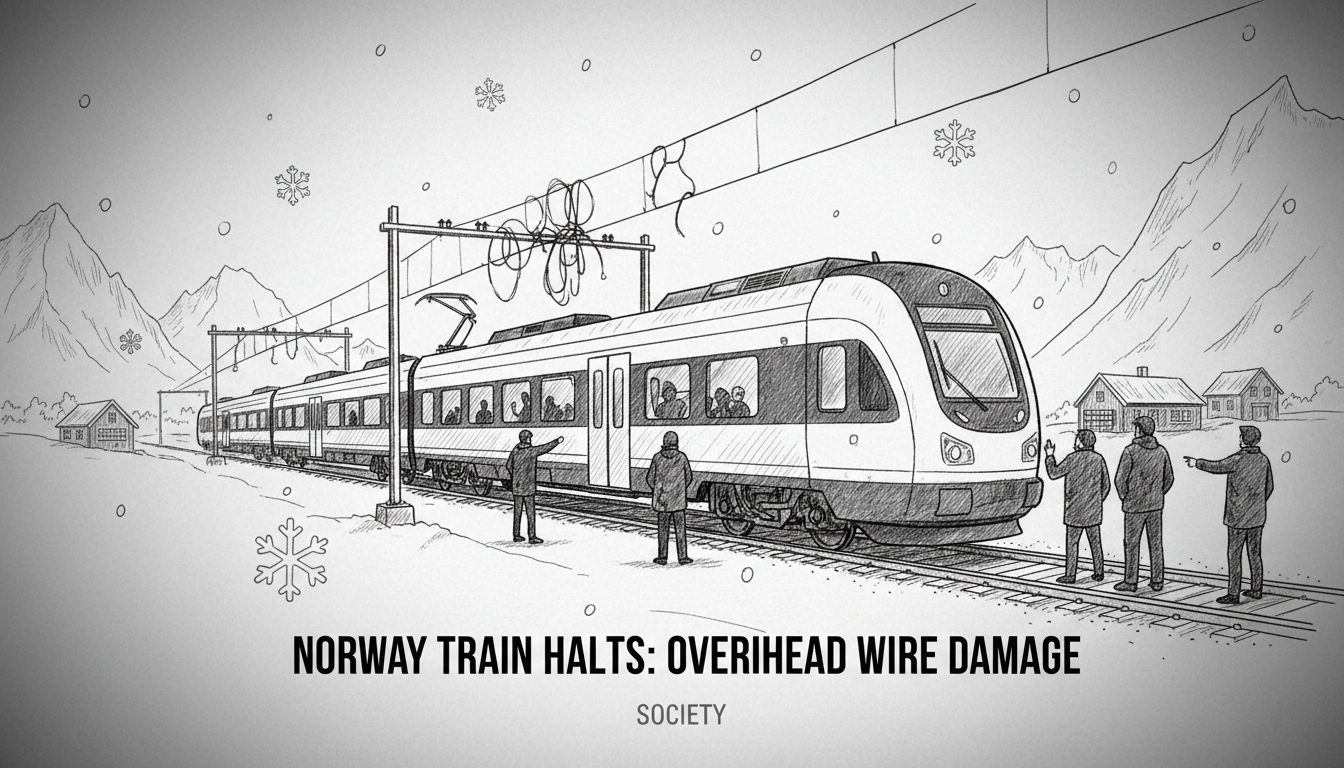
Norway's Bergen Line, a critical rail link carrying over 800,000 passengers annually, was abruptly halted this morning after a train tore down sections of the overhead power wire. The incident occurred at 9:30 AM between the mountain stations of Geilo and Ål, stranding the earliest morning service from Bergen to Oslo. Passengers are being evacuated from the immobilized train set, with Bane NOR implementing immediate bus replacements. 'The contact wire was partially torn down by a train,' said Bane NOR press officer Olav Nordli in a statement. 'We hope to have it fixed during the afternoon or early evening.'
This disruption cuts the primary rail connection between Norway's two largest cities, Oslo and Bergen. The Bergensbanen is not just a transport route but a vital artery for tourism and commerce. Its 371-kilometer path crosses some of Europe's most rugged terrain, including the Hardangervidda mountain plateau. Any failure here sends ripples across the national transport network, forcing hundreds to alter plans and highlighting the infrastructure's vulnerability.
Immediate Response and Passenger Impact
Bane NOR, the state-owned railway infrastructure manager, confirmed the cause as damage to the 15 kV 16.7 Hz AC overhead electrification system. The company's first priority is recovering the stranded train and ensuring passenger safety. 'Initially, it will be about salvaging the train set where passengers are in the process of being taken out,' Nordli explained. Bus services are shuttling travelers around the affected segment, but delays are extensive. For those reliant on this line, the alternative is a lengthy road trip through winding mountain passes, often challenging in early spring conditions.
The human impact is significant. The Bergensbanen is renowned as one of the world's most scenic train journeys, attracting tourists and serving daily commuters. A disruption during morning rush hours affects business travel, students, and freight logistics. Social media channels quickly filled with reports from stranded passengers, many expressing frustration over the lack of immediate information. This event underscores the dependency on this single rail line through the mountains, where few detours exist.
Engineering Challenges in the Mountains
The geography of the Bergensbanen makes it inherently prone to complex failures. The line boasts 182 tunnels and 130 bridges, engineered to navigate steep valleys and high altitudes. Maintaining continuous power supply across this landscape is a persistent challenge. Overhead wire damage, often called a 'catenary failure,' is a common source of delay on electrified railways globally. In Norway, factors like ice accumulation, strong winds, or mechanical wear can stress the system. An impact from a train's pantograph—the device that draws power—can swiftly bring operations to a standstill.
Repair crews face a difficult task. The site between Geilo and Ål is remote and mountainous, requiring specialized equipment and personnel. Weather conditions can hinder access, and safety protocols for working near high-voltage lines are stringent. 'Such repairs are more complex and time-consuming in this terrain,' a railway engineering expert noted, speaking on condition of anonymity. 'Every minute of downtime costs the economy in lost productivity and traveler inconvenience.' The estimated repair window into the evening reflects these logistical hurdles.
Economic and Systemic Repercussions
Beyond the stranded passengers, this stoppage has economic consequences. The Bergen Line facilitates the movement of goods, including seafood from the coast to inland markets. Freight trains are also delayed, disrupting supply chains. Norway's railway network is a key component of its green transport strategy, aiming to shift traffic from roads to electric rails. Incidents like today's challenge that policy goal by undermining reliability. The state invests heavily in maintenance, but aging infrastructure and extreme weather test its resilience.
This is not an isolated event. The Bergensbanen has experienced similar disruptions in recent years, often during winter months. Each incident prompts reviews of maintenance schedules and investment priorities. Bane NOR's budget for 2024 includes allocations for upgrading signaling and power systems, but implementation across such vast distances takes years. The question for policymakers is whether funding and focus match the system's critical importance. The Storting, Norway's parliament, regularly debates transport infrastructure spending, with northern and western regions advocating for more resources.
Historical Context and Future Reliability
The Bergensbanen opened in 1909, a marvel of engineering that connected east and west Norway. It symbolizes national unity and ambition. Today, it must meet modern demands for speed and punctuality. Comparing today's outage to historical challenges, the response is faster with real-time communication, but the physical constraints remain. Climate change introduces new variables, with more frequent freeze-thaw cycles and extreme weather potentially stressing infrastructure further.
Looking ahead, Bane NOR's long-term plan includes digitization and increased automation to monitor lines proactively. Sensors could detect wear on overhead wires before they fail. However, these technologies require substantial investment and rollout time. For now, the system relies on human crews reacting to failures. Travelers should expect residual delays even after power is restored, as normal scheduling takes time to resume.
A Test of Resilience
Today's overhead wire damage on the Bergensbanen is a stark reminder of the fragility of critical infrastructure. It tests the resilience of Norway's transport network and the patience of its citizens. As repair teams work against the clock in the shadow of snow-capped peaks, the incident fuels broader debates about national priorities. Is Norway investing enough to future-proof its iconic railways, or will such disruptions become a more frequent feature of travel? The answer lies in the political decisions made in Oslo and the technical solutions deployed on the ground. For the hundreds affected today, the immediate hope is for a swift repair and a smoother journey tomorrow.