
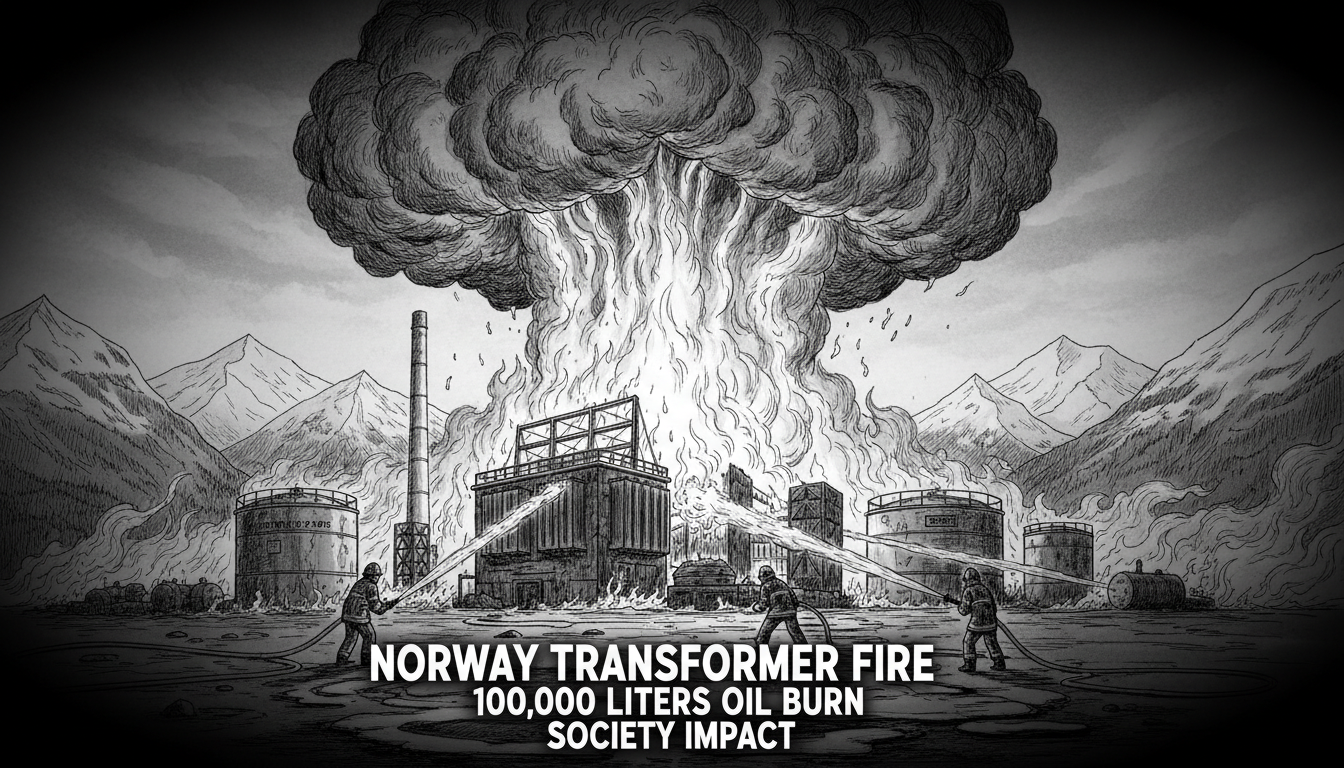
Norway's emergency services are battling a major transformer station fire in the Hallingdal valley that could burn for hours, fueled by an estimated 100,000 liters of oil. The blaze at the Kleivi industrial park in Hol municipality erupted with a loud explosion early Monday morning, sending thick smoke into the air and prompting urgent safety warnings for nearby residents and businesses.
Operational police leader Sigurd Edvardsen confirmed the fire would likely continue for several hours within the fenced area. "Police have been in dialogue with nearby businesses and advice to keep windows closed and turn off ventilation still stands," Edvardsen stated in the police log. Fire commander Atle Kleivdal from Hol Fire and Rescue described the scene, noting the transformer oil was burning inside a concrete construction open at the top. "It has burned so fiercely that cables running over the station have collapsed," Kleivdal said.
A Loud Explosion at Dawn
Local resident Kjell Kleven, who lives just a few hundred meters from the industrial park, became an eyewitness to the dramatic start of the fire around 7 a.m. "My wife and I were sitting in the living room watching TV when we suddenly heard a loud bang," Kleven recounted. "First I thought it came from a gravel pit, but I thought it was very early. Then I saw that there was a full blaze over at the facility." He immediately called the fire department.
Kleven described hearing explosion sounds and seeing high flames shooting upward. He shut his windows and ventilation system immediately but later observed the wind direction was not blowing toward his home. He noted the substantial emergency response, with fire, ambulance, and police resources all deployed to the scene. "It was quite blue," Kleven said, describing the distinctive hue of the burning transformer oil.
The Critical Fight to Contain the Blaze
The primary challenge for firefighters is the vast quantity of mineral oil, a standard coolant and insulator in such electrical equipment. This type of oil fire burns intensely and can be difficult to extinguish with water alone. Specialized reinforcements from the fire departments of Asker and Bærum have been called in to apply foam blankets over the burning oil. This technique smothers the fire by cutting off its oxygen supply and helps prevent reignition.
Transformer station fires present a dual threat: immediate danger from the blaze and potential long-term environmental contamination from oil runoff. Containing the oil within the site is a top priority to prevent it from seeping into the local soil and water systems. The fire is burning within a concrete enclosure, which offers some containment, but the open roof and intensity of the fire complicate efforts.
Authorities have been clear that no injuries have been reported, and no one is known to have been directly exposed to the smoke. The police are investigating the sequence of events leading to the fire and are in dialogue with the municipalities of Hol and Ål.
Keeping the Lights On in Hallingdal
Despite the destruction at a key electrical node, the local grid operator, Føie, has managed to prevent widespread blackouts. Føie's press contact, Cecilie Pindsle, confirmed that power supply has been rerouted. "We have switched the power supply and aim to keep the supply up. The status now is that no one has a power outage as a result of the fire," Pindsle stated.
This quick response highlights the redundancies built into modern power grids. However, the incident stresses the local network. Føie is advising customers to reduce their electricity consumption as a precautionary measure to ease the load on the alternative supply routes. Pindsle emphasized this is a voluntary request, not a formal rationing situation. The company is updating its websites to keep customers informed.
Understanding the Risks of Transformer Fires
Transformer stations are the unsung workhorses of the electrical grid, acting as vital intermediaries. They reduce high-voltage electricity from main transmission lines to lower, safer voltages for distribution to neighborhoods and factories. The oil inside serves as both a coolant and an electrical insulator, preventing short circuits. However, this same oil becomes a significant fuel source in the event of a fault or failure.
"Fires in these facilities are serious events due to the energy and fuel involved," explains Lars Hansen, a retired electrical safety inspector with decades of experience in Norway's energy sector. "The primary goals are always life safety, preventing grid collapse, and environmental protection. The use of foam is standard for hydrocarbon fires, but access and the sheer volume of oil can make it a prolonged operation."
Hansen notes that while such fires are rare, they require a highly coordinated response. "An investigation will look at everything from equipment age and maintenance records to potential lightning strikes or grid fluctuations that could have caused an overload," he adds. The findings will be crucial for preventing similar incidents across Norway's extensive power infrastructure, which is particularly vital in remote areas like Hallingdal.
A Community on Alert
The incident has put the rural community of Hol on alert. The initial police warnings to close windows and shut off ventilation were issued to protect residents from potentially harmful smoke particulates. While the wind has been favorable for some, the situation remains dynamic until the fire is fully under control.
The Kleivi industrial park houses various businesses, making the economic impact another concern. The swift communication from police to these companies helped mitigate immediate health risks to employees. The full extent of damage to the transformer station and any adjacent infrastructure will not be known until the fire is extinguished and engineers can conduct a safe assessment.
For now, the focus remains on the firefighting operation. The collaboration between local crews from Hol and specialized teams from Asker and Bærum demonstrates the tiered emergency response system in Norway. Municipal resources handle the initial response, while regional and specialized units provide backup for complex, large-scale incidents.
The Long Road Ahead: Extinguishment and Investigation
The statement that the fire could burn for "several hours" sets expectations for a lengthy operation. Even after the visible flames are suppressed, firefighters will need to ensure the oil is fully cooled to prevent flare-ups. The environmental agency will likely be involved in monitoring for contamination and overseeing any necessary cleanup.
Simultaneously, the police investigation into the cause will begin. This process is methodical, examining the physical evidence, operational data from the grid operator, and witness accounts like that of Kjell Kleven. Determining whether the cause was technical failure, external damage, or another factor is essential for national learning and safety improvement.
This fire in Hallingdal serves as a stark reminder of the complex infrastructure that powers daily life, often unnoticed until it fails. It tests the resilience of both the physical grid and the emergency protocols designed to protect it. The successful prevention of power outages so far is a positive sign, but the true test continues as the blue flames burn against the Norwegian sky, challenging crews to bring a volatile and hazardous situation to a safe conclusion. How Norway manages this crisis will offer lessons for safeguarding other critical nodes in its national energy network.