
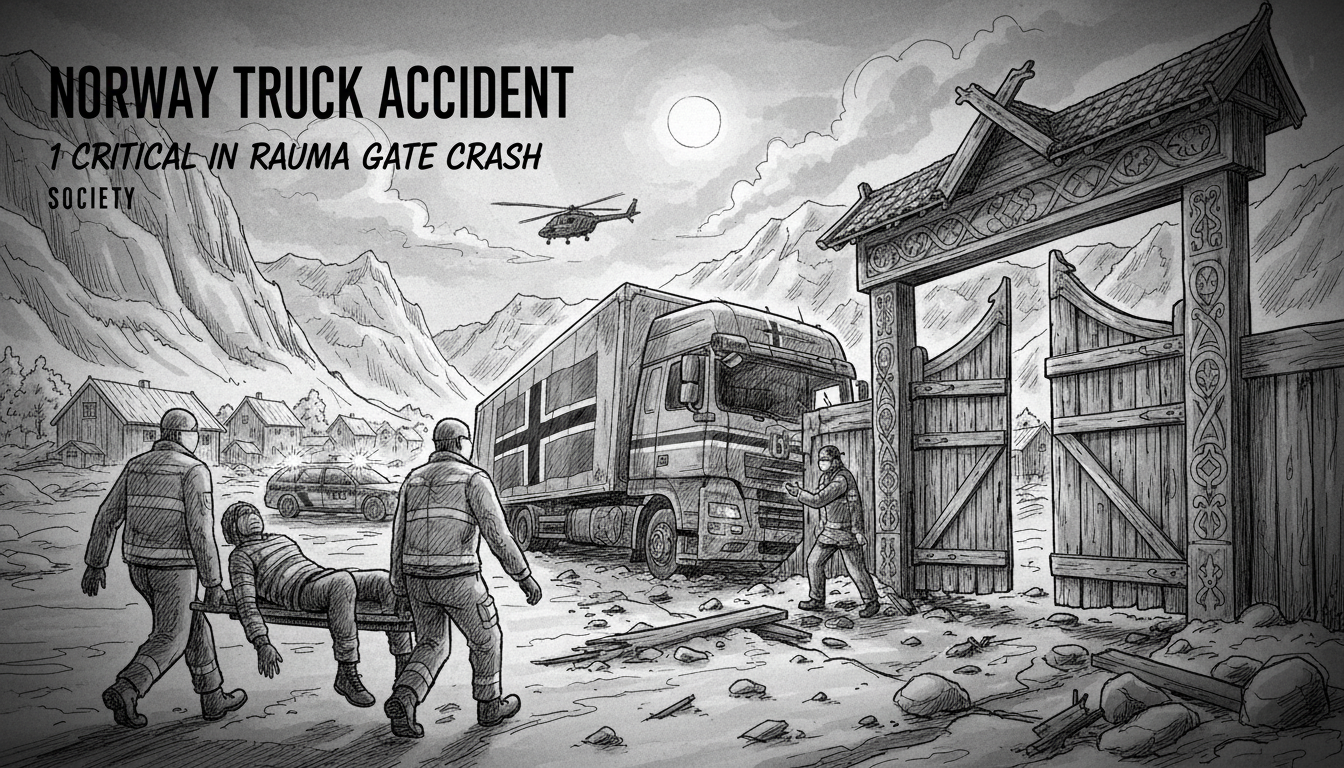
Norway truck accident investigators are probing a serious incident in Rauma municipality after a heavy vehicle drove through a gate and struck a person. Police and emergency health services responded to the scene, where one individual received critical medical attention. The accident occurred in the dramatic landscapes of Møre og Romsdal county, reigniting concerns about road safety in Norway's challenging terrain.
A Sudden Impact in Scenic Rauma
The incident unfolded when a truck reportedly failed to stop at a gate. The vehicle continued through the barrier, striking a person on the opposite side. Police have not released details about the victim's condition, but confirmed that emergency medical teams provided immediate care. The specific location within Rauma, known for the Rauma River and the towering Troll Wall, has not been disclosed pending the investigation.
This type of accident highlights the persistent risks in areas where industrial or commercial vehicle routes intersect with pedestrian access. Initial reports suggest the gate may have been a boundary for a worksite, private property, or a controlled road section. Accident investigators will meticulously reconstruct the event, examining the truck's speed, braking performance, and the driver's line of sight.
The Persistent Challenge of Mountain Roads
Rauma's topography is both breathtaking and hazardous. Winding roads carved through mountainous terrain, combined with variable weather conditions, present unique dangers. While comprehensive national statistics for 2023 are still being finalized, historical data shows that counties like Møre og Romsdal consistently see a higher rate of incidents involving heavy goods vehicles compared to flatter regions.
Experts point to a confluence of factors in such accidents. "When a vehicle passes through a gate or barrier, there is an inherent assumption that the area beyond is clear," said a senior traffic safety analyst with the Norwegian Public Roads Administration, speaking on background. "Investigators will look at whether that assumption was valid. Was the gate clearly marked? Were there warning signs? Was the pedestrian in a designated area?"
Mechanical failure remains another critical line of inquiry. The braking systems, steering, and even the load security of the truck will be scrutinized. Norway maintains strict periodic vehicle inspections, particularly for commercial vehicles, but sudden failures can still occur.
Safety Protocols Under Scrutiny
The accident will inevitably lead to a review of safety protocols at the site. Norwegian workplace safety regulations, governed by the Arbeidstilsynet (Labour Inspection Authority), are stringent. They mandate clear separation zones, signage, and procedures where vehicles and foot traffic interact. Whether these protocols were established, communicated, and followed will be a central question.
"It's not just about the driver or the pedestrian in isolation," the analyst explained. "It's about the system. Was the layout of the area inherently safe? Were the right controls in place to prevent this exact scenario? This is what the investigation must determine."
For local residents, the incident is a jarring reminder of vulnerability. In small communities, news of a serious accident travels quickly, and the victim is often known to many. The psychological impact extends beyond the immediate family, affecting neighbors and fellow workers.
A National Context of Road Safety
Norway boasts one of the world's lowest rates of traffic fatalities, a achievement credited to continuous investment in infrastructure, strict enforcement of traffic laws, and a strong safety culture. However, each serious incident prompts introspection. The zero-vision policy, aiming for no fatalities or serious injuries on Norwegian roads, sets an ambitious standard that makes every accident a subject of intense analysis.
Accidents involving large vehicles often have the most severe outcomes. The mass and momentum of a loaded truck make collisions with pedestrians or smaller vehicles particularly devastating. This reality drives ongoing policy debates about further technological mandates, such as advanced emergency braking systems and blind-spot detection for all heavy vehicles.
Furthermore, the long daylight hours in summer and the deep darkness of winter in regions like Møre og Romsdal affect driver fatigue and visibility. While a majority of accidents nationwide occur during daylight, the severity of incidents in poor light or weather conditions can be higher.
The Path Forward for Rauma
In the coming days, the police investigation will seek to establish a clear sequence of events. Witness statements, physical evidence from the scene, and data from the truck's onboard systems will be pieced together. The Norwegian Labour Inspection Authority may launch a parallel inquiry if the accident is linked to a workplace.
The immediate focus remains on the condition of the injured person. The community of Rauma, while accustomed to the risks posed by its majestic environment, will be hoping for a recovery. The incident serves as a sobering case study for transport companies, municipal planners, and safety regulators across Norway.
It underscores that even in a nation with exemplary road safety records, the combination of human error, mechanical complexity, and unforgiving geography can lead to tragedy in moments. The ultimate measure of the response will be what lessons are learned and what concrete changes are implemented to prevent a recurrence, not just in Rauma, but at thousands of similar sites across the country where gates, vehicles, and people meet.
As the investigation continues, the key questions linger: Was this a tragic but isolated failure, or does it point to a systemic gap in safety planning for Norway's unique industrial and geographical landscape? The answers will determine whether this incident becomes a footnote or a catalyst for change.