
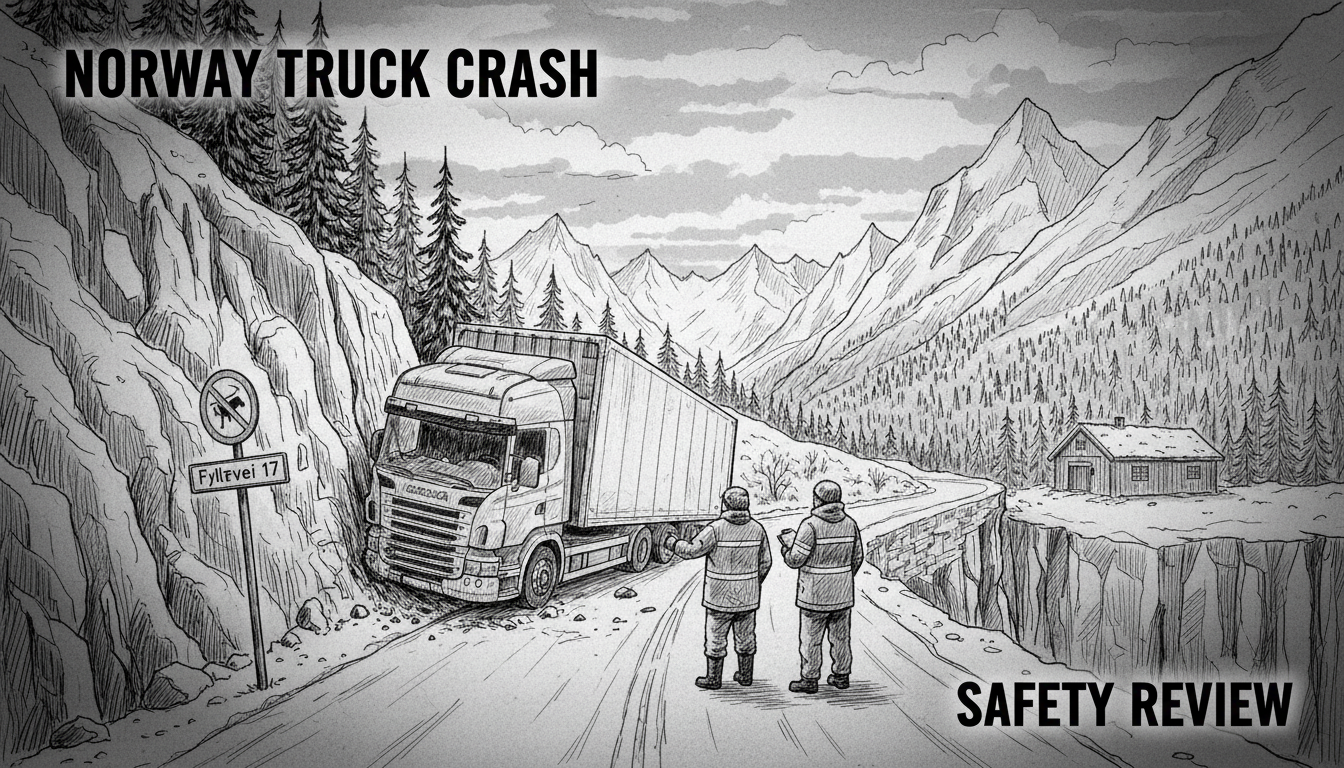
Norway's scenic but treacherous Fylkesvei 17 was the site of a serious truck accident early Thursday morning. A heavy goods vehicle collided with a rock wall at Forneset in Nærøysund, northern Trøndelag, causing extensive damage to the cab. The driver was conscious but in pain, with injuries of unknown severity, according to police operations manager Ellen Maria Brende. Emergency services reported extremely slippery conditions at the scene as they responded.
A Vital Artery Under Scrutiny
Fylkesvei 17, also known as the Coastal Route, is more than just a picturesque drive. It serves as a critical north-south transportation link for coastal communities in Trøndelag and Nordland counties. The road winds through dramatic fjord landscapes, but its sharp curves and exposure to harsh coastal weather make it challenging for all drivers, particularly those operating large commercial vehicles. This latest incident near the merged municipality of Nærøysund has intensified a perennial debate about balancing vital freight transport with driver safety on Norway's secondary highways.
“The driver is conscious, but has pain. Unknown degree of injury,” Brende said in a statement, confirming the immediate response. The Norwegian Public Roads Administration (Statens vegvesen) is expected to conduct a full investigation into the cause. Initial reports from emergency responders highlighted “very slippery” conditions, pointing to winter weather as a likely contributing factor.
Winter Roads and Economic Pressure
Statistics underscore the seasonal danger. Road conditions, including ice and snow, are contributing factors in roughly 20% of truck accidents in Norway during winter months. In 2022, preliminary figures show 11 fatal accidents involved heavy goods vehicles. While this number has trended downward over the long term due to improved vehicle safety and infrastructure, each incident renews focus on the specific risks faced by professional drivers.
“Routes like Fylkesvei 17 are essential for local economies, delivering goods to remote communities,” says Lars Holen, a transport analyst based in Trondheim. “But they present a unique set of challenges. Drivers face tight schedules, often dictated by just-in-time logistics, while navigating roads that can change from clear to treacherous within a few kilometers. When black ice forms on a coastal road, even the most experienced driver can be caught off guard.”
Experts consistently emphasize the “winter driving triad”: proper winter tires, adjusted speed, and heightened situational awareness. For trucking companies, this translates to a significant operational responsibility. They must ensure vehicles are equipped for specific conditions and that drivers are not pressured to maintain unrealistic timetables when weather deteriorates.
The Investigation and Infrastructure Questions
The Statens vegvesen investigation will likely examine multiple angles. Investigators will assess the vehicle's mechanical condition, including tire tread depth and brake systems. They will analyze the specific road conditions at Forneset, looking at factors like drainage, signage, and the road's alignment with the rock face. The driver's log and company scheduling practices may also come under review to rule out fatigue or undue pressure.
This accident raises infrastructure questions beyond a single slippery curve. The Kystriksveien is a road of national importance but is not built to the same standard as the E6 highway further inland. Continuous investment is required for improvements like better road surfacing, enhanced barrier systems, and more frequent winter maintenance. Local politicians often advocate for such upgrades, arguing that safe transport is fundamental for sustaining populations along the coast.
“Every accident is one too many,” states a report from the Road Administration on heavy goods vehicle safety. “Our goal is zero fatalities and serious injuries. Achieving this on all our roads requires a combination of engineering, enforcement, and education.” The agency runs regular campaigns targeting professional drivers, focusing on load security, speed management, and rest periods.
A Community's Reliance on a Dangerous Road
For residents of Nærøysund and other municipalities along the route, Fylkesvei 17 is their lifeline. It brings groceries, building supplies, and mail. It is the road to schools, hospitals, and regional centers. When an accident like this occurs, it disrupts more than traffic; it highlights the community's vulnerability. A closed road can mean isolation, especially if ferries—which are part of the Coastal Route—are also affected by weather.
Local emergency services train extensively for scenarios exactly like this one. Extricating a driver from a damaged truck cab on a narrow, icy road requires specialized equipment and precise coordination. Their swift response in this case likely prevented a worse outcome. The fact that the driver remained conscious is a positive sign, though the extent of injuries will only be known after a full medical assessment.
Looking Ahead: Safety Versus Necessity
The aftermath of the Forneset crash will involve more than clearing the wreckage. It will prompt internal reviews at the trucking company involved. It will lead to discussions in the city council chambers of Nærøysund about road safety priorities. It will be a case study in the next Road Administration safety seminar. The fundamental tension remains: Norway's geography demands a network of roads like Fylkesvei 17, and its economy demands that goods move along them year-round.
Technological solutions offer some hope. Advanced driver assistance systems (ADAS) like electronic stability control and lane-keeping assist are becoming more common in new trucks. Telematics systems that monitor driving behavior and provide real-time weather alerts to dispatchers are also valuable tools. However, technology is only an aid to a skilled, alert, and well-rested human driver.
As the investigation proceeds, the industry and regulators will search for lessons. Was this a tragic but unavoidable incident due to a sudden ice patch? Or does it point to a systemic issue that requires changes in regulation, infrastructure spending, or industry practice? The answers will determine if the scenic Kystriksveien can become a safer highway for the people and goods that depend on it, without losing the character that makes it a national treasure. For now, the community's thoughts are with the injured driver, hoping for a full recovery, while officials examine the scar on the rock wall—a stark reminder of the risks embedded in Norway's breathtaking landscape.