
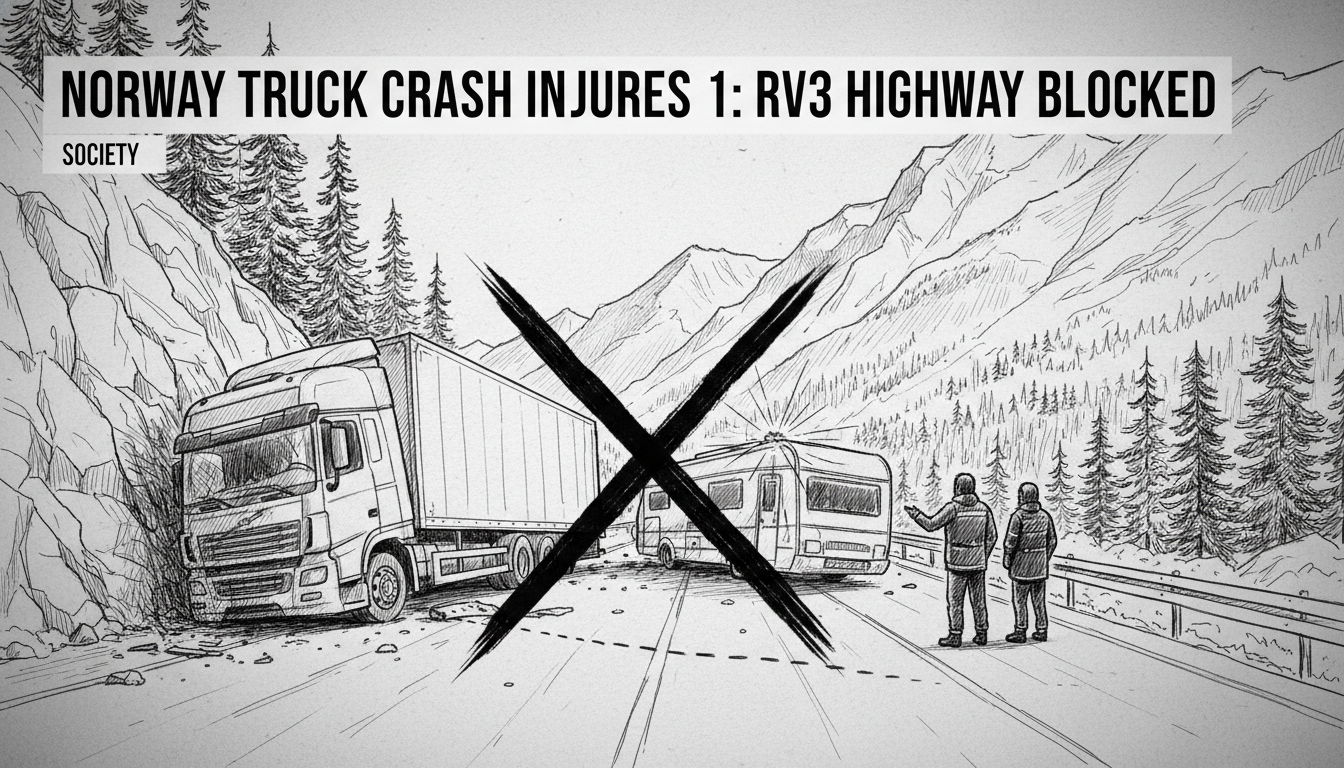
Norway's crucial RV3 highway was blocked for hours Tuesday evening after a serious collision between a truck and a passenger car near Tynset. One person sustained injuries in the crash, which police attributed to slippery autumn road conditions on the major inland route. Emergency services secured the scene and treated the injured individual, whose exact condition remains unknown.
The accident occurred shortly before 6 PM on Riksvei 3 within Tynset municipality in Innlandet county. Police operations leader Per Solberg confirmed the incident involved two vehicles and two people. "The extent of the injuries is unknown, but he is conscious," Solberg said regarding the injured party, who received immediate care at the site. Authorities closed the road in both directions, causing significant disruption to north-south traffic through the region.
A Vital Artery Temporarily Severed
RV3 is not just any road. It functions as a primary economic and transport corridor linking southern and central Norway with Trøndelag and the north. The highway is essential for freight transport, tourism, and daily commutes for residents of the mountainous inland region. Its closure, even for a few hours, forces lengthy detours and disrupts supply chains. Police managed to open one lane for directed traffic by 7:05 PM as recovery operations continued, but the initial full closure highlighted the route's vulnerability.
Tynset municipality, where the crash happened, is characterized by vast forested areas, rolling agricultural land, and significant seasonal weather shifts. Autumn in this part of Innlandet brings rapidly changing conditions—rain, frost, and early snow—that create treacherous driving surfaces. "It has been reported that it is slippery at the scene," Solberg noted, identifying conditions as a key factor. This period is notoriously challenging for road safety, with decreasing daylight and unpredictable weather.
The Inherent Danger of Mixed Traffic
Road safety experts point to the profound risk when heavy goods vehicles and lighter passenger cars collide. The mass and size disparity often leads to severe consequences for the occupants of the smaller vehicle. "Accidents involving trucks and passenger cars are a major concern due to the potential for serious injury," explains a transport safety researcher from the Institute of Transport Economics, who requested anonymity as they were not directly involved in the incident analysis. "The kinetic energy involved is immense, and safety systems in smaller cars are not designed for such impacts."
This crash on RV3 fits a broader, worrying pattern on Norwegian roads, particularly outside urban centers. While Norway boasts one of the world's lowest traffic fatality rates per capita, accidents on rural highways remain a stubborn challenge. These roads often have older design standards, higher speeds, and longer emergency response times compared to city streets or modern motorways. The mix of local traffic, long-distance travelers, and heavy commercial transport on routes like RV3 creates a complex and sometimes hazardous environment.
Infrastructure and the Challenge of Geography
The incident forces a renewed look at Norway's continuous battle to maintain safe road networks across difficult terrain. The country invests heavily in road safety through measures like improved lighting, guardrails, and winter maintenance. However, the sheer scale of the network and the harsh climate make perfect safety an elusive goal. Roads like RV3 are the lifelines for remote communities, yet they wind through landscapes where weather can change in minutes.
Local municipalities like Tynset bear significant responsibility for winter maintenance, including salting and plowing. Their efforts are coordinated with the Norwegian Public Roads Administration (Statens vegvesen). The effectiveness of these measures is critical from September through May. A brief gap between a cold shower and the arrival of a salting truck can be enough to create an invisible layer of black ice, catching even experienced drivers off guard.
A National Focus on Vision Zero
Norway's official traffic safety policy is Vision Zero, which aims to eliminate all fatal and serious injuries on the roads. The strategy encompasses vehicle safety improvements, stricter enforcement, and infrastructure upgrades. Significant progress has been made in reducing deaths, yet serious injuries from collisions persist. Each crash, like the one in Tynset, provides data that feeds back into this system, informing where better signage, rumble strips, or speed limit reductions might be needed.
The human cost of these incidents extends far beyond the immediate emergency response. The injured person faces potential life-altering consequences and a long recovery. Families are affected, and witnesses to serious crashes can experience lasting trauma. For the truck driver involved, even if not at fault, the psychological impact can be profound.
Looking Beyond the Crash Barrier
As the damaged vehicles were cleared from RV3, the fundamental questions remain. Is investment in Norway's secondary highway network keeping pace with traffic volume and vehicle size? Are there specific stretches of road, like the area near Tynset where this crash occurred, that require targeted safety campaigns or engineering reviews? How can technology, such as electronic stability control mandatory on all new trucks and advanced winter tire requirements, be leveraged further?
The quiet aftermath of the crash leaves a community reminded of its dependence on a single ribbon of asphalt. It underscores the daily gamble of distance and geography in Norway's regions. The successful reopening of the lane, with traffic guided past the scene by officers, is a testament to efficient emergency response. Yet, it is a temporary fix. The permanent solution lies in the unglamorous, ongoing work of maintenance, education, and infrastructure investment—a task as vast as the Norwegian landscape itself. The real measure of success will be whether such evening bulletins from the inland highways become rarer events in the years to come.