
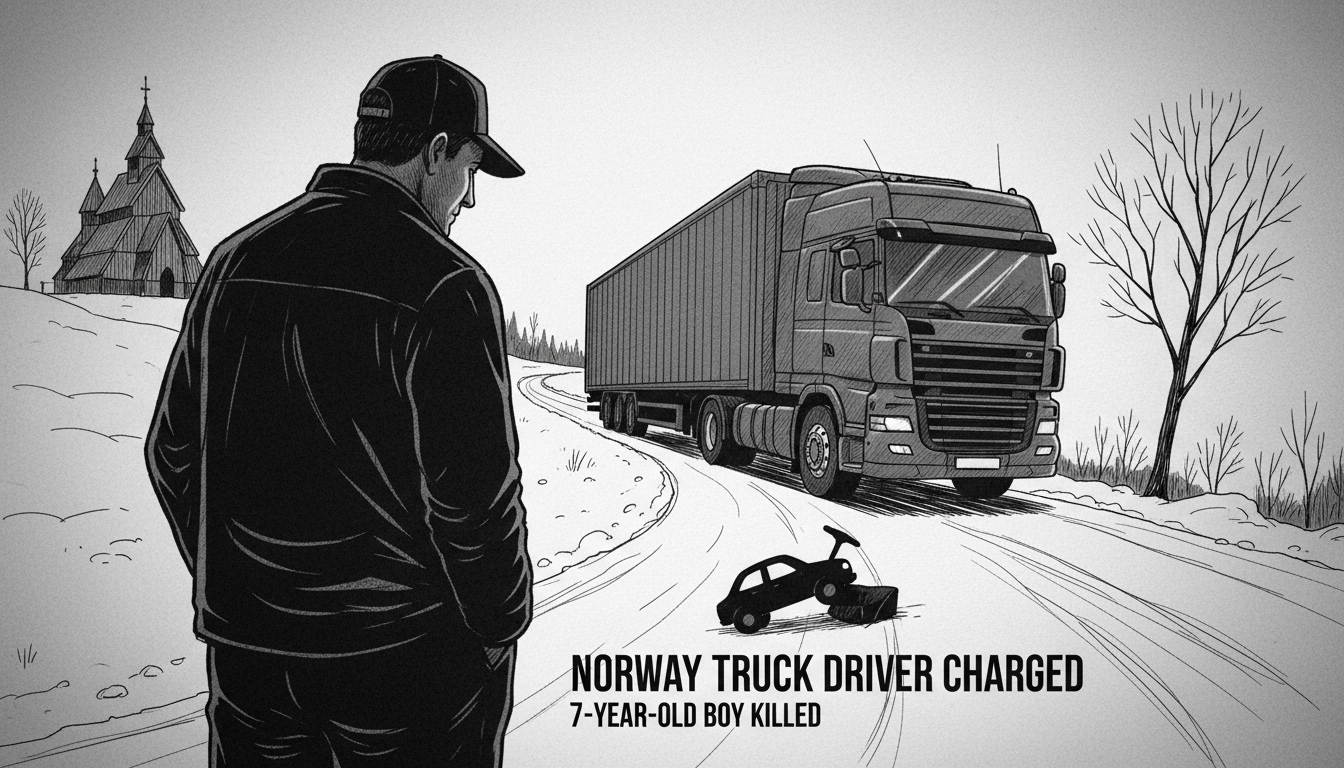
Norway traffic accident investigators have charged a truck driver in a fatal 2023 collision that took the life of a seven-year-old boy. Finn Matre Langeland died after being hit in a pedestrian crossing on his way to school in Kristiansand last March. On Thursday, the Agder public prosecutor's office formally charged the driver with negligent manslaughter and reckless driving, launching a legal case that will examine the line between tragic accident and criminal culpability.
A Community's Grief and a Legal Challenge
The driver's defense attorney, Nils A. Grønås, expressed immediate surprise at the decision to prosecute. His client has denied criminal guilt since being named a suspect shortly after the incident. "We believe the standard for negligence has not been met," Grønås stated. "But we acknowledge that charges have been filed. This will hopefully be thoroughly examined during the court proceedings." The case is expected to go to trial early next year, placing a painful local tragedy under the formal scrutiny of the Norwegian legal system. For the boy's family and the community, the charges mark a new and painful chapter, shifting the focus from mourning to a courtroom.
The Legal Threshold for Negligence in Norwegian Traffic Law
The charges—uaktsom forvoldelse av død (negligent manslaughter) and hensynsløs kjøring (reckless driving)—carry significant weight. Norwegian law requires a substantial deviation from the duty of care expected of a driver to secure a conviction for negligent manslaughter. Legal experts note that prosecutors must prove the driver's conduct fell seriously short of what a competent, attentive professional driver would have done in that situation. "It is not enough that a mistake was made," explains Professor Arild Knutsen, a criminal law scholar at the University of Oslo. "The prosecution must demonstrate a clear breach of the required standard of care that directly caused the death. For professional drivers, the expected standard is particularly high." Factors like speed, visibility, weather conditions, and the driver's attentiveness at the approach to a marked pedestrian crossing near a school will form the core of the evidence.
Infrastructure Changes Following the Tragedy
In the aftermath of the fatal accident, local authorities in Kristiansand moved swiftly to alter the physical environment where it occurred. The municipality implemented road improvements and, critically, reduced the speed limit at that specific location. This reactive measure is a common practice in Norway's proactive road safety philosophy, where fatal accidents often trigger immediate reviews of road design. Norway has one of the lowest road mortality rates in the world, a status achieved through Vision Zero policies that prioritize systematic safety over individual blame. These infrastructure changes will likely be cited in court, not as an admission of fault, but as evidence of identified risks. The defense may argue the modifications suggest inherent environmental dangers, while the prosecution could use them to highlight known perils a professional driver should have mitigated through extreme caution.
The Human Cost and the Professional Driver's Burden
The case underscores the immense responsibility borne by operators of heavy goods vehicles in urban environments. A truck driver's cab has significant blind spots, and stopping distances are far longer than for passenger cars. This professional context is central to the case. The Norwegian Public Roads Administration runs stringent certification and ongoing training programs, emphasizing vulnerability around schools and pedestrian zones. The tragedy in Kristiansand represents a worst-case scenario for any driver and a devastating loss for a family. It forces a difficult public conversation about shared responsibility: the duty of authorities to create safe infrastructure, the duty of parents to educate children, and the non-negotiable duty of drivers—especially professionals—to exercise utmost care.
A Broader Look at Road Safety and Child Fatalities
While Norway is a global leader in road safety, the death of a child is a profound shock that resonates nationwide. According to the latest official statistics from the Institute of Transport Economics, an average of four children under 15 die in Norwegian traffic annually. Each one prompts intense scrutiny. Pedestrian crossings, long considered safe havens, have been the site of several serious incidents in recent years, leading to national campaigns and technological trials like blinking LED lights in crosswalk pavements. The legal outcome of this case could influence how similar incidents are investigated and prosecuted in the future. It tests the application of criminal law in an area increasingly governed by a systemic safety approach where multiple factors, rather than a single actor, are often analyzed.
The Path to Trial and Unanswered Questions
The court proceedings, slated for early 2025, will methodically reconstruct the events of that March morning. Police accident reconstruction reports, witness testimonies, data from the vehicle, and expert opinions will be presented. The court must answer agonizing questions: Was the driver's attention diverted? Was the speed appropriate for the conditions near a school? Could the accident have been avoided given the prevailing circumstances? Meanwhile, the boy's family continues to live with an irreplaceable loss. Their private grief now becomes part of a public legal process aimed at determining accountability under Norwegian law. The trial will not bring Finn back, but its verdict will deliver a formal judgment on the actions that led to his death, offering a form of closure through the rule of law.
A Nation's Ongoing Commitment to Zero Fatalities
This tragic case occurs within Norway's unwavering commitment to its Vision Zero goal—eliminating all serious traffic injuries and fatalities. This policy framework intentionally shifts the perspective from blaming individual road users to designing a fault-tolerant system. However, it does not preclude criminal charges when gross individual negligence is alleged. The Kristiansand case sits at the tense intersection of these two principles: systemic safety improvement through better roads and lower speed limits, and individual accountability through criminal law. The coming trial will be watched closely by road safety advocates, legal professionals, and transport industry representatives across the Nordic region. Its judgment may clarify the boundaries of criminal liability in a society desperately trying to prevent any family from enduring such a loss again.